

- News
- Science
- SpaceX's Starship Orbital Flight 14 Targets Key Milestones: Orbital Velocity and Full Stack Reusability
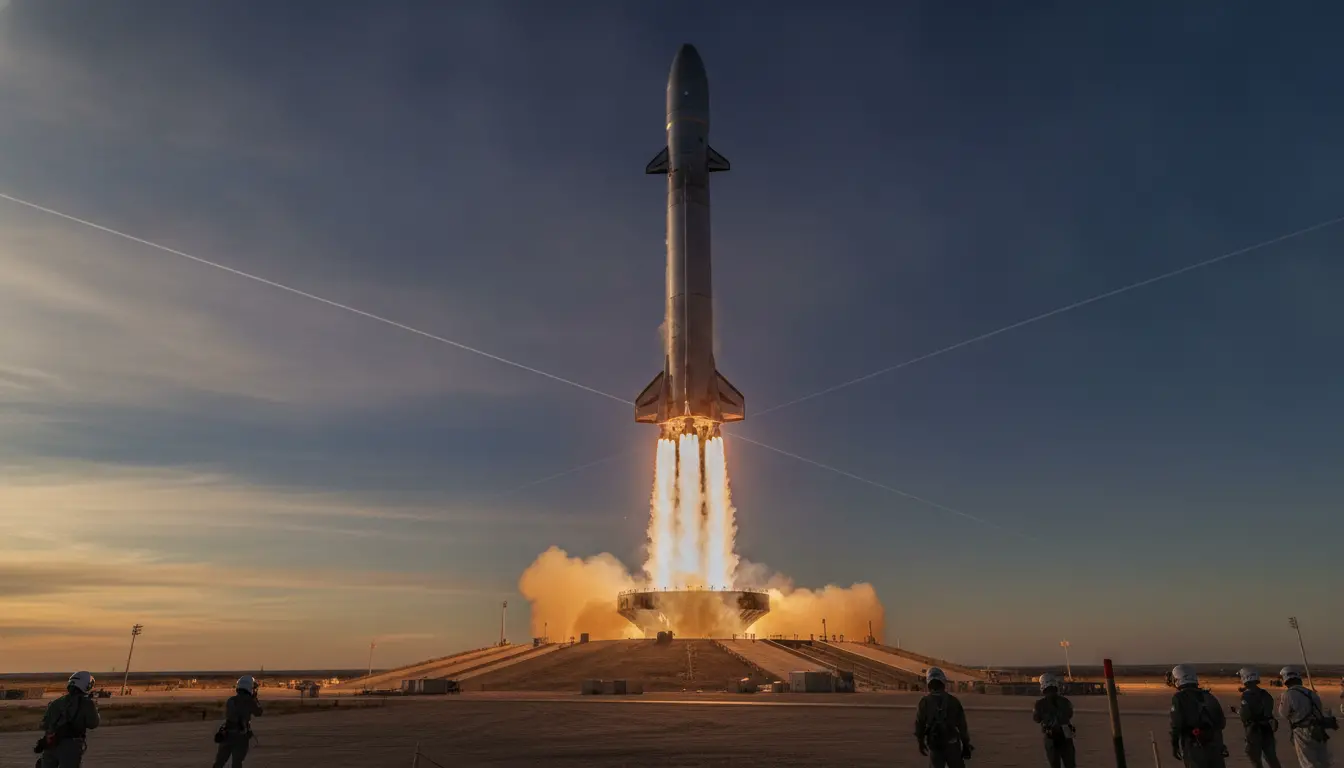
SpaceX's Starship Orbital Flight 14 Targets Key Milestones: Orbital Velocity and Full Stack Reusability
SpaceX is gearing up for a pivotal moment in its ambitious Starship program with Orbital Flight 14, currently slated for September 29, 2026. This upcoming mission represents a critical step in the company’s vision for deep space travel and aims to achieve two monumental objectives: reaching orbital velocity and demonstrating full stack reusability for the entire Starship system. Success on both fronts would not only validate years of strenuous development and testing but also profoundly reshape the economics and capabilities of space exploration.
Since its inception, the Starship program has been characterized by an iterative, rapid-prototyping approach, pushing the boundaries of rocket design and manufacturing at SpaceX's Starbase facility in Boca Chica, Texas. Earlier orbital test flights (OFTs) have seen increasing levels of success, demonstrating critical aspects such as integrated stack flight, hot staging, and controlled descent profiles, albeit often concluding with spectacular unplanned rapid disassemblies. Each flight, regardless of outcome, has provided invaluable data, allowing engineers to refine designs, update software, and enhance operational procedures. This persistent, learn-by-doing philosophy is central to SpaceX’s methodology, treating each launch as a crucial learning opportunity on the path to a fully reusable, reliable space transport system.
Achieving orbital velocity is a fundamental prerequisite for any sustained presence in space, whether for deploying satellites, servicing the International Space Station, or embarking on lunar and Martian missions. It signifies that the Starship spacecraft, propelled by the Super Heavy booster, has accelerated to a speed of approximately 17,500 miles per hour (28,000 kilometers per hour) and reached an altitude where it can continuously fall around Earth without re-entering the atmosphere. This critical milestone will demonstrate the combined power and efficiency of the Starship and Super Heavy vehicle to escape the gravitational pull of Earth and establish a stable orbit, proving its capability as a truly orbital-class launch system. Prior tests have edged closer to this goal, but OFT-14 aims to cross the threshold decisively.
Even more transformative is the objective of full stack reusability. This entails both the Super Heavy booster and the Starship upper stage returning to Earth and executing controlled, propulsive landings, ready for rapid refurbishment and reflight. The Super Heavy booster is designed to return to the launch site, performing a complex “catch” maneuver using the launch tower’s robotic arms, while the Starship upper stage will attempt a precise propulsive landing, similar to its Starship SN prototypes, likely in a designated oceanic landing zone or eventually back at Starbase. This capability, if perfected, would dramatically slash launch costs, making space travel and infrastructure deployment far more economically viable. The concept of truly reusable rockets, first championed by SpaceX with its Falcon 9, is now set to reach its zenith with Starship, potentially ushering in an era of routine, affordable access to space.
The implications of success on OFT-14 are immense, extending far beyond SpaceX’s immediate ambitions. A fully functional and reusable Starship system is central to NASA’s Artemis program for human lunar landings, where Starship will serve as the Human Landing System. It is also critical for deploying SpaceX's next-generation Starlink satellites in unprecedented numbers, further enhancing global internet connectivity. Ultimately, Starship is envisioned as the primary transport vehicle for establishing a permanent human presence on Mars, a long-term goal that underscores the profound significance of each developmental step, particularly OFT-14. The technical challenges are formidable, encompassing everything from engine reliability and thermal protection to guidance systems and ground support operations, making each flight a high-stakes endeavor.
While the September 2026 date remains a target, subject to regulatory approvals, manufacturing schedules, and the outcomes of preceding test flights, the aerospace community eagerly anticipates the progress of OFT-14. Its successful completion of these dual objectives would not only be a testament to SpaceX’s engineering prowess but also a monumental leap forward for humanity's reach into the cosmos. The world will be watching as Starship continues its journey, potentially unlocking an era of unprecedented accessibility to space and accelerating humanity's multi-planetary future.
Stay Informed. Act Smarter.
Get weekly highlights, major headlines, and expert insights — then put your knowledge to work in our live prediction markets.
Related News
SpaceX Eyes Comprehensive Starship Orbital Test Flight and Dual Landing in Late 2026
SpaceX Starship Aims for Milestone 14th Flight Test, Targeting Satellite Deployment and Controlled Landing

SpaceX Targets August 2026 for Critical Starship Orbital Test, Eyeing First Starlink Satellite Deployment
SpaceX Prepares Starship for Critical Orbital Flight Test to Advance Reusability Goals

SpaceX Accelerates Starship Development Toward Fully Successful Orbital Flight with Intact Landing by 2026
SpaceX Readies Starship for Thirteenth Orbital Test Flight, Eyes Critical Re-entry and Satellite Deployment Milestones
SpaceX Prepares for Starship V3 Flight 14 Amid Ongoing FAA Regulatory Review
SpaceX Prepares Starship for First Satellite Deployment Attempt During 13th Flight Test in Mid-2026
SpaceX Prepares for Crucial Starship Flight 13, Targeting Starlink V3 Deployment and Booster Recovery

SpaceX Starship Flight Test 13 Aims for Simultaneous Booster and Ship Controlled Landings