

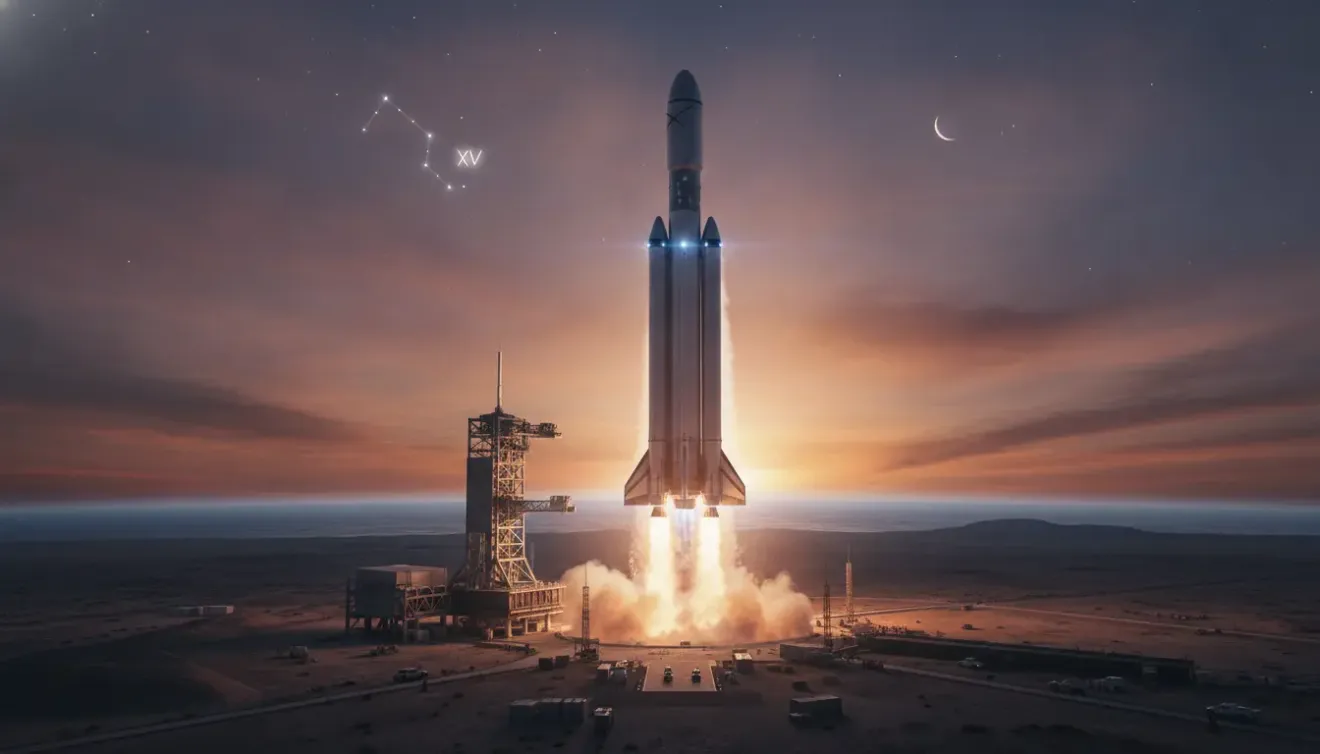
SpaceX Charts Ambitious Course for Starship Orbital Flight 15 in Late 2026
SpaceX is setting the stage for what could be its most ambitious Starship test yet: Flight 15, projected for late 2026. This pivotal mission aims not only to achieve a critical orbital trajectory but also to demonstrate the groundbreaking, full-stack reusability concept by attempting to catch both the Super Heavy booster and the Starship spacecraft upon their return. The successful execution of this complex maneuver is seen as a cornerstone for realizing SpaceX's audacious vision for lunar landings, Martian colonization, and ultra-low-cost, rapid-turnaround space transportation.
The Starship program, headquartered at Starbase in Boca Chica, Texas, represents a radical departure from traditional rocket design. Unlike expendable rockets or even partially reusable systems like the Falcon 9, Starship is engineered for full and rapid reusability, akin to an airplane. Its two-stage architecture—comprising the massive Super Heavy first-stage booster and the Starship upper stage—is designed to lift unprecedented payloads to orbit and beyond. Previous test flights, while demonstrative of progress and gathering invaluable data, have faced a series of challenges, from launchpad incidents to in-flight anomalies, underscoring the formidable engineering hurdles involved in developing such a revolutionary system. Each iteration, however, has provided critical insights, allowing SpaceX to refine its designs and operational procedures under an iterative, rapid-development philosophy.
The most distinctive feature of Flight 15's ambitions lies in its recovery sequence. The Super Heavy booster is designed to execute a controlled descent back to the launch site, where it will be captured by the launch tower's mechanical arms, affectionately dubbed "chopsticks," as it hovers above the ground. Simultaneously, the Starship upper stage, after completing its orbital profile, would perform a re-entry maneuver and also be caught by the same tower upon its return. This innovative, almost balletic, recovery mechanism eliminates the need for expensive and time-consuming refurbishment, promising to unlock the truly rapid turnaround times essential for sustained deep-space operations and high-cadence satellite launches. The technical precision required for these coordinated catches at such immense scales is unprecedented in aerospace history.
Beyond the immediate technical achievement, the implications of a successful Flight 15 resonate across the landscape of space exploration. Starship is central to NASA's Artemis program, having been selected as the Human Landing System (HLS) for returning astronauts to the Moon. A fully operational and reusable Starship would dramatically lower the cost of access to space, fundamentally altering the economics of satellite deployment, space tourism, and the establishment of permanent human outposts on celestial bodies. This could accelerate not only scientific discovery but also foster a new era of commercial activities beyond Earth orbit, transforming industries and geopolitics alike. The intense scrutiny from regulators and environmental agencies, particularly concerning launch frequency and impact, also forms a critical part of the program's ongoing narrative.
The path to Flight 15 will undoubtedly involve further ground tests, regulatory approvals, and potentially more suborbital or orbital attempts as SpaceX continues to iterate on its designs and gain operational experience. The late 2026 target reflects the complexity and scale of the engineering, manufacturing, and logistical challenges that must be overcome. Should SpaceX achieve its ambitious goals with Flight 15, it would not merely be a singular success but a profound redefinition of what is possible in space travel, setting a new benchmark for heavy-lift capability and reusability, and bringing humanity's long-held aspirations for multi-planetary existence significantly closer to reality.
Stay Informed. Act Smarter.
Get weekly highlights, major headlines, and expert insights — then put your knowledge to work in our live prediction markets.
Related News

SpaceX Eyes Comprehensive Starship Orbital Test Flight and Dual Landing in Late 2026

SpaceX's Starship Orbital Flight 14 Targets Key Milestones: Orbital Velocity and Full Stack Reusability

SpaceX Targets August 2026 for Critical Starship Orbital Test, Eyeing First Starlink Satellite Deployment

SpaceX Prepares Starship for Critical Orbital Flight Test to Advance Reusability Goals

SpaceX Accelerates Starship Development Toward Fully Successful Orbital Flight with Intact Landing by 2026

SpaceX Readies Starship for Thirteenth Orbital Test Flight, Eyes Critical Re-entry and Satellite Deployment Milestones

SpaceX Prepares Starship for First Satellite Deployment Attempt During 13th Flight Test in Mid-2026

SpaceX Starship Aims for Milestone 14th Flight Test, Targeting Satellite Deployment and Controlled Landing

SpaceX Accelerates Drive for Super Heavy Booster Reusability in Starship Development

SpaceX Starship Flight Test 13 Aims for Simultaneous Booster and Ship Controlled Landings