

- News
- Politics
- Federal Appeals Court Weighs Challenge to Trump Administration's Use of Alien Enemies Act
Federal Appeals Court Weighs Challenge to Trump Administration's Use of Alien Enemies Act
A federal appeals court is currently deliberating a pivotal case that scrutinizes the Trump administration's immigration policies through the lens of the long-dormant Alien Enemies Act of 1798. This legal challenge, which seeks to contest actions perceived as an overreach of executive authority, has drawn significant attention due to its potential to redefine presidential powers and the constitutional rights of non-citizens. The appellate review comes after a lower court dismissed the initial lawsuit, setting the stage for a high-stakes decision that could resonate throughout American jurisprudence and future administrations' approaches to national security and immigration.
At the heart of the controversy is the Alien Enemies Act, a relic of the late 18th century, enacted during a period of heightened tensions with France. This statute grants the President broad powers to apprehend, restrain, secure, and remove non-citizens who are subjects or citizens of a foreign nation "at war" with the United States. Historically, the act has seen limited application, primarily during declared wars such as the War of 1812 and World War II, when it was used to intern individuals from enemy nations. For over two centuries, its expansive authority has largely remained in abeyance, making its recent re-examination in the context of modern immigration policy a unique and legally complex development.
The current legal challenge, initiated by a coalition of civil liberties advocates and immigrant rights organizations, argues that certain Trump administration policies, while not explicitly invoking the Alien Enemies Act, effectively mirrored its draconian powers. Plaintiffs contended that actions such as the expedited deportation of certain non-citizens, the imposition of broad travel restrictions, and aggressive enforcement measures against specific groups of immigrants, bypassed due process and other constitutional protections in a manner consistent with an informal application of the 1798 act. They posited that such policies, regardless of their stated legal basis, functionally treated certain non-citizens as "alien enemies" without the necessary legal safeguards.
The case initially faced dismissal at the district court level, where judges often sided with the government's arguments concerning executive prerogative in immigration and national security matters, or found that the plaintiffs failed to demonstrate direct applicability of the Alien Enemies Act itself. However, the appeal has breathed new life into the contention, forcing the federal appeals court to grapple with the statute's contemporary relevance and the extent of presidential power. Legal scholars are keenly watching the proceedings, noting that a ruling either affirming the dismissal or allowing the case to proceed could establish significant precedents regarding the separation of powers and the protection of fundamental rights for all individuals within U.S. borders.
Key arguments before the appeals court center on the interpretation of "at war" in a modern context, where conflicts might not involve formal declarations of war but rather ongoing geopolitical tensions or cyber threats. Plaintiffs maintain that a broad interpretation of the act without strict constitutional guardrails risks paving the way for unchecked executive authority, potentially leading to widespread human rights abuses under the guise of national security. Conversely, proponents of executive power argue that the President requires flexibility to address evolving threats and that courts should defer to the executive branch on matters of foreign policy and national defense. The court's decision will inevitably weigh these competing interests, navigating the delicate balance between presidential authority and individual liberties.
The implications of the appellate court's decision extend far beyond the immediate parties involved. A ruling that allows the challenge to proceed could open avenues for future litigation against executive actions perceived as overreaching, particularly in immigration and national security contexts. Conversely, upholding the lower court's dismissal could reinforce executive authority, potentially limiting judicial oversight over presidential decisions concerning non-citizens during times of perceived national threat. Whatever the outcome, this legal battle over an archaic law highlights enduring questions about the scope of presidential power, the rights of immigrants, and the judiciary's critical role in upholding the Constitution's principles in a rapidly changing world.
Stay Informed. Act Smarter.
Get weekly highlights, major headlines, and expert insights — then put your knowledge to work in our live prediction markets.
Related News
United States Weighs Permanent Policy for Immediate Asylum Expulsion at Southern Border
Future US Administration Poised to Reimplement Immediate Asylum Expulsions at Southern Border
Supreme Court Considers Trump-Era Mail-In Voting Order Amidst Looming Election Cycle

Twenty-Five States Launch Legal Battle Against Trump-Era Global Tariffs
Trump Reportedly Renews Push to Remove Federal Reserve Governor Lisa Cook, Setting Stage for Constitutional Clash
Supreme Court Examines Presidential Authority Over Federal Reserve Governor Removals
U.S. Supreme Court Deliberates Sweeping Presidential Immunity Claims Amidst Landmark Case
Supreme Court Rulings Ignite Debate Over Presidential Authority to Challenge FCC Leadership
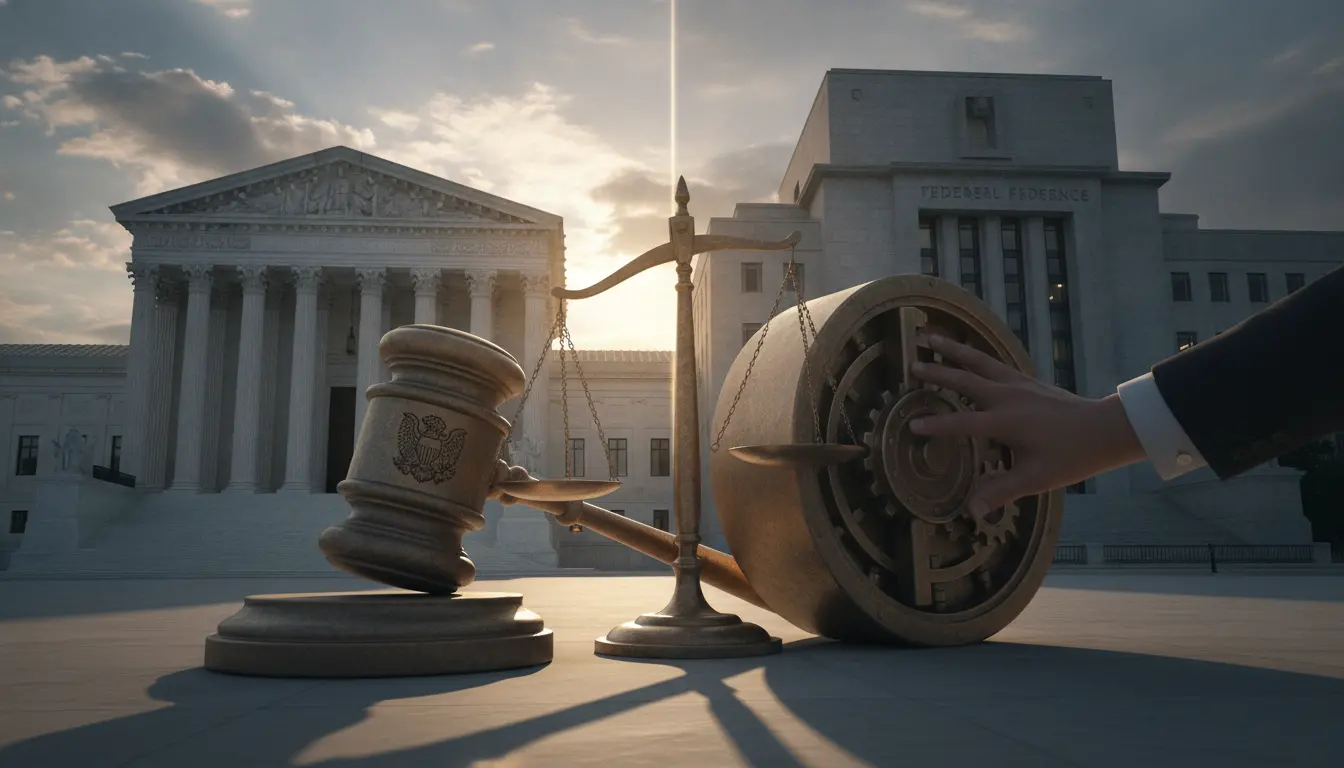
Supreme Court Weighs Presidential Power to Remove Federal Reserve Governors

Supreme Court Poised to Redefine Presidential Authority Over Federal Reserve Governors