

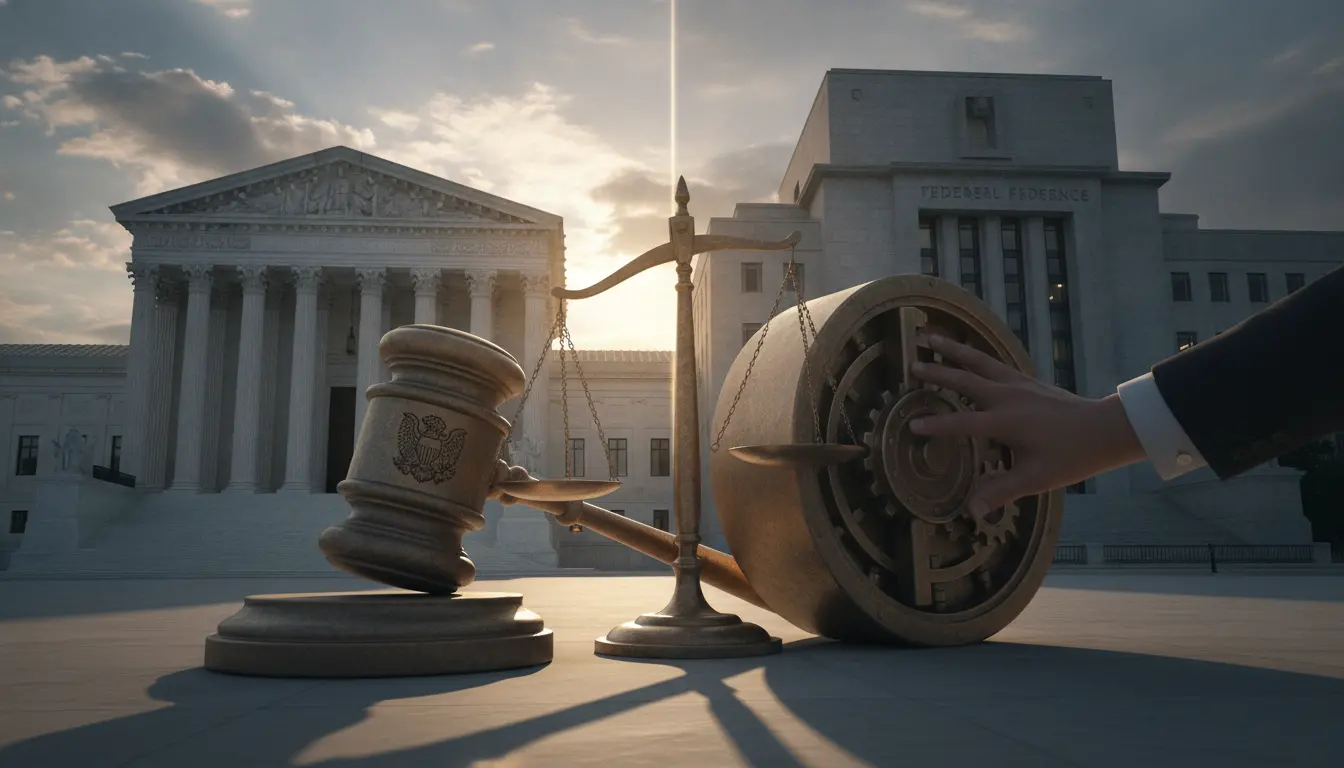
Supreme Court Weighs Presidential Power to Remove Federal Reserve Governors
The United States Supreme Court is currently deliberating a pivotal case that could fundamentally reshape the balance of power between the executive branch and independent federal agencies, specifically addressing the President's authority to dismiss Federal Reserve governors without cause. This constitutional question, anticipated to yield a ruling by mid-2026, carries profound implications not only for the Fed's celebrated independence in setting monetary policy but also for the broader landscape of regulatory bodies designed to operate free from direct political interference.
At the heart of the matter lies a long-standing legal principle established in the 1935 Humphrey's Executor v. United States case, which affirmed that the President’s power to remove certain officials is not absolute. This precedent distinguished between purely executive officers, whom the President can remove at will, and those serving in quasi-legislative or quasi-judicial roles, whose removal can be restricted by Congress to protect their independence. The Federal Reserve, with its governors appointed to 14-year terms and insulation from day-to-day political pressures, has traditionally been seen as falling squarely into the latter category. Its independence is considered crucial for maintaining economic stability, allowing it to make difficult, sometimes unpopular, decisions regarding interest rates and financial regulation based on economic data rather than short-term political cycles.
The arguments before the Court delve into complex interpretations of executive power and the separation of powers doctrine. Proponents of expanded presidential removal power contend that the President, as the head of the executive branch, must have the ultimate authority to ensure that all government officials are accountable and aligned with the administration's policy agenda. They argue that restrictions on removal hinder effective governance and dilute democratic accountability, particularly when independent agencies wield significant economic and regulatory influence. This perspective often frames the issue as one of ensuring the President can implement their mandate effectively, preventing unelected bureaucrats from thwarting the will of the voters expressed through presidential elections.
Conversely, those advocating for the preservation of the Federal Reserve's current structure emphasize the critical importance of its autonomy. They warn that allowing a President to fire a Fed governor without cause would politicize monetary policy, making decisions vulnerable to political expediency rather than economic necessity. Such a move, they argue, could destabilize financial markets, erode investor confidence, and potentially lead to cycles of boom and bust dictated by electoral calendars rather than sound economic principles. The Fed's ability to act independently in times of crisis, free from the immediate pressures of a presidential election cycle, has historically been lauded as a cornerstone of U.S. economic resilience.
The Supreme Court's decision will hinge on its interpretation of the Appointments Clause and the Vesting Clause of the Constitution, along with the precedents set by cases like Humphrey's Executor and more recent rulings concerning the Consumer Financial Protection Bureau (Seila Law LLC v. Consumer Financial Protection Bureau). While the Seila Law case affirmed presidential removal power over the single director of the CFPB, it did so while distinguishing it from multi-member bodies like the Federal Reserve Board. The current case therefore presents an opportunity for the Court to clarify the boundaries of executive authority over a broader array of independent agencies, extending beyond single-director structures to those with multi-member boards.
The stakes are incredibly high. A ruling that grants the President unfettered power to remove Federal Reserve governors would not only fundamentally alter the Fed's institutional design but also send ripples across numerous other independent agencies—from the Securities and Exchange Commission to the Federal Trade Commission—which currently operate with similar protections against arbitrary presidential dismissal. Such a shift could usher in an era where the executive branch exercises significantly greater direct control over the nation’s economic and regulatory policy, potentially increasing volatility and reducing the perceived neutrality of these crucial governmental functions. Observers are keenly awaiting the Court's decision, recognizing its potential to redefine a core aspect of American governance and its implications for economic stability and democratic accountability for decades to come.
The long-term impact on the credibility of U.S. institutions, both domestically and on the global stage, is also a significant concern. The U.S. Federal Reserve's independence is often cited as a model for central banks worldwide, fostering trust in its ability to manage the world's largest economy with an impartial hand. Any perceived erosion of this independence could undermine that trust, affecting international financial markets and the dollar's role as a global reserve currency. As the justices deliberate, the financial world watches closely, understanding that their ruling will not just be a legal pronouncement, but a critical determinant of the future of economic policymaking and institutional autonomy in the United States.
Stay Informed. Act Smarter.
Get weekly highlights, major headlines, and expert insights — then put your knowledge to work in our live prediction markets.
Related News
Supreme Court Deliberates Presidential Authority to Remove Federal Reserve Governors
Supreme Court Poised to Redefine Presidential Authority Over Federal Reserve Leadership
Supreme Court Poised to Redefine Presidential Authority Over Federal Reserve Governors
Supreme Court Examines Presidential Authority Over Federal Reserve Governor Removals
Supreme Court Set to Deliver Landmark Ruling on Presidential Authority Over Federal Reserve Governors
Supreme Court Weighs President's Power to Fire Federal Reserve Governors
Supreme Court Expands Presidential Authority to Remove Independent Agency Heads, Redefining Executive Control
Trump Reportedly Renews Push to Remove Federal Reserve Governor Lisa Cook, Setting Stage for Constitutional Clash
Supreme Court Rulings Ignite Debate Over Presidential Authority to Challenge FCC Leadership
Kevin Warsh Faces Mounting Pressure as Fed Chair Amid Political Storm