

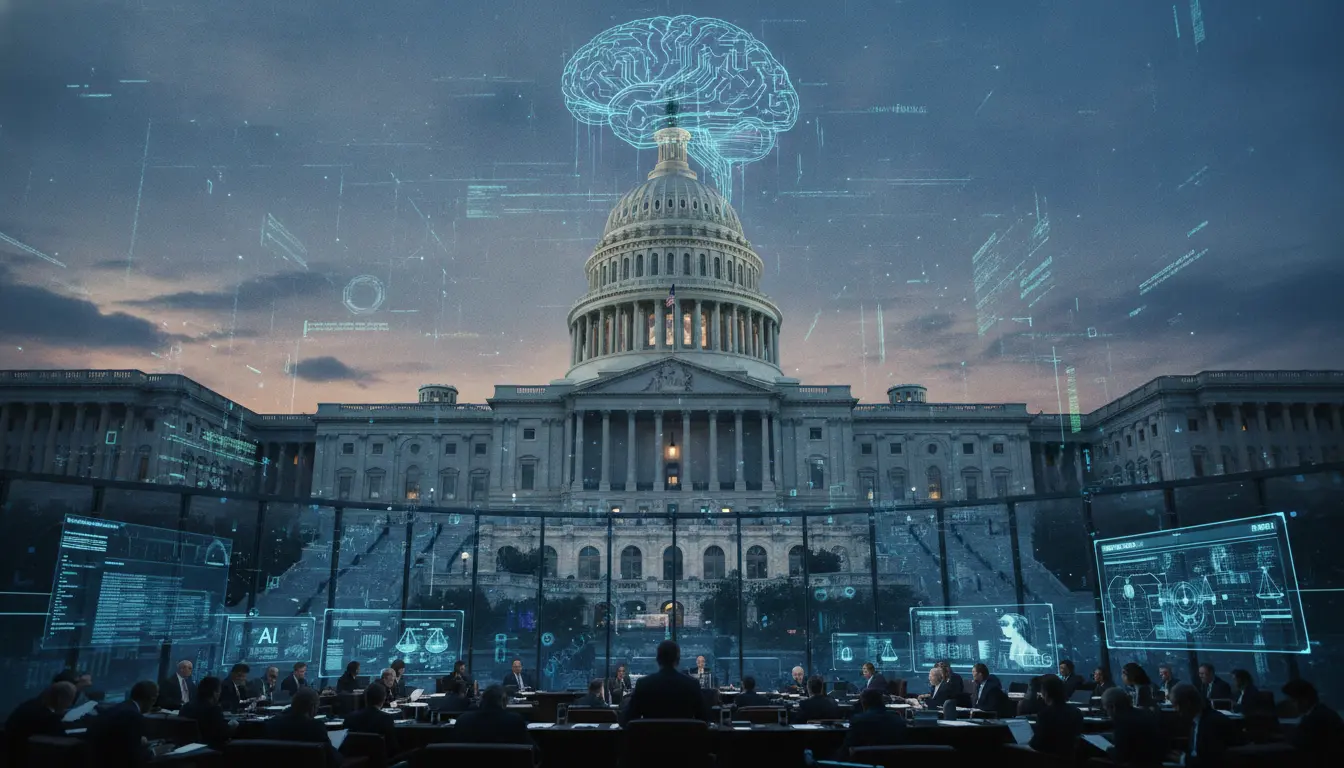
Congress Grapples with Landmark Federal Legislation to Govern Artificial Intelligence
WASHINGTON D.C. – The United States Congress is deep into a complex and unprecedented push to establish a comprehensive federal regulatory framework for artificial intelligence, spurred by the technology's rapid advancements and the mounting concerns over its societal implications. From Capitol Hill hearing rooms to private bipartisan forums, lawmakers are urgently attempting to navigate the intricate landscape of AI, aiming to craft legislation that balances innovation with safety, ethical considerations, and national security. The current momentum suggests a recognition across the aisle that proactive governance is essential to shape AI's future.
The urgency stems from AI's explosive growth in recent years, particularly with the widespread adoption of generative models. These powerful tools, capable of producing human-like text, images, and audio, have captivated public imagination while simultaneously raising red flags. Policymakers are acutely aware of potential harms ranging from the spread of misinformation and deepfakes to job displacement, algorithmic bias, intellectual property infringement, and even autonomous weapons systems. Unlike previous technological revolutions, where regulation often lagged behind innovation, there is a clear appetite within Congress to get ahead of AI's curve, a lesson perhaps learned from the slow response to issues with social media platforms.
Key congressional leaders, including Senate Majority Leader Chuck Schumer, have spearheaded initiatives to bridge the knowledge gap among lawmakers and foster bipartisan consensus. Schumer's "AI Insight Forums" have brought together tech executives, civil rights advocates, academics, labor leaders, and national security experts for closed-door discussions, aiming to inform legislative strategies. Several working groups have emerged, focusing on distinct aspects such as data privacy, AI liability, intellectual property rights in the age of generative AI, and the potential need for a new federal agency or expanded powers for existing ones to oversee AI development and deployment. Discussions also revolve around establishing clear standards for transparency, accountability, and the testing of advanced AI models before public release.
While there is broad agreement on the need for some form of regulation, the specifics remain a contentious battleground. Technology giants, some of whom initially resisted government oversight, have increasingly signaled a willingness to engage, with some even calling for baseline regulations to ensure a level playing field and mitigate existential risks. However, the industry remains divided on the scope and intrusiveness of potential laws, particularly concerning open-source AI models versus proprietary systems, and the potential impact on innovation. Lobbying efforts from various sectors are intense, reflecting the colossal economic and strategic stakes involved in defining AI's regulatory future.
The path to a comprehensive federal bill is fraught with significant hurdles. The sheer technical complexity of AI, which continues to evolve at an astonishing pace, presents a challenge for legislators trying to draft durable and future-proof laws. Political polarization, the typical slow pace of congressional action, and disagreements over which government body should hold primary regulatory authority further complicate matters. Some argue for a new, dedicated AI agency akin to the FAA or FDA, while others suggest empowering existing agencies like the National Institute of Standards and Technology (NIST) or the Federal Trade Commission (FTC) with enhanced AI-specific mandates.
Despite these challenges, the bipartisan push suggests a real possibility of significant legislative action. The global landscape, with the European Union already enacting its landmark AI Act, adds pressure on the United States to assert its leadership in AI governance. The stakes extend beyond economic competitiveness, touching upon national security, democratic integrity, and fundamental human rights. As the debates continue, Congress faces the monumental task of crafting a regulatory framework that encourages beneficial innovation while safeguarding society from AI's potential downsides—a balance that will define the nation's technological trajectory for decades to come.
Stay Informed. Act Smarter.
Get weekly highlights, major headlines, and expert insights — then put your knowledge to work in our live prediction markets.
Related News
US Congress Grapples with Urgency of Federal AI Regulation Amidst Rapid Innovation
US Lawmakers Intensify Push for Landmark AI Safety Legislation Amid Global Warnings
US Congress Accelerates Efforts to Enact Comprehensive Federal AI Regulation by 2026
US Lawmakers Intensify Push for Federal AI Regulation to Preempt State Laws
US Federal Government Weighs Comprehensive AI Safety Legislation Amid Catastrophic Risk Warnings

Congress Introduces 'AI Kill Switch Act' Granting Executive Authority Over Rogue Systems Following Major Tech Incidents
Momentum Builds for Landmark Crypto Bill as Bipartisan Push Faces Uphill Battle in Congress
US Lawmakers Advance Efforts Towards Comprehensive Crypto Regulatory Framework
US Congress Faces Continued Push for CLARITY Act to Define Crypto Regulation
Senator Sanders Unveils Radical Proposal for Public Control of AI Industry