

- News
- Science
- End of an Era: Celebrated Swift Telescope to Fall to Earth as NASA Abandons Servicing Plan
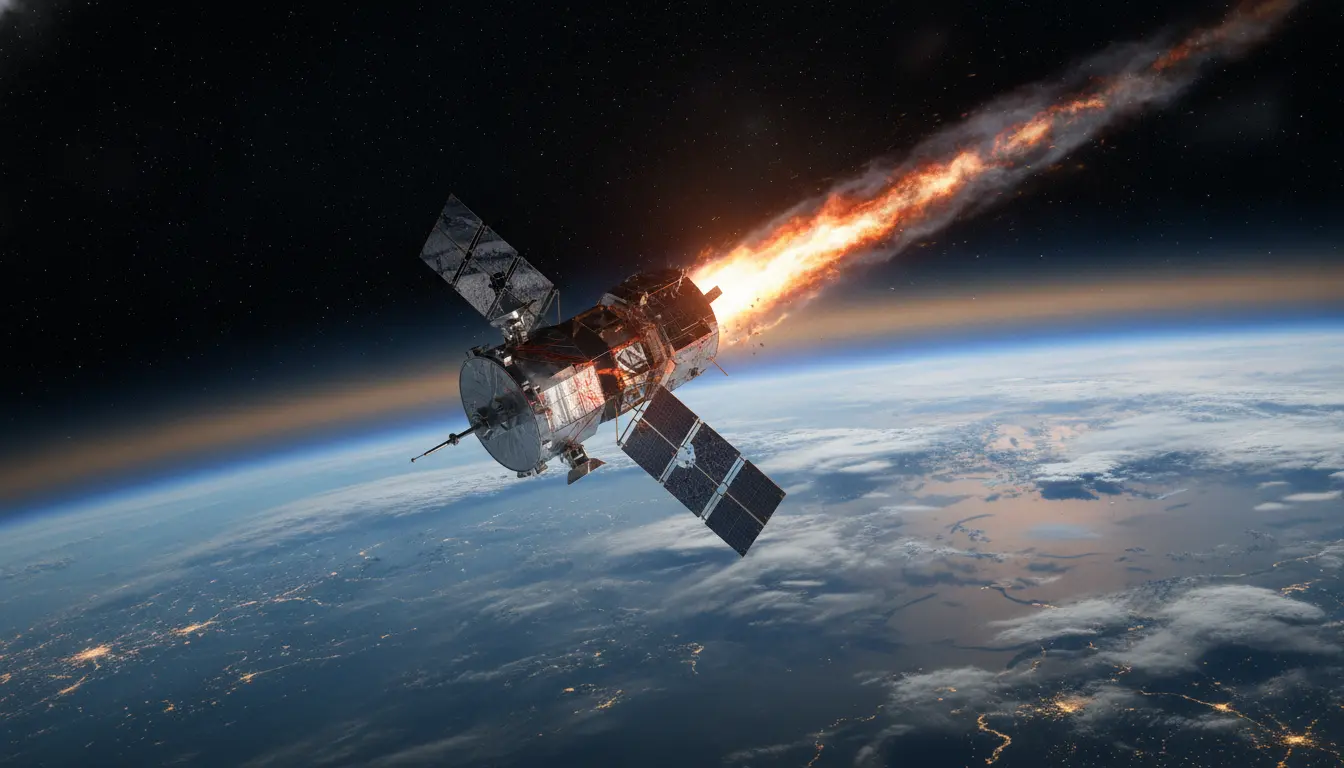
End of an Era: Celebrated Swift Telescope to Fall to Earth as NASA Abandons Servicing Plan
One of NASA’s most productive and celebrated astrophysical observatories is now on a final, irreversible trajectory toward Earth. The agency has formally concluded that it will not pursue a robotic servicing mission for the Neil Gehrels Swift Observatory, a venerable space telescope that has revolutionized our understanding of the most violent explosions in the cosmos. The decision effectively sets the clock ticking on the satellite's eventual and uncontrolled re-entry into the atmosphere, marking the beginning of the end for a mission that has far outlived its initial design life.
Launched in 2004, Swift was designed with a singular, agile purpose: to rapidly detect and study gamma-ray bursts (GRBs), fleeting but immensely powerful flashes of light from the distant universe. These events, often associated with the collapse of massive stars or the merger of neutron stars, are the brightest electromagnetic events known to occur. Swift’s unique three-instrument design allowed it to pivot in seconds to catch the fading afterglow of these bursts across X-ray, ultraviolet, and optical wavelengths, providing a treasure trove of data that has been central to more than 10,000 scientific papers. Its legacy was cemented in 2017 when it played a crucial role in observing the light from a neutron star merger first detected via gravitational waves, heralding a new age of multi-messenger astronomy.
Despite its storied success, the nearly two-decade-old observatory has been showing its age. The satellite relies on a set of reaction wheels, essentially spinning flywheels, to orient itself with the high precision needed for astronomical observations. Of the original six, only two remain fully functional. The failure of a third wheel in early 2022 sent the observatory into a protective safe mode and significantly hampered its ability to rapidly and accurately point toward new targets. While engineers managed to restore some functionality using creative workarounds, the observatory’s primary scientific capabilities have been critically degraded, limiting it to a pre-planned observation schedule rather than its signature rapid-response mode.
Faced with the observatory’s deteriorating health, NASA explored a novel and ambitious solution: a commercial robotic servicing mission. The plan involved potentially contracting a private company to send a robotic vehicle to rendezvous with Swift in its 585-kilometer-high orbit. The mission could have involved either attempting a repair by attaching an external module to assist with pointing, or a controlled de-orbit, guiding the satellite to a safe demise over a remote stretch of the Pacific Ocean. Such a mission would have served as a landmark test case for the burgeoning field of in-space servicing and debris management. However, after a thorough review, the agency determined that the complexity, cost, and potential risks of such an endeavor outweighed the remaining scientific value of the aging observatory.
With the servicing option off the table, Swift is now subject to the slow but inexorable forces of orbital decay. The faint drag from the Earth's upper atmosphere will gradually pull the 1.5-ton satellite downward. The exact timing of its final descent is difficult to pinpoint, with estimates ranging from as early as next year to the early 2030s. The timeline is heavily influenced by the Sun's activity; as the current solar cycle ramps up, the atmosphere expands, increasing drag and accelerating the decay of satellites in low-Earth orbit. NASA's Orbital Debris Program Office will closely monitor Swift's trajectory as its orbit lowers to provide more precise re-entry predictions.
While the term “uncontrolled re-entry” can sound alarming, the risk to life and property is statistically minuscule. The vast majority of the satellite is expected to burn up and vaporize due to the intense heat and friction of its atmospheric plunge. However, some dense and resilient components, such as fuel tanks or parts of its instruments made from titanium, could survive the fiery journey and reach the surface. Because over 70% of the Earth is covered by water and much of its landmass is unpopulated, the odds of any debris causing harm are exceptionally low. For the scientific community, the inevitable end of Swift will be a moment of reflection on a mission that fundamentally changed our view of the dynamic and violent universe.
Stay Informed. Act Smarter.
Get weekly highlights, major headlines, and expert insights — then put your knowledge to work in our live prediction markets.
Related News

August US Jobs Report to Shape Federal Reserve's Monetary Policy Outlook

Olivia Rodrigo Readies for Monumental 'Unraveled Tour' Debut Next Year

US Economy Braces for August 2026 Jobs Report, Critical for Fed Outlook

Trump Campaign Floats 20% Strait of Hormuz Toll, Signaling Tougher Iran Stance

Trump Proposes 'Hormuz Toll,' Threatening to Overhaul Decades of US Maritime Security Doctrine

Washington Alleges Global Complicity in China Tariff Evasion, Signaling Intensified Trade Tensions

Anticipation Builds for Billie Eilish's Fourth Album, New Music Expected by 2026

The Brazil-Haiti match that changed the world
Air Force One, gifted to Trump from Qatar, arrives at Joint Base Andrews

Trump unveils new plane for Air Force One, a gift from Qatar