

- News
- AI
- Race for Level 5 Autonomy Intensifies as Waymo, Cruise, and Tesla Navigate Technological and Regulatory Roadblocks
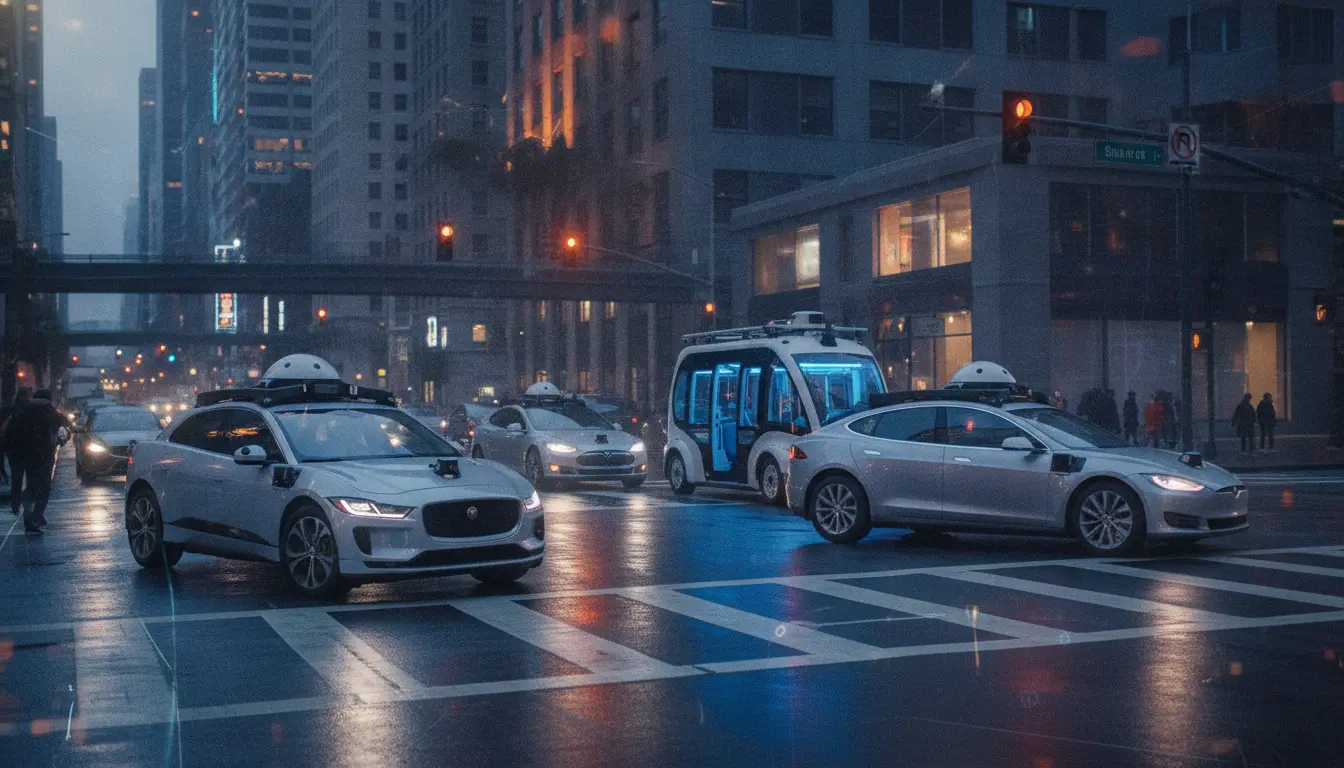
Race for Level 5 Autonomy Intensifies as Waymo, Cruise, and Tesla Navigate Technological and Regulatory Roadblocks
The streets of major American cities have become the testing ground for one of the most ambitious technological pursuits of the 21st century: the development of fully autonomous vehicles. Tech and automotive giants like Waymo, Cruise, and Tesla are locked in a high-stakes race to achieve what is known as Level 5 autonomy, a state where a vehicle can operate entirely on its own, without human intervention, under all conceivable conditions. While the promise of a driverless future has captivated the public imagination for years, the path to achieving it is proving far more challenging and protracted than early proponents predicted, with formidable technological hurdles and a complex regulatory landscape slowing the pace of progress.
The industry uses a scale defined by the Society of Automotive Engineers (SAE) to classify driving automation, ranging from Level 0 (no automation) to Level 5 (full automation). Most of the self-driving cars currently operating in limited robotaxi services, like those from Waymo and Cruise, are classified as Level 4. This means they can perform all driving functions under specific conditions, typically within a geographically restricted and meticulously mapped area known as a geofence, and often only in favorable weather. The leap from Level 4 to Level 5 is monumental. A Level 5 vehicle would need the capability to drive anywhere a human can, from a snowy mountain pass to a chaotic urban intersection during a downpour, a challenge that requires solving an astronomical number of unpredictable “edge cases.”
The leading contenders are pursuing this goal with distinctly different strategies. Waymo, an Alphabet subsidiary, has long been considered a frontrunner, employing a cautious, data-centric approach. Its vehicles are equipped with a sophisticated suite of sensors, including LiDAR, radar, and cameras, to create a redundant and richly detailed picture of the world. After years of testing, Waymo now operates commercial robotaxi services in Phoenix and San Francisco, slowly expanding its operational domain. In contrast, General Motors' subsidiary, Cruise, pursued a more aggressive expansion strategy, rapidly launching its services across multiple cities. However, this haste led to a significant setback in October 2023, when a serious incident in San Francisco resulted in the suspension of its entire fleet and a major corporate restructuring, highlighting the immense safety and public trust challenges at stake.
Meanwhile, Tesla has taken a unique and often controversial path. The company, led by Elon Musk, has eschewed LiDAR and radar in favor of a vision-only system, betting that a powerful enough neural network fed by camera data can replicate human driving. Its “Full Self-Driving” (FSD) feature, despite its name, is a Level 2 driver-assistance system that requires constant human supervision. Musk has repeatedly made bold predictions about achieving full autonomy, but these timelines have consistently been missed, underscoring the immense difficulty of the problem. Critics argue that Tesla's branding of its system overstates its capabilities and creates safety risks, while proponents believe its data-gathering from millions of consumer vehicles gives it a long-term advantage.
The road to Level 5 is paved with more than just technical challenges. The regulatory environment remains a fragmented patchwork of city, state, and federal rules. Incidents involving autonomous vehicles immediately draw intense scrutiny from regulators and lawmakers, creating a climate of uncertainty for companies investing billions in research and development. Public acceptance is another critical factor; for robotaxis to become a viable business, passengers and pedestrians must trust the technology implicitly. High-profile accidents, regardless of fault, can severely damage that trust and set the entire industry back.
Given these profound obstacles, the prospect of a true Level 5 autonomous vehicle operating in a major city before 2027 appears increasingly slim to most industry experts. The immediate focus for companies like Waymo and a chastened Cruise is on perfecting and gradually expanding their Level 4 geofenced services, proving their safety and reliability one city block at a time. The ultimate goal of a car that can truly drive itself anywhere, anytime, remains on a distant horizon. The race continues, but it is less a sprint toward a near-term finish line and more a marathon of meticulous engineering, rigorous testing, and the slow, arduous process of building trust with the public and regulators.
Stay Informed. Act Smarter.
Get weekly highlights, major headlines, and expert insights — then put your knowledge to work in our live prediction markets.
Related News
Robotaxi Rollouts Hint at Driverless Future, but True Level 5 Autonomy Faces Technical and Regulatory Hurdles
Tesla Sets Aggressive 2026 Target for Driverless Robotaxi Fleet Amid Regulatory and Technical Hurdles
Autonomous Multi-Step AI Agents Emerge as Next Major Frontier in Artificial Intelligence Development
OpenAI's Ambitious AGI Quest Intensifies as Industry Eyes Potential Pre-2027 Breakthrough
Leading AI Firms Intensify Pursuit of Breakthroughs in Reasoning and Multimodal Capabilities
The Race for AI Supremacy: Tech Giants Accelerate Timelines for Next-Generation Language Models
Tesla's Dominant US EV Market Share Faces Erosion Amid Stiffening Competition
OpenAI Pushes for Human-Equivalent Multi-Modal AI Agents by 2026
US Congress Intensifies Efforts to Forge Comprehensive Federal AI Regulation
Major AI Companies Intensify Race to Unveil Next-Generation Flagship Language Models