

- News
- AI
- Tesla Sets Aggressive 2026 Target for Driverless Robotaxi Fleet Amid Regulatory and Technical Hurdles
Tesla Sets Aggressive 2026 Target for Driverless Robotaxi Fleet Amid Regulatory and Technical Hurdles
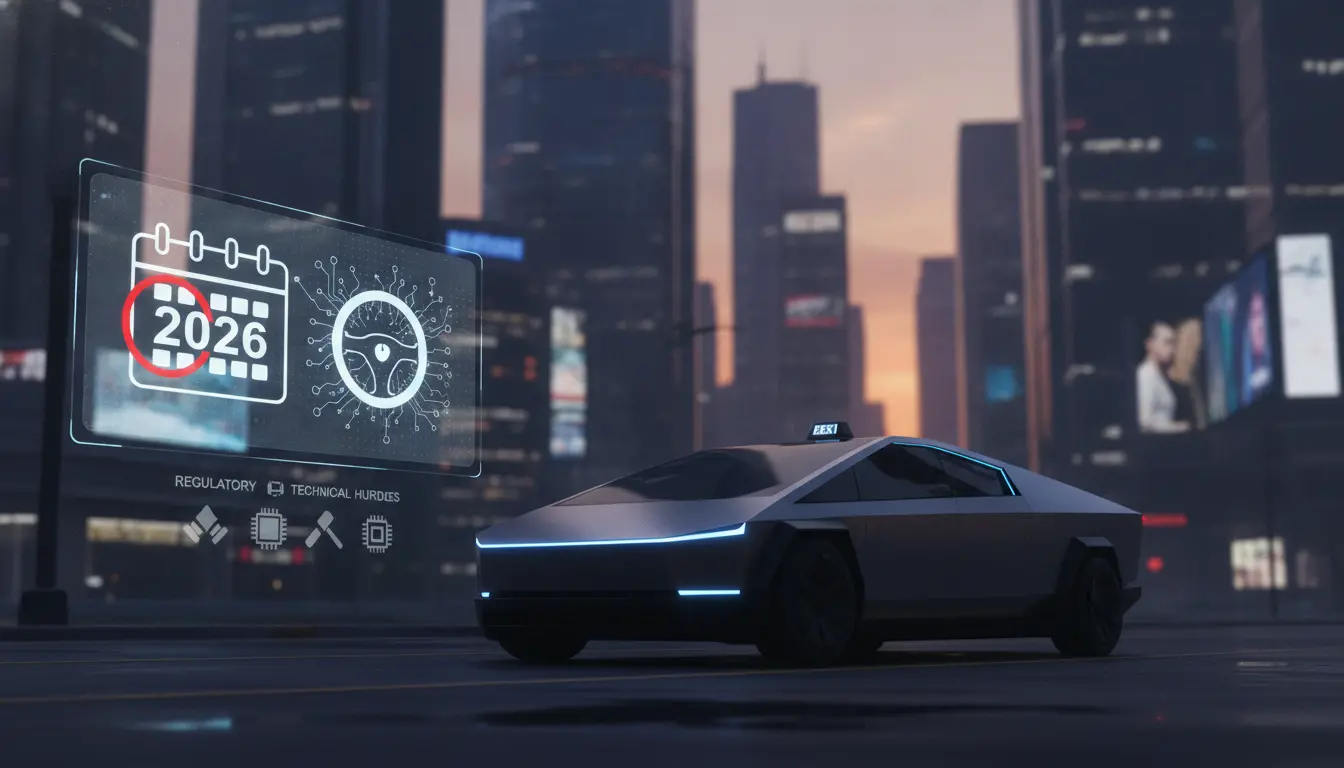
Tesla CEO Elon Musk has placed another high-stakes wager on the company's future, setting an ambitious target for its long-promised Robotaxi service to be operating without human safety drivers in at least 10 major U.S. cities by the end of 2026. This aggressive timeline escalates the race for autonomous mobility, positioning Tesla against established players like Waymo while navigating a complex maze of technological challenges and regulatory scrutiny. The company plans to showcase its progress during a dedicated event on August 8, a moment that investors and industry observers see as critical for validating a vision that could fundamentally reshape both urban transportation and Tesla's own business model.
The challenge Tesla faces is monumental, requiring a technological leap far beyond its current offerings. The company's “Full Self-Driving” (FSD) beta, despite its name, is classified as a Level 2 driver-assistance system. This means it requires constant, active supervision from a human driver who must be prepared to take control at any moment. Achieving a “fully unsupervised” service, as the 2026 goal dictates, means reaching at least Level 4 autonomy, where the vehicle can handle all driving functions within a specific operational domain without any human intervention. This transition from a sophisticated cruise control system to a truly autonomous vehicle that can safely navigate complex urban environments is one of the most difficult engineering problems of our time.
Tesla’s approach, which relies solely on cameras and a neural network for processing visual data, stands in contrast to most competitors. Rivals like Alphabet's Waymo and, until recently, GM's Cruise, have built their platforms on a suite of sensors that includes not only cameras but also lidar and radar. Lidar, in particular, uses lasers to create a detailed 3D map of the surroundings, which many in the industry consider essential for the redundancy and reliability required for safe driverless operation. Musk has famously dismissed lidar as a “crutch,” betting that a vision-only system can eventually surpass the capabilities of multi-sensor arrays. Proving this theory at scale across 10 distinct cities within two and a half years is the core of Tesla's gamble.
The competitive landscape provides a stark reminder of the difficulties ahead. Waymo has been operating fully driverless commercial services for years, slowly and methodically expanding its footprint in cities like Phoenix, San Francisco, and Los Angeles. Its progress, however, has been deliberate and cautious. Meanwhile, Cruise’s rapid expansion came to an abrupt halt in late 2023 after a serious incident in San Francisco involving one of its vehicles and a pedestrian. The fallout included a suspension of its entire U.S. fleet, a recall, and a complete overhaul of its management and safety culture. The Cruise debacle has heightened public and regulatory skepticism, making the path to securing operating permits significantly more arduous for all companies in the space.
Beyond the technological hurdles lies a formidable wall of regulation. In the United States, there is no single federal framework governing autonomous vehicles. Instead, companies must navigate a patchwork of state and municipal laws. Gaining approval for a fully driverless taxi service is a painstaking process that involves extensive testing, data sharing, and convincing local transportation authorities of the system's safety. Repeating this complex and politically sensitive process in 10 different major metropolitan areas, each with its own unique traffic patterns, weather conditions, and regulatory bodies, presents a logistical and bureaucratic challenge that may prove even more difficult to solve than the underlying technology.
For Tesla and its shareholders, the stakes could not be higher. Musk has frequently framed the company’s valuation not on its car manufacturing prowess but on its potential as an AI and robotics company, with the Robotaxi network as the crown jewel. The vision is a future where millions of Tesla owners can deploy their personal vehicles onto a shared autonomous network, generating passive income while the car would otherwise be parked. This would transform Tesla from a hardware seller into a high-margin, software-driven mobility service provider. However, this future is entirely contingent on solving full autonomy. Failure to meet the 2026 deadline would not just be a missed target but could call into question the fundamental investment thesis that has propelled Tesla to its massive market capitalization.
Stay Informed. Act Smarter.
Get weekly highlights, major headlines, and expert insights — then put your knowledge to work in our live prediction markets.
Related News
Robotaxi Rollouts Hint at Driverless Future, but True Level 5 Autonomy Faces Technical and Regulatory Hurdles
Race for Level 5 Autonomy Intensifies as Waymo, Cruise, and Tesla Navigate Technological and Regulatory Roadblocks
Scrutiny Intensifies Over Elon Musk's Extensive CEO Responsibilities at Tesla, SpaceX, and X
Tesla's Dominant US EV Market Share Faces Erosion Amid Stiffening Competition
OpenAI's Ambitious AGI Quest Intensifies as Industry Eyes Potential Pre-2027 Breakthrough
OpenAI Pushes for Human-Equivalent Multi-Modal AI Agents by 2026
Major AI Companies Poised to Launch Advanced LLMs by End of 2026
Autonomous Multi-Step AI Agents Emerge as Next Major Frontier in Artificial Intelligence Development
US Congress Intensifies Efforts to Forge Comprehensive Federal AI Regulation
Leading AI Firms Intensify Push for Flagship LLM Releases by 2026