

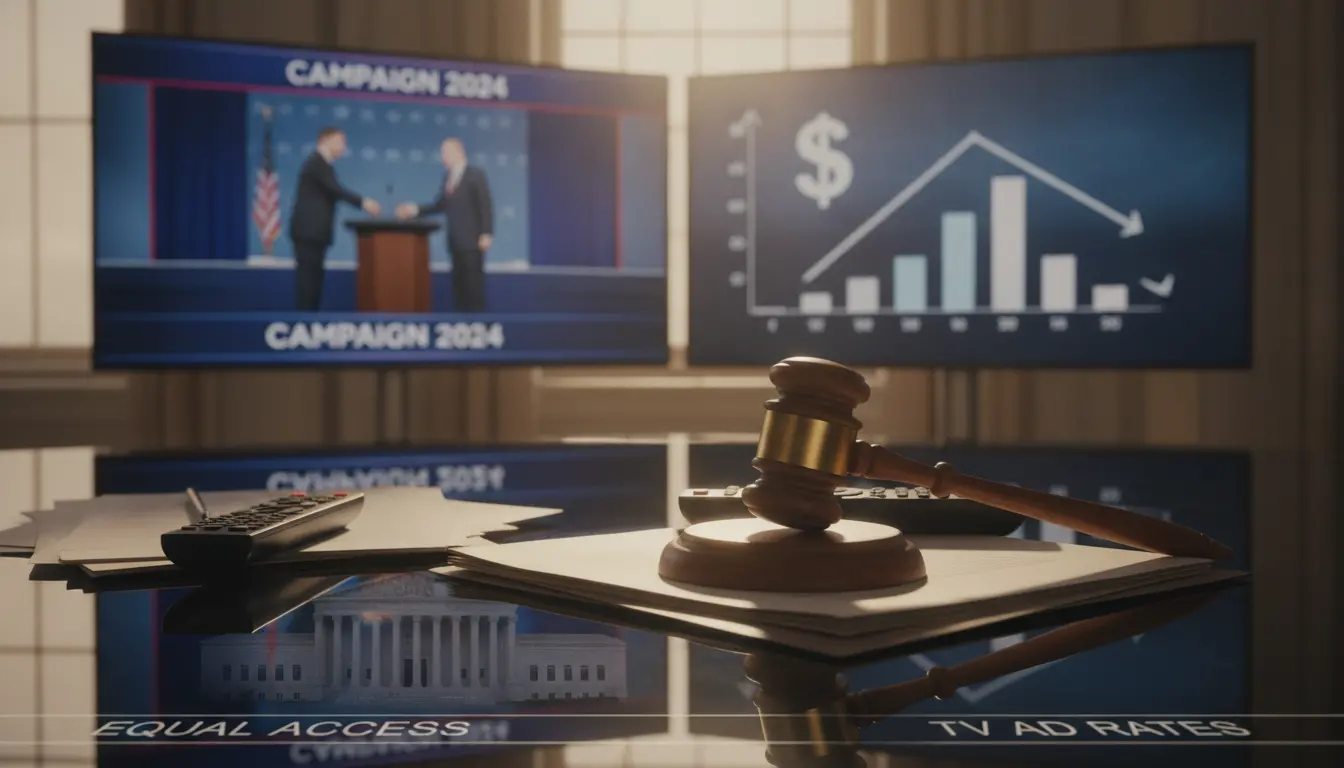
US Supreme Court Poised to Review Political Parties' Access to Discounted TV Ad Rates
The United States Supreme Court is facing a pivotal decision that could significantly reshape campaign finance and political advertising in the nation. At the heart of the matter is a contentious legal challenge over whether political parties, like individual candidates, are entitled to purchase television advertising at the federally mandated “lowest unit rate.” This appeal, primarily driven by the Republican National Committee, seeks to overturn a lower court ruling that denied parties this advantageous pricing, potentially altering the financial landscape for political campaigns leading up to future elections.
The dispute centers on a long-standing provision in federal communications law, specifically Section 315(b) of the Communications Act of 1934, as amended by the Bipartisan Campaign Reform Act of 2002 (BCRA), commonly known as McCain-Feingold. This statute mandates that broadcasters offer “legally qualified candidates” the “lowest unit charge” for their advertising during specific windows before primary and general elections. The original intent behind this provision was to prevent broadcasters from price gouging candidates, ensuring fair access to the airwaves for political speech. For decades, the interpretation primarily focused on individual candidates, but political parties have increasingly asserted their right to similar treatment, arguing their integral role in the electoral process and their function as extensions of their candidates.
The recent lower court decision sided against the Republican Party, affirming that the statutory language explicitly refers to “candidates” and not to “political parties.” This ruling highlighted a narrow reading of the law, suggesting that expanding the lowest unit rate benefit to parties would require legislative action, not judicial reinterpretation. The GOP's appeal contends that this distinction is arbitrary and detrimental to their ability to communicate effectively with voters. They argue that political parties are fundamental to democratic elections, serving as crucial conduits for candidate promotion and issue advocacy. Denying them access to LUR, they claim, unfairly increases the cost of political speech and disadvantages parties compared to wealthy independent expenditure groups or individual candidates.
Broadcasters, on the other hand, have often resisted the expansion of LUR. Extending these discounted rates to political parties, in their view, would significantly impact their revenue streams, especially during peak election seasons when demand for advertising time is highest. They argue that the existing law is clear and that if Congress had intended for parties to receive LUR, it would have explicitly stated so. Campaign finance reform advocates also often express concerns that expanding LUR could create new avenues for loopholes or less transparent spending, potentially undermining the spirit of campaign finance regulations designed to promote fairness and accountability in elections.
Should the Supreme Court choose to take up the case and ultimately rule in favor of the political parties, the implications for campaign finance would be substantial. It could lead to a significant reduction in advertising costs for party committees, potentially allowing them to purchase more airtime and amplify their messaging. This shift could enhance the power and influence of national and state parties in elections, enabling them to play an even larger role in shaping public discourse. Conversely, a decision upholding the lower court's ruling would maintain the current landscape, continuing to differentiate between candidate and party advertising costs and leaving parties to bear higher rates for their broadcast campaigns.
The outcome carries broad consequences, not just for the parties directly involved but for the entire ecosystem of political communication. It touches on fundamental questions about the role of political parties in modern democracy, the financial realities of media outlets, and the ongoing debate over how to balance free speech with campaign finance regulations. As the nation prepares for upcoming election cycles, the Supreme Court's potential intervention in this matter underscores the intricate interplay between law, politics, and the economics of influence on the airwaves, setting the stage for a decision that could reverberate through American elections for years to come.
Stay Informed. Act Smarter.
Get weekly highlights, major headlines, and expert insights — then put your knowledge to work in our live prediction markets.
Related News
Supreme Court Considers Trump-Era Mail-In Voting Order Amidst Looming Election Cycle
Strategic Battle Lines Drawn for Control of U.S. Senate Ahead of 2026 Elections
Supreme Court Poised to Redefine Presidential Authority Over Federal Reserve Leadership
Supreme Court Set to Deliver Landmark Ruling on Presidential Authority Over Federal Reserve Governors
Supreme Court Deliberates Presidential Authority to Remove Federal Reserve Governors
Democrats Face Uphill Battle to Maintain Senate Majority in 2026 Midterm Elections
Supreme Court Weighs Presidential Power to Remove Federal Reserve Governors
Supreme Court Poised to Redefine Presidential Authority Over Federal Reserve Governors
Supreme Court Examines Presidential Authority Over Federal Reserve Governor Removals
Control of US Senate Hangs in Balance as 2026 Midterm Elections Loom