

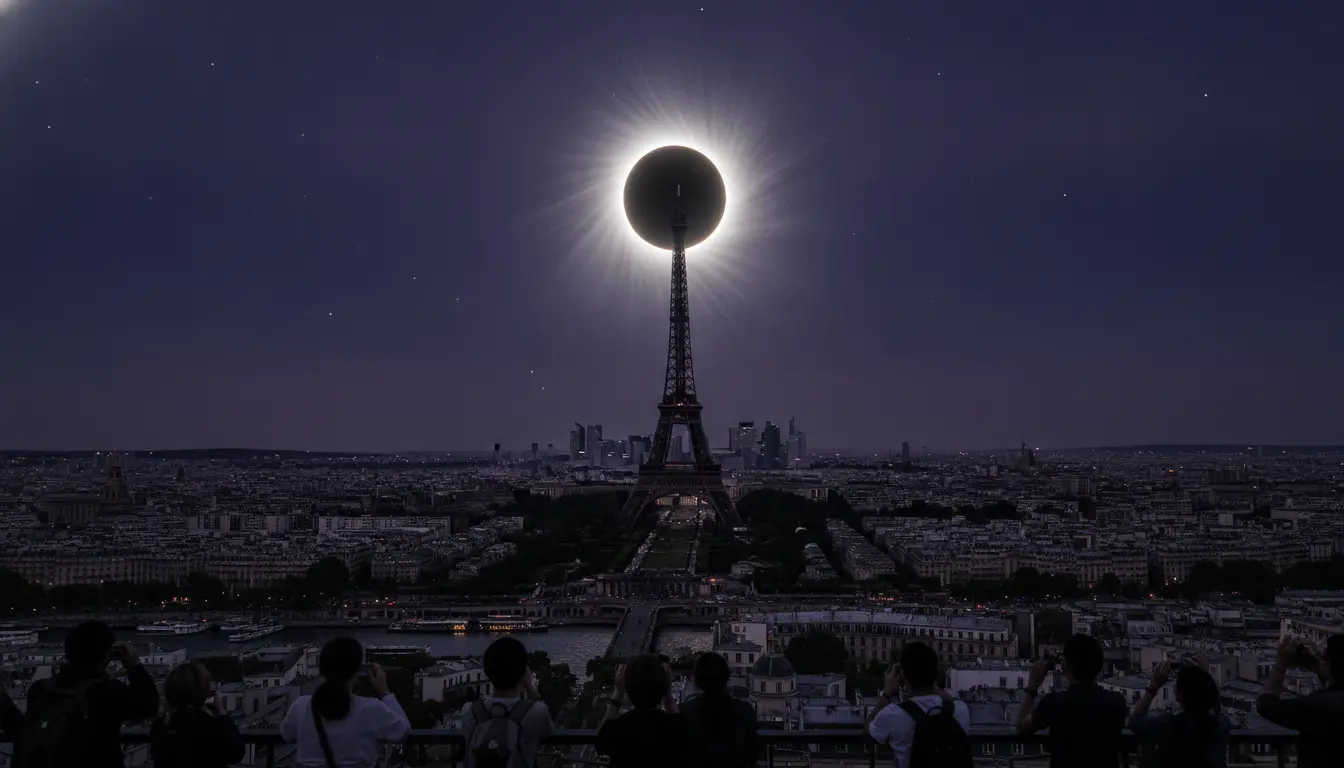
Paris Set to Witness Rare Total Solar Eclipse in August 2026
On August 12, 2026, a celestial spectacle of rare magnitude will grace the skies above Europe, with precise astronomical calculations confirming that Paris, France, is positioned squarely within the path of totality for a total solar eclipse. This extraordinary event, where the Moon completely obscures the Sun, is anticipated to draw millions of spectators and scientific researchers alike, transforming a significant portion of the continent into an unparalleled viewing ground for one of nature’s most awe-inspiring phenomena.
Total solar eclipses occur when the Moon passes directly between the Sun and Earth, casting a shadow that temporarily plunges parts of the planet into twilight. While partial solar eclipses are more common, the precise alignment required for a total eclipse is infrequent for any given geographical location. For Paris, the event will mark a significant occasion, as major European capitals rarely find themselves directly in the path of such an impressive celestial alignment. The 2026 eclipse path begins over the Arctic, sweeps down across Greenland, clips Iceland, and then traverses Spain and Portugal before concluding in the Mediterranean. Its passage over prominent European cities, most notably Paris and several Spanish population centers, enhances its global appeal and logistical complexity.
Astronomers have meticulously plotted the trajectory of the Moon’s shadow, known as the path of totality, which will stretch several tens of kilometers wide. For those within this narrow corridor, the daytime sky will darken dramatically, stars and planets may become visible, and the Sun’s ethereal corona—its outermost atmosphere—will be revealed in all its delicate beauty, typically hidden by the Sun's bright disk. The duration of totality will vary depending on the observer's precise location within the path, but in areas like Paris and key regions of Spain, observers can expect several minutes of full obscuration, providing ample time for both casual viewing and dedicated scientific observation. Such events are crucial for heliophysicists studying the Sun’s corona, offering a unique opportunity to observe this dynamic region without specialized equipment that mimics an eclipse, thus yielding invaluable data on solar wind and space weather phenomena.
The anticipation for the 2026 total solar eclipse extends beyond the scientific community, gripping the public with a blend of wonder and logistical challenges. Cities and regions within the path of totality, particularly in France and Spain, are expected to experience a significant surge in tourism. Local authorities and tourism boards are already beginning to formulate plans for managing the influx of visitors, ensuring public safety, and maximizing the viewing experience. This includes organizing viewing events, distributing certified solar filters and eclipse glasses, and coordinating emergency services. The economic impact is projected to be substantial, offering a boon to hospitality sectors, but also necessitating careful planning for traffic management and public infrastructure strain.
Historically, solar eclipses have captivated humanity, inspiring myths, scientific breakthroughs, and public fascination. From ancient astronomers predicting their occurrence to modern scientists deploying advanced instruments, the quest to understand these cosmic alignments has driven both cultural and scientific progress. The 2026 event provides a powerful reminder of our place in the cosmos and the elegant precision of celestial mechanics. It also offers a unique educational opportunity, particularly for younger generations, to engage directly with astronomy and appreciate the vastness of the universe. The precise and predictable nature of such events underscores humanity's advanced understanding of our solar system, making preparations for safe and successful viewing a testament to both scientific knowledge and civic cooperation.
As the date approaches, interest will undoubtedly intensify. Researchers will fine-tune their experiments, aiming to capture unprecedented data from the corona and chromosphere. Meanwhile, millions across Europe and beyond will mark their calendars, eagerly awaiting the opportunity to witness a rare and profound natural phenomenon. The challenge for host nations like France and Spain will be to balance scientific endeavor with public access, ensuring that this fleeting moment of cosmic alignment is both safely experienced and scientifically fruitful for all involved, leaving a lasting impression on a generation of sky-watchers and scientists alike. The legacy of this eclipse will not only be measured in scientific papers but also in the shared human experience of gazing up at a temporarily silenced sun.
Stay Informed. Act Smarter.
Get weekly highlights, major headlines, and expert insights — then put your knowledge to work in our live prediction markets.
Related News
PSG and Aston Villa Set for UEFA Super Cup Showdown in 2026

Eurozone Awaits Crucial August 2026 CPI Flash Estimate Amid Persistent Inflation Concerns

Clash of Titans: Paris Saint-Germain Set to Welcome Stade Rennais in High-Stakes Ligue 1 Encounter

Real Madrid Set for Anticipated 2026 La Liga Encounter Against RCD Espanyol

Berlin Gears Up for Pivotal 2026 State Parliament Election Amid Tight Political Contest

Eurozone Economic Outlook and Persistent Inflation Set Stage for ECB's Mid-2026 Monetary Policy Review

MLB Contenders Set Sights on Illustrious 2026 World Series Title

European Union Pushes for Landmark Common Defense Policy by 2026 Amid Geopolitical Shifts

Paris Saint-Germain Solidifies Decades-Long Hegemony in French Football

Zinedine Zidane Reportedly Set to Become France National Team Manager in July 2026