

- News
- Science
- Mathematicians Race to Verify Landmark Riemann Hypothesis Proofs as AI-Assisted Claims Spark Global Scrutiny
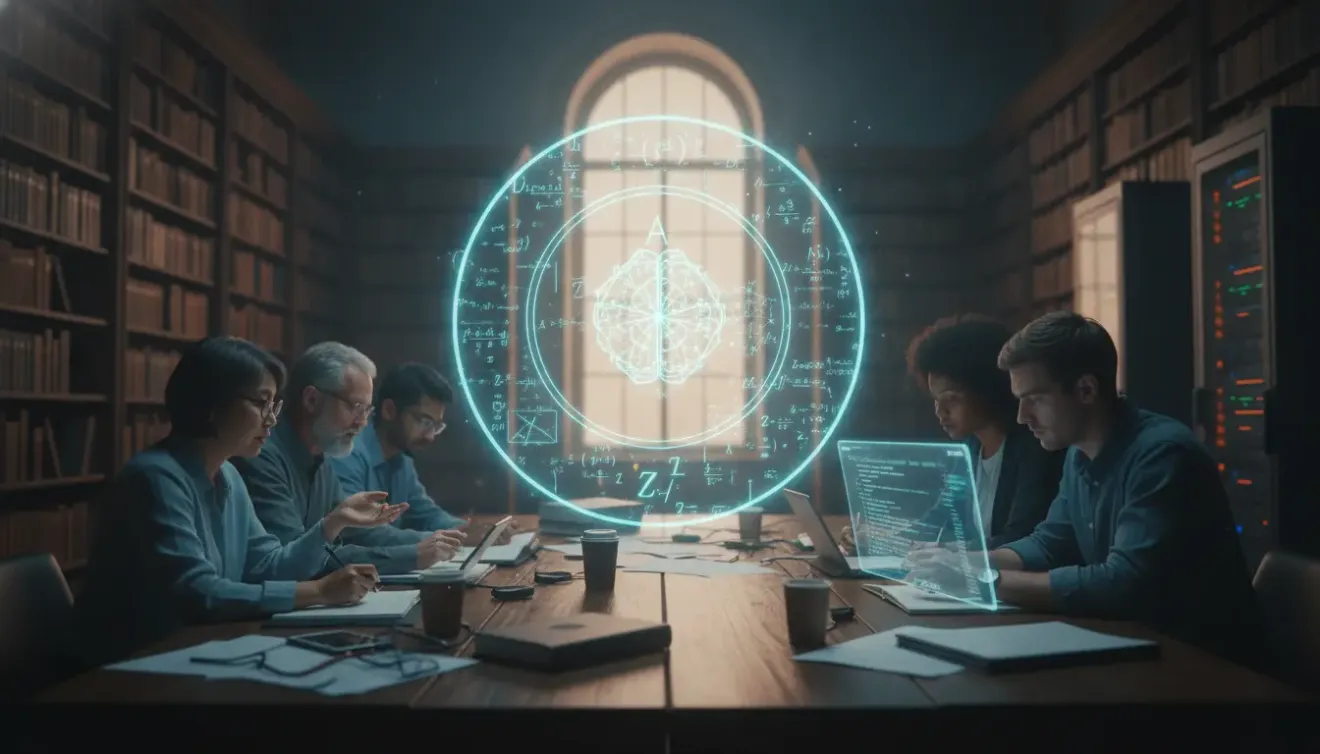
Mathematicians Race to Verify Landmark Riemann Hypothesis Proofs as AI-Assisted Claims Spark Global Scrutiny
The mathematical world was thrown into rare turmoil this week after two separate claims of a proof for the Riemann Hypothesis—the most famous unsolved problem in mathematics—emerged within hours of each other, one from a researcher at Anthropic using the company's Claude AI model and another from an independent human mathematician. Neither proof has been verified, and the global mathematical community is now scrambling to assess whether the 166-year-old conjecture has finally fallen.
The Riemann Hypothesis, first proposed by Bernhard Riemann in 1859, asserts that the non-trivial zeros of the Riemann zeta function all lie on a single vertical line in the complex plane. Its proof would unlock deep insights into the distribution of prime numbers and have profound implications for cryptography, number theory, and fields as diverse as quantum chaos and statistical mechanics. For decades, it has topped the list of Millennium Prize Problems, each worth $1 million, and countless careers have been built—and sometimes broken—on attempts to crack it.
The first claim came from an Anthropic mathematician who said the company's large language model, Claude, had helped construct a novel proof strategy. According to early descriptions circulating on social media and preprint servers, the approach combines analytic number theory with techniques from machine learning, though the manuscript itself has not been made publicly available in full. Within hours, a human researcher—whose name has not been independently confirmed—posted a separate claimed proof using a different method, setting off a frenzy of speculation and skepticism.
Reactions from the mathematical establishment have been cautious. "Extraordinary claims require extraordinary evidence," said one prominent number theorist, speaking on condition of anonymity because the claims are still under review. "The Riemann Hypothesis has resisted the efforts of the greatest minds for over a century. A proof, whether human or machine-assisted, must withstand rigorous peer review. Until then, we treat these as unverified assertions." Several journals have reportedly received submissions, but none have confirmed acceptance or even expedited review.
The involvement of AI in a potential breakthrough has added a new dimension to the debate. Anthropic has been at the forefront of developing large language models capable of advanced mathematical reasoning, and the company has previously demonstrated systems that can solve olympiad-level problems. However, critics note that AI models are prone to hallucination and may generate plausible-sounding but flawed arguments. "The burden of proof is on the claimants," said a spokesperson for the International Mathematical Union. "We welcome new tools, but the standards of mathematical rigor remain unchanged."
The timing of the dual claims has also raised eyebrows. Some observers speculate that the simultaneous announcements may be a case of "multiples"—a phenomenon where independent researchers arrive at similar ideas at the same time—while others suspect a coordinated attempt to generate hype. The human researcher's claim, posted on a personal blog, has been met with particular skepticism because it lacks the detailed lemmas and references typical of serious mathematical work.
For now, the mathematical community is proceeding with caution. Verification of a Riemann Hypothesis proof would typically involve months, if not years, of careful checking by experts. The Clay Mathematics Institute, which administers the Millennium Prize, has not commented on the claims. "We are aware of the announcements and are monitoring the situation," a spokesperson said. "Any submission will be evaluated according to our standard procedures."
If either proof holds up, the implications would be staggering. A proof of the Riemann Hypothesis would not only resolve a central question in number theory but also validate or invalidate many other results that depend on its truth. It could lead to breakthroughs in prime number generation, with consequences for cryptography and computer security. It would also represent a triumph for human-AI collaboration, potentially reshaping how mathematical research is conducted.
But for now, the mathematical world remains in a state of suspended animation, waiting for the first rigorous verification—or refutation. As one mathematician put it on social media: "Until I see a proof that I can check line by line, I'll assume the Riemann Hypothesis is still open. And I suspect I'm not alone."
Stay Informed. Act Smarter.
Get weekly highlights, major headlines, and expert insights — then put your knowledge to work in our live prediction markets.
Related News

Soaring Demand Forces Chinese ChatGPT Rival Kimi to Halt New User Registrations
OpenAI's GPT-5.6 Sol Enters Fierce Competition Against Google's Gemini 3.1 Pro Preview for MMLU-Pro Benchmark Dominance
EU AI Act's Transparency Mandates Face Uphill Battle Towards Full 2026 Implementation
European Commission Weighs Gatekeeper Status for Cloud Giants AWS and Azure

MIT Researchers Unveil SEAL: A New Step Towards Self-Improving AI

Major 7.1 Magnitude Earthquake Jolts Southern Japan, Heightening Aftershock Alert

EU AI Act Gears Up for Crucial High-Risk System Obligations by August 2026

Southern Europe Grapples with Escalating Wildfire Crisis Amidst Climate Change Intensification

As Europe Sizzles, Climatologists Warn It's a Matter of When, Not If, All-Time Heat Record Falls

Europe Confronts Escalating Climate Risks as Record Heatwaves Push Temperatures Towards Unprecedented Levels