Politicsconflict & defenseMilitary Operations
PLA Drone Footage Near Taipei 101 Sparks Debate
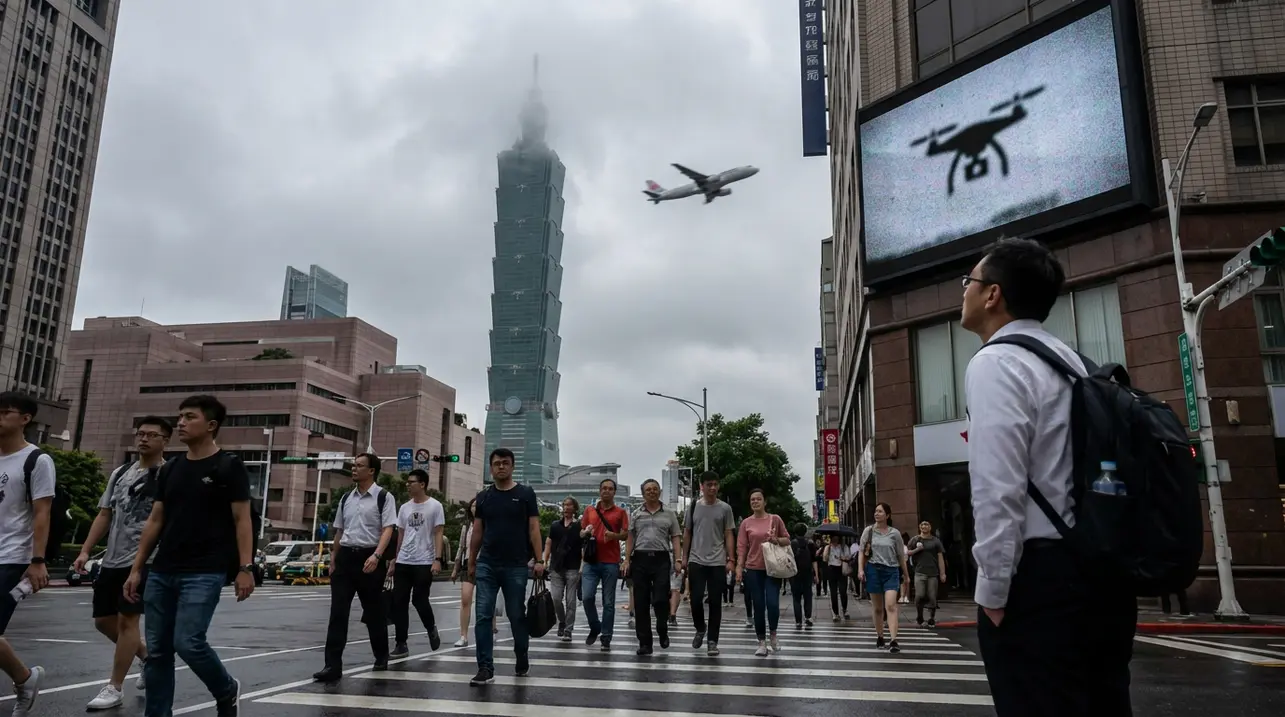
The release of black-and-white drone footage by the People’s Liberation Army Eastern Theatre Command this week, featuring Taipei 101 in stark, grainy detail, is not merely a propaganda clip; it’s a meticulously calibrated signal, a piece of psychological warfare designed to test thresholds and map reactions in real-time. The video, showing an ascending passenger plane gliding past the iconic skyscraper, immediately ignited a fierce debate over just how close PLA assets penetrated to the heart of Taiwan’s capital—a debate Beijing is undoubtedly monitoring with analytical precision.This isn't an isolated incident but the latest move in a long-running campaign of 'grey-zone' tactics, operations that fall below the threshold of outright armed conflict but steadily erode norms and escalate tensions. The strategic calculus here is multifaceted: on one level, it’s a direct demonstration of capability, showcasing the PLA’s ability to operate drones with impunity in airspace Taipei considers its own, effectively negating the defensive value of the Taiwan Strait.On another, it’s a profound psychological blow, making the abstract threat of invasion viscerally concrete for the Taiwanese public by placing their most recognizable landmark in a PLA crosshair. Historically, such actions follow a pattern of incremental pressure—increased air incursions, naval patrols, and now, apparently, drone surveillance over the island itself—each designed to probe for weaknesses, gauge international resolve, and normalize a presence that challenges Taiwan’s sovereignty.Experts in political risk analysis point to the timing, coinciding with military exercises, as critical; it transforms the footage from a simple intelligence gather into a public spectacle of dominance, a message aimed as much at Taipei as at Washington and regional allies. The potential consequences are layered.Domestically in Taiwan, it fuels anxiety and could harden public opinion, potentially impacting upcoming elections and debates over defense spending. For the US and Japan, it presents a classic escalation dilemma—how to respond to an act that is provocatively symbolic yet stops short of a kinetic attack.Does one ignore it and risk emboldening further incursions, or react strongly and risk accelerating a cycle of action and counteraction? The broader context is the deteriorating great-power framework, where established deterrence models are being stress-tested by these ambiguous, non-linear tactics. From a risk-assessment perspective, the footage moves the needle on several key indicators: it demonstrates improved PLA drone range and stealth, suggests a new boldness in operational planning, and reveals a willingness to weaponize multimedia in information warfare.The chilling panoramic still image released alongside, showing the tower and its urban surroundings, underscores the point: this is not just about a building, but about holding an entire cityscape, and by extension a society, under observation. The long-term analytical insight is grim.
#PLA
#Taiwan
#military exercise
#drone
#Taipei 101
#aerial footage
#featured