

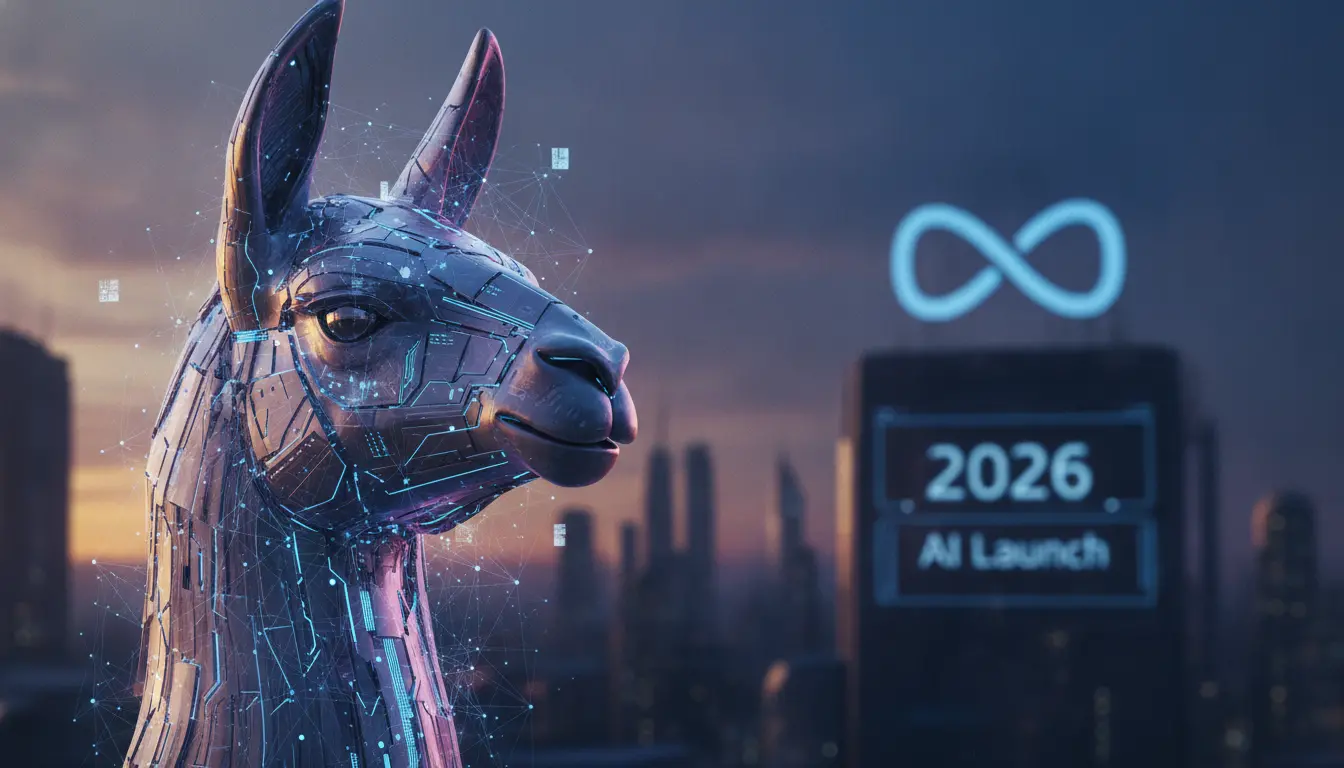
Meta Aims for Late 2026 Launch of Next-Generation Llama AI Model
Meta is reportedly setting its sights on a significant milestone in artificial intelligence development, with plans underway for the launch of its next foundational AI model, potentially a new iteration in the Llama series, by late 2026. This ambitious timeline underscores the company's aggressive push to advance its "personal superintelligence" vision, a concept articulated by CEO Mark Zuckerberg as a future where AI systems can assist individuals across all facets of life.
Since the introduction of its Llama series, Meta has carved out a distinct niche in the fiercely competitive AI landscape by championing an open-source approach to its foundational models. While rivals like OpenAI and Google have largely maintained proprietary control over their most advanced systems, Meta has made its Llama models freely available to researchers and developers, fostering a vibrant ecosystem of innovation. This strategy has not only democratized access to powerful AI tools but has also accelerated the pace of development across the broader AI community. The anticipated Llama 5, or whatever the next iteration may be named, is expected to build upon these principles, delivering substantial advancements in capabilities, efficiency, and scale, further entrenching Meta's position as a key player.
The development of a new foundational model like Llama 5 represents a monumental undertaking, requiring vast computational resources, extensive data curation, and the expertise of thousands of engineers and researchers. Each successive generation of large language models (LLMs) has introduced greater parameter counts, enhanced reasoning abilities, improved multimodal understanding, and more sophisticated contextual processing. For Meta, the stakes are particularly high, as the performance of its next-gen AI will directly impact its ability to deliver on the promise of "personal superintelligence," which envisions AI agents deeply integrated into user experiences across its social platforms, virtual reality environments, and future hardware. Such an agent would be capable of complex reasoning, learning individual preferences, and proactively assisting users in highly personalized ways.
The competitive environment in AI is intensifying, with tech giants pouring billions into research and development. OpenAI's GPT series, Google's Gemini, and Anthropic's Claude models continually push the boundaries of what AI can achieve. Meta's Llama series, particularly Llama 3, has already demonstrated strong performance against its closed-source counterparts, often excelling in benchmarks and finding widespread adoption among developers due to its flexibility and transparency. The next iteration will need to not only match but significantly surpass current benchmarks to maintain Meta's competitive edge and attract top-tier talent and partnerships.
Looking ahead, the successful launch of Llama 5 by late 2026 would not only solidify Meta's technical leadership but also profoundly influence the direction of open-source AI development. The implications extend beyond technological prowess, touching upon critical discussions around AI ethics, safety, and governance. Building increasingly powerful and autonomous AI systems necessitates robust safeguards and transparent development practices, areas where Meta's open-source ethos could play a crucial role in fostering collective responsibility. As the countdown to 2026 begins, the global AI community will undoubtedly be watching closely to see how Meta's next foundational model shapes the future of artificial intelligence.
Stay Informed. Act Smarter.
Get weekly highlights, major headlines, and expert insights — then put your knowledge to work in our live prediction markets.
Related News

OpenAI's GPT-5 Launch Expected by 2026, Poised to Reshape AI Landscape
AI Race Intensifies as Major Companies Target 2026 for Next-Generation Language Models
OpenAI Targets GPT-6 Release by 2026 as AI Race Intensifies
Google Targets Major AI Leap with Gemini 2.0 Ultra Development by 2026

Meta Intensifies AI Coding Ambitions with 'Muse Code' Agent, Targeting Public Developer Access

OpenAI Accelerates Development of Next-Generation GPT Models Amidst Performance Surge Reports

Tech Giants Intensify Race for Widely Adopted Agentic AI Platforms by 2026

S&P 500 Poised for New All-Time Highs by 2026 Amid Tech Sector Resurgence and Anticipated Federal Reserve Rate Cuts

Google Readies Potential Foldable Pixel 11 Pro Fold Debut for August 2026 Event

Brazil Braces for Contentious 2026 Presidential Election as Lula Eyes Re-election Bid