

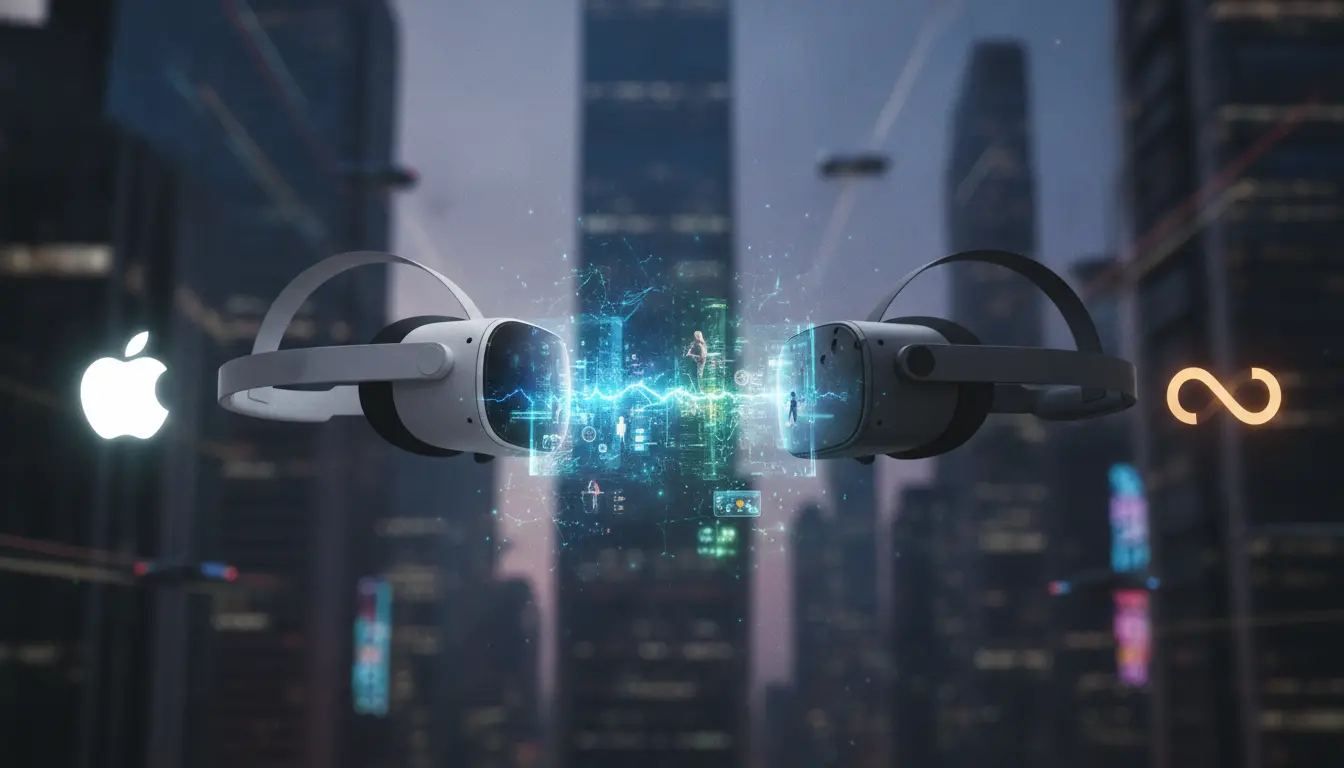
Beyond Vision Pro: Apple and Meta Locked in High-Stakes Battle for Mainstream AR Dominance
The launch of Apple's Vision Pro headset earlier this year may have fired the starting gun on the next era of personal computing, but for Silicon Valley’s biggest players, it was merely the first public salvo in a much longer and more consequential war. The true prize is not a bulky, expensive mixed-reality device, but its successor: a pair of lightweight, all-day augmented reality (AR) glasses that could one day replace the smartphone. This quest has ignited a quiet but intense technological arms race, primarily between Apple and Meta, to define and ultimately dominate the platform that will shape how we interact with the digital world for decades to come.
Meta, under the leadership of Mark Zuckerberg, has been the most transparent about its ambitions. Having staked the company's future on the concept of the metaverse, Meta has poured tens of billions of dollars into its Reality Labs division. Its strategy is twofold: build the market from both the high and low ends. The Meta Quest line of VR headsets has established a strong foothold in the consumer virtual reality space, creating a nascent ecosystem for developers. Simultaneously, its partnership with EssilorLuxottica on the Ray-Ban Meta smart glasses represents a subtle, iterative effort to normalize the idea of wearing technology on your face. While the current Ray-Bans are more camera-and-speaker-equipped glasses than true AR devices, they are a crucial step in solving the aesthetic and social acceptance challenges that doomed early attempts like Google Glass.
In classic fashion, Apple is pursuing a more deliberate and secretive path. The Vision Pro, with its staggering price tag and advanced capabilities, was never intended for the mass market. Instead, it serves as a high-fidelity prototype for developers and a vehicle to build out its visionOS software platform. Tim Cook has long been a vocal proponent of augmented reality, viewing it as a more profound technology than virtual reality because it enhances the real world rather than replacing it. Apple’s challenge lies in shrinking the formidable technology of the Vision Pro—its high-resolution micro-OLED displays, complex sensor array, and powerful processing—into a form factor that is not just wearable, but fashionable and unobtrusive. The company is methodically acquiring startups and filing patents related to everything from waveguide displays to advanced battery technology, signaling a long-term commitment to solving these monumental engineering hurdles.
This is not a two-horse race, however. Google, the pioneer that stumbled with the public reception of Google Glass a decade ago, has not abandoned the field. Having learned crucial lessons about privacy and social optics, the company is re-engaging through strategic partnerships, notably with Samsung, to develop its own mixed-reality hardware, likely powered by a specialized version of Android. The combined manufacturing prowess of Samsung and the software ecosystem of Google presents a formidable potential challenger, aiming to replicate the Android-iOS duopoly that has defined the mobile era. The collective challenge for all contenders remains immense, spanning power consumption, heat dissipation, display brightness for outdoor use, and, most critically, developing a compelling, intuitive user interface for a world without a physical screen.
Beyond the hardware, the ultimate battle will be for the ecosystem. The company that first delivers a viable pair of consumer AR glasses will be in a position to control the next dominant operating system and its corresponding app store. This is the true stake: not just selling a new category of device, but owning the platform on which future applications for communication, navigation, entertainment, and productivity will be built. It represents a fundamental paradigm shift away from the handheld screen, a prize so large that it justifies the colossal research and development expenditures. While a truly mainstream, iPhone-moment for AR glasses remains several years away, the foundational investments and strategic maneuvers happening today are drawing the battle lines for the next great technological revolution.
Stay Informed. Act Smarter.
Get weekly highlights, major headlines, and expert insights — then put your knowledge to work in our live prediction markets.
Related News

Tech Giants Push for 2026 Launch of Consumer-Ready AI Smart Glasses
Apple Readies Foldable iPhone for Potential 2026 Unveiling Amid Industry Scrutiny

Google's Upcoming Pixel 11 Puts Spotlight on Tensor G6 Chip in High-Stakes Performance Battle
Apple Gears Up for Major AI Integration with iPhone 18 Series Launch in 2026
Outpoll Weekly Recap: Entertainment (August 24 – 30, 2026)

European Commission Intensifies Scrutiny of Google's Android and AI Practices, New Compliance Measures Expected by July 2026

G20 Accelerates Push for Global Digital Policy Consensus, Focusing on AI and Data Governance
Apple Explores Ultra-Premium iPhone Tier for 2026 Launch
Google Poised to Expand Pixel Portfolio with New Foldable Device in 2026

Outpoll Weekly Recap: Science (August 10 – 16, 2026)