In 2025, AI and EVs gave the US an insatiable hunger for power
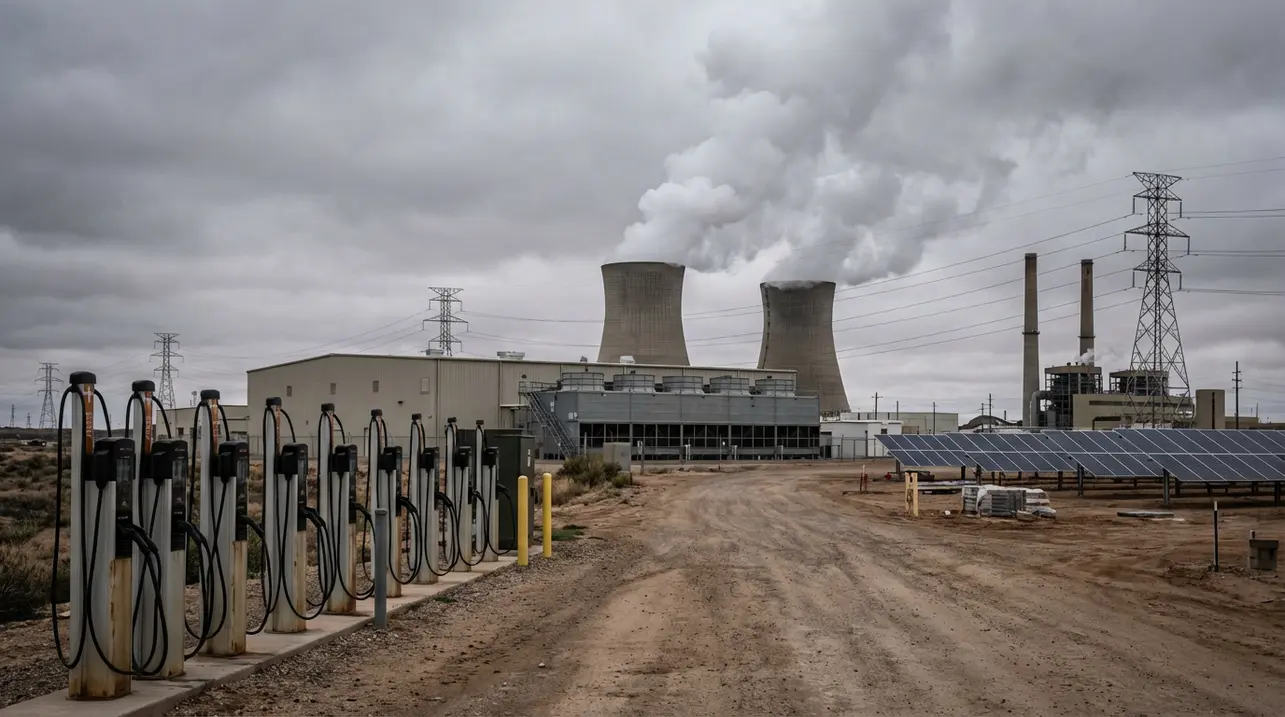
It’s a startling fact that electricity, for all its centrality to modern life, still only accounts for about 21 percent of the world’s total energy consumption. The rest is dominated by fossil fuels, but that balance is shifting dramatically.The International Energy Agency projects that electricity’s share will double within the next decade, a staggering acceleration driven by the twin engines of artificial intelligence and the global electrification of transport. This isn't a gradual evolution; it's a power surge of cosmic proportions, and the United States, as the epicenter of the AI boom, is facing a fundamental question: where will all this energy come from? The answer is shaping up to be a messy, contradictory scramble that looks to the stars for inspiration while digging deeper into the earth.The narrative of 2025 has been one of re-embracing the atom with a fervor not seen in generations. Early in the year, an executive order aimed at 'Unleashing American Energy' explicitly targeted regulatory roadblocks for new nuclear plants, signaling a profound policy shift.This wasn't just rhetoric; it was followed by a concrete push for advanced nuclear technologies. Big Tech, acutely aware that its AI ambitions are power-bound, has become a major financier of this nuclear renaissance.Meta secured the future output of Illinois's Clinton Power Station, Microsoft is backing the controversial restart of a reactor at the renamed Three Mile Island facility—a project bolstered by a $1 billion Department of Energy loan—and both Google and Amazon are investing in startups like Kairos Power and X-Energy, betting on a future of small, modular reactors. This isn't an isolated American trend.Globally, 70 reactors are under construction from Turkey to South Korea, with China leading the charge by building 33 and greenlighting 10 more this April alone, achieving costs that make Western projects like the UK's Hinkley Point look astronomically expensive. Yet, building a fission reactor is the work of a decade or more.In the interim, the energy gap must be bridged, and here the US strategy reveals a troubling duality. While championing a nuclear future, the administration has simultaneously kneecapped the domestic solar industry by stripping subsidies, a move that hands long-term advantage to China.At the same time, the Department of Energy has established a $625 million fund to revive the coal industry and is working to refill the Strategic Petroleum Reserve. Energy Secretary Chris Wright’s claim that fusion power would be on the grid within a decade, thus justifying continued fossil fuel extraction, was widely criticized by climate experts as scientifically dubious.
#featured
#AI energy demand
#nuclear power
#solar energy
#fusion research
#US energy policy
#electric vehicles
Stay Informed. Act Smarter.
Get weekly highlights, major headlines, and expert insights — then put your knowledge to work in our live prediction markets.
This schism was made bureaucratic reality in a November org chart reshuffle that eliminated offices for renewables and efficiency while creating a new Office of Fusion. Despite the political headwinds, solar power’s momentum may be unstoppable on a global scale.
The IEA forecasts renewable energy growth equivalent to the combined capacity of China, the EU, and Japan by 2030, with 77 percent of that coming from solar. In the US, even with a revised downward forecast, the Federal Energy Regulatory Commission still expects nearly 93 gigawatts of new solar to come online by mid-2028, driven by the urgent need to power AI data centers.
As Rob Gardner of the Solar Manufacturers for America Coalition noted, AI investments can't deliver returns without quickly deployed power, and US solar remains the fastest option. This brings us to the ultimate moonshot: fusion.
The Department of Energy has released a detailed roadmap, declaring fusion a 'strategic national priority. ' The promise is the stuff of science fiction—limitless, clean power mimicking the process that fuels our sun, using fuels derived from water and lithium, with no risk of meltdown or long-lived radioactive waste.
International projects like the massive ITER reactor in France and China’s record-setting EAST tokamak are pushing the boundaries, while private companies like Commonwealth Fusion and Helion have attracted billions in venture capital. Stuart White of Tokamak Energy, which achieved a plasma temperature of 100 million degrees Celsius, believes the next decade will be about 'scaling up' these experiments.
He cautions that while national programs like the UK's STEP target 2040 and the US aims for the mid-2030s, fusion will not be a deus ex machina. It will arrive to complement other clean sources over the coming half-century, not save us in the next ten years.
The core tension of 2025, then, is between timescales. The demand for power from AI and EVs is exploding now.
Nuclear fission offers a medium-term, low-carbon solution but builds too slowly. Solar is fast and cheap but faces political opposition.
Fossil fuels are a readily available but environmentally catastrophic bridge. And fusion remains a dazzling dream on the far horizon.
The US energy policy, in its current form, seems to be trying to bet on all of them at once, a strategy that may satisfy no timeline adequately. The nation's insatiable hunger for power is forcing a reevaluation of every energy source we have, revealing that the path to a electrified future is less a straight line and more a chaotic, multi-front war against physics, economics, and time itself.