Scienceearth scienceSeismology
This simple math trick could transform earthquake science
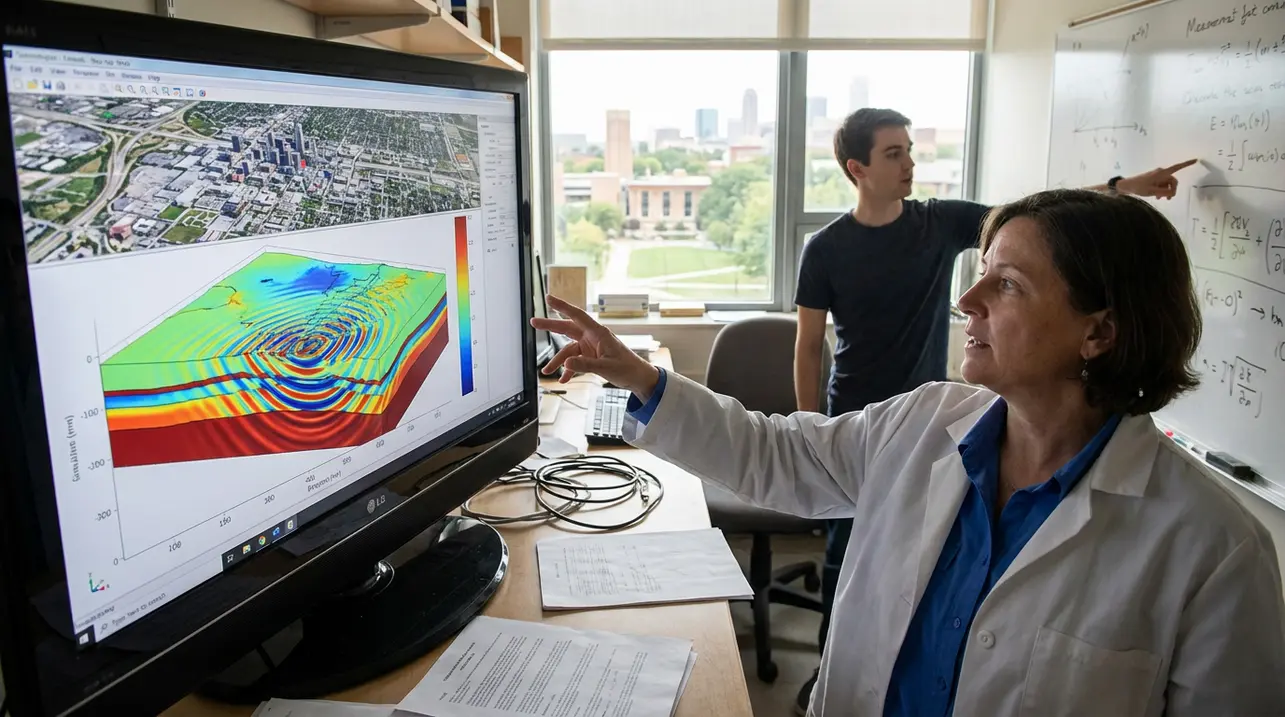
Earthquakes are a daily, planetary heartbeat, a stark reminder that we live on a dynamic and often unforgiving celestial body. While the dream of predicting the precise moment a fault will rupture remains as elusive as ever—a kind of scientific holy grail that has taunted researchers for generations—our ability to understand and model the aftermath is undergoing a seismic shift of its own.The core challenge has always been the sheer computational brute force required to simulate how shockwaves from a quake travel through the Earth's incredibly complex, layered crust. Traditional methods are like trying to calculate a rocket's trajectory with an abacus; they're slow, expensive, and limit how many scenarios we can test.Now, a breakthrough approach is changing the game, accelerating these vital simulations by a staggering factor of about 1,000. Think of it as upgrading from a telescope in your backyard to the James Webb Space Telescope—suddenly, the hidden architecture beneath our cities comes into breathtaking, high-resolution focus.This isn't about forecasting the 'when' of the next Big One; it's about revolutionizing our understanding of the 'how bad' for any given location. By leveraging advanced mathematical tricks and high-performance computing, scientists can now map, with unprecedented speed and detail, how the unique geology under Los Angeles, Tokyo, or Istanbul will amplify or dampen shaking.This means engineers and urban planners can move beyond one-size-fits-all building codes. We can now run thousands of simulations for a single neighborhood, factoring in the exact composition of the soil, the angle of the fault line, and the depth of the bedrock to see which blocks would become death traps in a magnitude 7.5 event and which might hold firm. The implications are profound.For decades, seismic risk assessment has been a compromise between accuracy and practicality. This new method shatters that compromise.It allows for what experts call 'physics-based probabilistic risk assessment,' where we can finally quantify, with real confidence, the likelihood of a skyscraper collapsing or a critical bridge failing. The work builds on principles from fields like astrophysics and AI model training, where managing immense datasets and complex variables is routine.As Dr. Elena Vargas, a seismologist at Caltech not directly involved in the research but familiar with its contours, puts it, 'This is a paradigm shift from inference to simulation.Instead of making educated guesses based on past quakes, we're building a digital twin of the subsurface and stress-testing it relentlessly. ' The consequences extend far beyond safer building codes.Insurance models, long based on historical averages that are increasingly obsolete in our changing climate, can be rewritten. Emergency response routes can be planned not on guesswork, but on data showing which roads are most likely to be buried in liquefaction.The economic and human toll of being unprepared is astronomical; the 2011 Tohoku quake and tsunami in Japan caused over $360 billion in damage, while Haiti's 2010 catastrophe killed an estimated 250,000 people, tragedies compounded by a lack of resilient infrastructure. This computational leap brings a Mars-mission-level of engineering to Earth's own terra incognita—the ground beneath our feet.It transforms seismic science from a reactive field, documenting disasters after they happen, into a proactive tool for planetary defense. We may never get a five-minute warning before the ground shakes, but with this new lens, we can ensure that when it does, our homes, hospitals, and schools are ready to withstand the storm.
#earthquake simulation
#seismic risk assessment
#ground shaking
#computational speedup
#featured
#research breakthrough
#natural hazards