SciencearchaeologyExcavations and Discoveries
Dinosaur bones found almost on top of each other in Transylvania
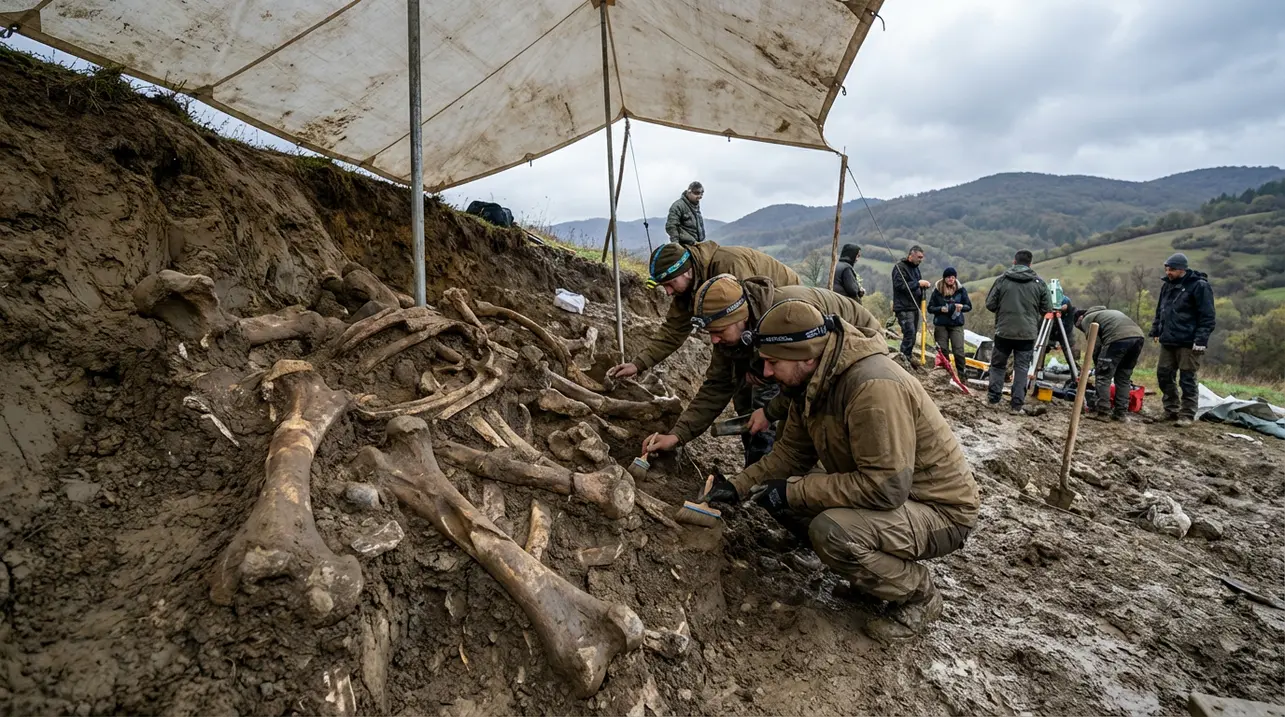
Picture a scene, not of a dusty museum shelf, but of a prehistoric cataclysm frozen in time: in Romania’s Hațeg Basin, a region already legendary for its dwarfed dinosaurs, scientists have just cracked open a geological vault of staggering density. The newly detailed K2 site is a paleontological jackpot, a bone bed so crammed with fossils they lie almost on top of each other, a chaotic jumble that tells a crystal-clear story of a 72-million-year-old ecosystem meeting its sudden end.This wasn't a slow accumulation; it was a natural trap, a flood-fed lake that acted like a prehistoric quicksand, ensnaring and preserving a cross-section of life in the final, fading chapter of the Cretaceous period in Europe. The sheer volume is mind-bending—thousands of remains, from common local denizens like the rhino-sized herbivore *Telmatosaurus* and the armored *Struthiosaurus* to the true headline-grabbers: the first exquisitely preserved titanosaur skeletons ever recovered from the region.These long-necked behemoths, the largest animals to ever walk the Earth, transform our understanding of this ancient island continent. Their presence in such numbers at K2 shatters the old notion of Hațeg as solely an island of dwarfs, suggesting a far more complex and dynamic ecosystem where giants could thrive alongside their smaller, possibly island-adapted cousins.Think of it as a Mesozoic Pompeii, a single catastrophic event—likely a massive flood or a series of violent mudflows—instantly burying a diverse community, offering a snapshot with unparalleled ecological resolution. For researchers, this site is a time capsule with the seal barely broken.Each bone, each fragment, is a data point in a massive puzzle about how these ancient European dinosaur communities were structured, how they interacted, and how they evolved in relative isolation as the global sea levels fluctuated. The Hațeg Basin was part of the Tethyan archipelago, a series of islands in a warm, shallow sea, making its ecosystems unique evolutionary laboratories.The K2 bone bed allows scientists to move beyond studying individual species and start analyzing population dynamics, age distributions, and even potential predator-prey relationships from a single moment in deep time. Experts like Dr.Zoltán Csiki-Sava of the University of Bucharest, who has long worked in the region, emphasize that this density allows for statistical analyses previously impossible with scattered finds. It provides concrete evidence of which species were truly abundant and which were rare, painting a quantitative picture of biodiversity.Furthermore, the pristine condition of the titanosaur bones—some articulated, meaning the skeleton is still connected as in life—opens a new window into the anatomy and biology of these giants in this specific environment. Were they a distinct, possibly smaller island species, or migrants from larger landmasses? The answers lie in the meticulous excavation now underway.
#featured
#dinosaur fossils
#Hațeg Basin
#titanosaur
#bone trap
#paleontology
#Transylvania
#Cretaceous period