

- News
- AI
- xAI Poised to Launch Next-Generation Grok Model by August 2026, Emphasizing Scientific and Reasoning Capabilities
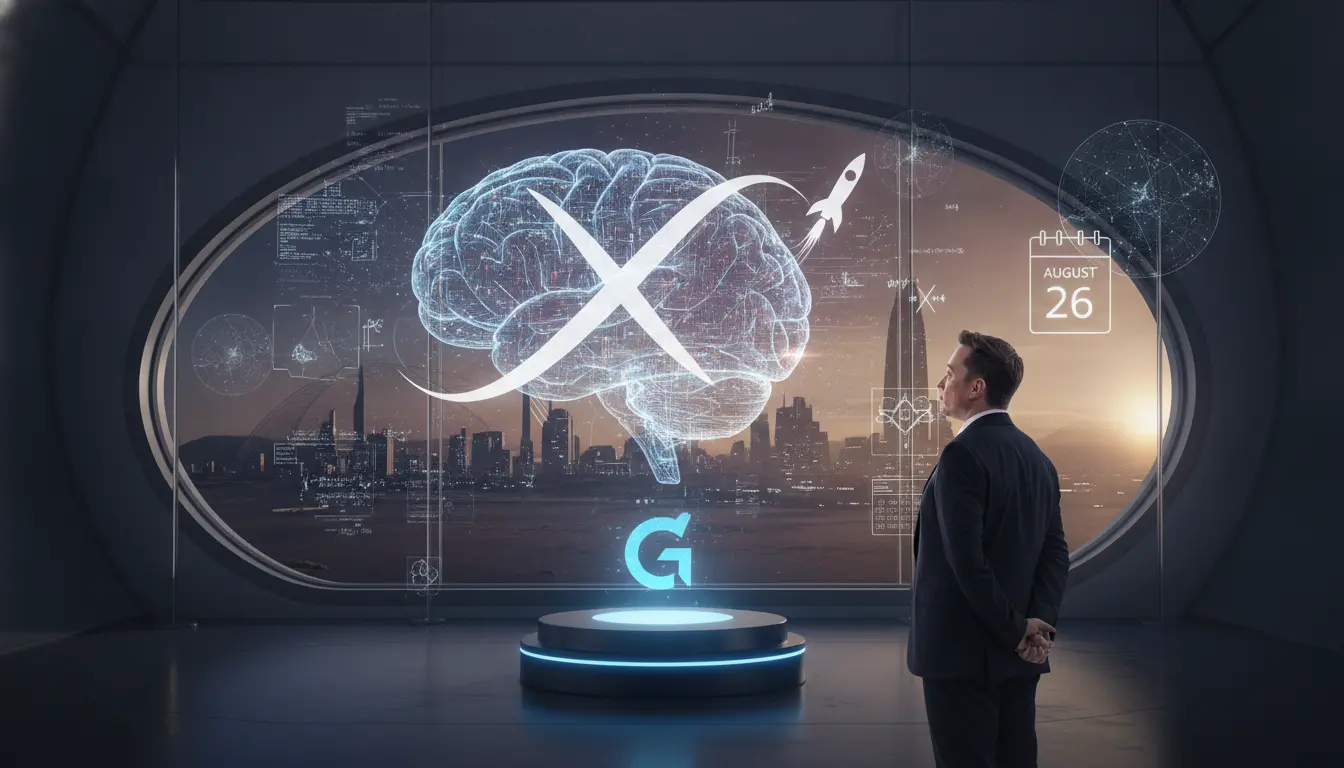
xAI Poised to Launch Next-Generation Grok Model by August 2026, Emphasizing Scientific and Reasoning Capabilities
xAI, the artificial intelligence venture spearheaded by Elon Musk, is reportedly targeting an August 2026 release for a significantly upgraded version of its Grok large language model. This next-generation AI is anticipated to feature substantially enhanced reasoning capabilities and could potentially be specialized for advanced scientific applications, marking a critical step in the company's ambitious quest to develop artificial general intelligence.
The expected launch underscores the relentless pace of innovation in the burgeoning AI sector, where companies are locked in a fierce race to deliver more capable and versatile models. xAI, founded in 2023 with a mission to "understand the true nature of the universe," has positioned itself as a challenger to established players like OpenAI, Google, and Anthropic. Its initial Grok model, known for its real-time knowledge access via X (formerly Twitter) and a distinct, sometimes irreverent, personality, has already garnered attention. However, the proposed enhancements suggest a pivot towards more fundamental AI challenges, moving beyond conversational novelty to tackle complex cognitive tasks and potentially accelerate scientific discovery.
Developing "enhanced reasoning capabilities" in an AI model represents a monumental technical hurdle. Current large language models often excel at pattern recognition, language generation, and information retrieval but can struggle with multi-step logical deduction, abstract problem-solving, and tasks requiring deep causal understanding. A Grok model that genuinely improves upon these limitations could unlock new frontiers for AI applications, making it more reliable for critical decision-making support and complex analytical tasks. Simultaneously, specialization for "scientific applications" hints at an AI system designed not just to process scientific literature but to assist in hypothesis generation, experimental design, data analysis, and even the discovery of new materials, drugs, or theoretical frameworks. Such a tool could dramatically shorten research cycles and democratize access to advanced scientific inquiry.
Elon Musk has often voiced concerns about AI safety and the potential for superintelligence, while also emphasizing the need for a benevolent AGI. xAI's strategy, therefore, is not merely about building powerful AI but also about shaping its trajectory. The aggressive timeline for the new Grok model's release indicates a commitment to rapid iteration and a belief that xAI can quickly close any perceived gap with its competitors. The competition is formidable, with OpenAI continuously refining its GPT series, Google advancing Gemini, and Anthropic pushing the boundaries with Claude, all striving for superior performance across diverse benchmarks and real-world utility. Each successive model release from these tech giants demonstrates incremental but significant progress in areas like multimodal understanding, context window length, and reasoning.
The investment required for such a sophisticated model is immense, encompassing vast computational resources, access to diverse and high-quality training data, and a top-tier team of AI researchers and engineers. The technical challenges involved in scaling models while maintaining control over their behavior and ensuring safety are paramount. Furthermore, the ethical implications of highly reasoning and scientifically capable AI systems, including potential biases, misuse, and the impact on human employment and societal structures, will undoubtedly remain a central point of discussion as xAI and its peers continue their developmental race. Should xAI succeed in delivering on these ambitious goals by August 2026, it would not only solidify its position as a major AI innovator but also potentially accelerate the broader industry's pursuit of truly intelligent machines.
The implications for various sectors are profound. In research, a Grok model specialized for science could revolutionize fields from medicine to astrophysics, assisting in breakthroughs previously unimaginable. In business, enhanced reasoning could lead to more sophisticated analytics, automated complex problem-solving, and superior strategic insights. The competitive landscape for AI is set to intensify further, with each major release acting as a benchmark for the industry's collective progress toward more capable and transformative artificial intelligence systems. xAI’s planned release is thus more than just an upgrade; it’s a declaration of intent to push the boundaries of what AI can achieve on a global scale.
Stay Informed. Act Smarter.
Get weekly highlights, major headlines, and expert insights — then put your knowledge to work in our live prediction markets.
Related News
xAI Eyes Major AI Leap with Grok 5, Emphasizing Enhanced Reasoning and Factual Accuracy

xAI Aims for Grok 5 Full API Rollout by September 2026, Signaling Major AGI Push
xAI Reportedly Developing Grok 5, a Massive 6 Trillion Parameter AI Model, for Public Access

Anthropic Poised to Unveil Major Claude Successor by 2026, Promising Advanced Reasoning and Multimodality

Anthropic Sets October 2026 for Major AI Model Update, Industry Eyes Potential Claude 6 Debut

Industry Eyes 'Claude 5' as Anthropic's Next Major Leap in AI Reasoning and Scale

Anthropic Poised to Unveil Next-Generation Claude Model with Enhanced Reasoning Capabilities

Anthropic Eyes Landmark 2026 IPO as Industry Buzzes Over Potential $2 Trillion Valuation

Anthropic Reportedly Developing Claude Successor with Massive 1 Million Token Context Window for 2026 Debut

AI Giants Anthropic and OpenAI Chart Parallel Paths to Public Markets, Setting Stage for Landmark Tech IPO Race