PoliticsdiplomacyBilateral Relations
South Korean President Lee visits China with large business delegation.
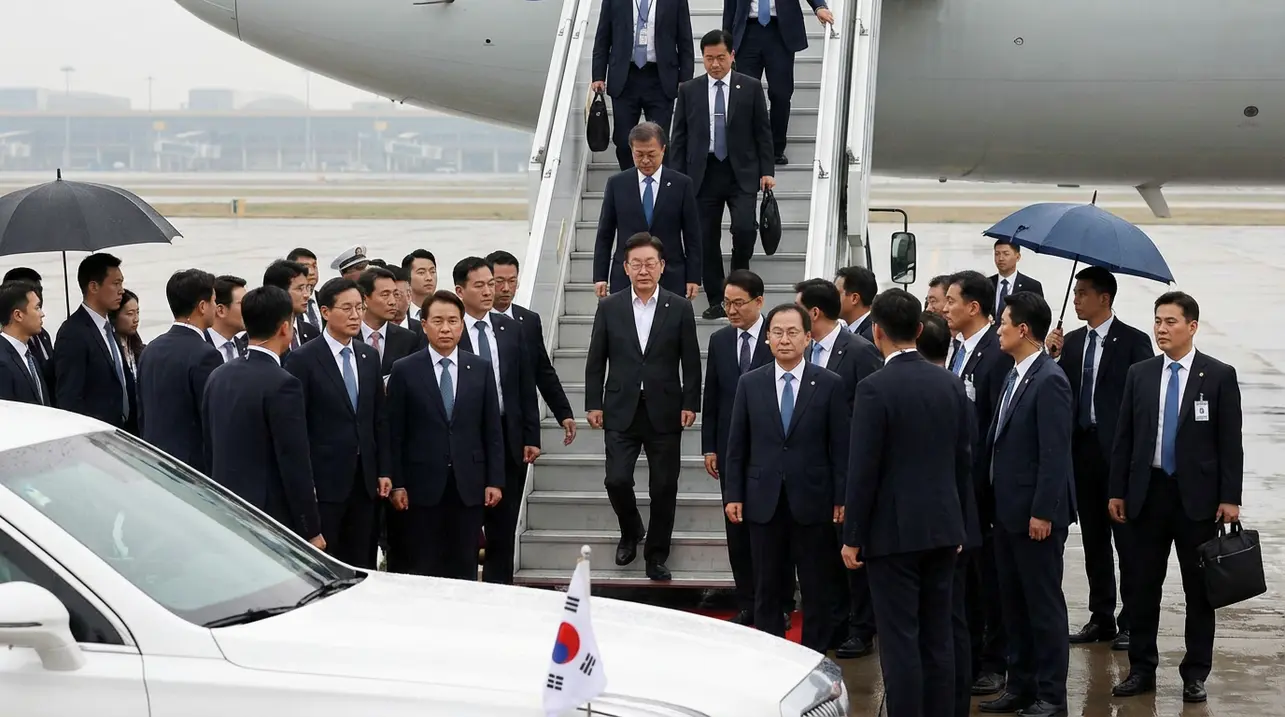
President Lee Jae-myung of South Korea, a linchpin U. S.ally in the increasingly tense theater of East Asia, touched down in Beijing at noon on Sunday, marking a significant diplomatic pivot with his first state visit to China since his inauguration. This four-day mission, unfolding against a backdrop of a global order in profound flux—where old alliances are stress-tested and new power dynamics remain unsettlingly opaque—is far more than a ceremonial tour.Accompanying Lee is a formidable delegation of over 200 South Korean business titans, including the chairmen of the chaebol giants Samsung and SK Group, a move that underscores the high-stakes economic diplomacy at play. The itinerary, split between the political heart of Beijing and the financial engine of Shanghai, signals a dual-track approach: reaffirming strategic dialogue while aggressively pursuing commercial partnerships.This visit arrives at a critical juncture, with Seoul navigating a precarious tightrope between its deep-seated security alliance with Washington and its undeniable, massive economic interdependence with Beijing. The historical precedent is telling; such balancing acts recall the diplomatic maneuvers of mid-sized powers during the Cold War, forced to chart a course between superpowers.Analysts will be scrutinizing every handshake and joint statement for shifts in tone, particularly regarding thorny issues like Taiwan, North Korea’s provocations, and U. S.-led semiconductor export controls that have directly impacted South Korean firms. The presence of the business elite is a clear signal to Beijing that Seoul is serious about decoupling economic engagement from geopolitical friction, yet it also serves as a subtle reminder of South Korea’s leverage as a technological powerhouse.Expert commentary suggests that while a major strategic realignment is unlikely, Lee’s trip could pave the way for a more stable, predictable framework for managing the inherent contradictions in the ROK-PRC relationship. The consequences are manifold: a successful visit could insulate bilateral trade from wider geopolitical storms and potentially open avenues for quiet diplomacy on the North Korean nuclear dossier.Conversely, perceived overtures that alarm Washington could strain the very security umbrella that has underpinned South Korea’s remarkable economic ascent. As Churchill might have observed, this is not the beginning of the end, but perhaps the end of the beginning of a new, more complex phase in Northeast Asian geopolitics, where economic statecraft and hard security concerns are irrevocably intertwined.
#South Korea
#China
#Lee Jae-myung
#diplomatic visit
#trade delegation
#US ally
#East Asia
#featured