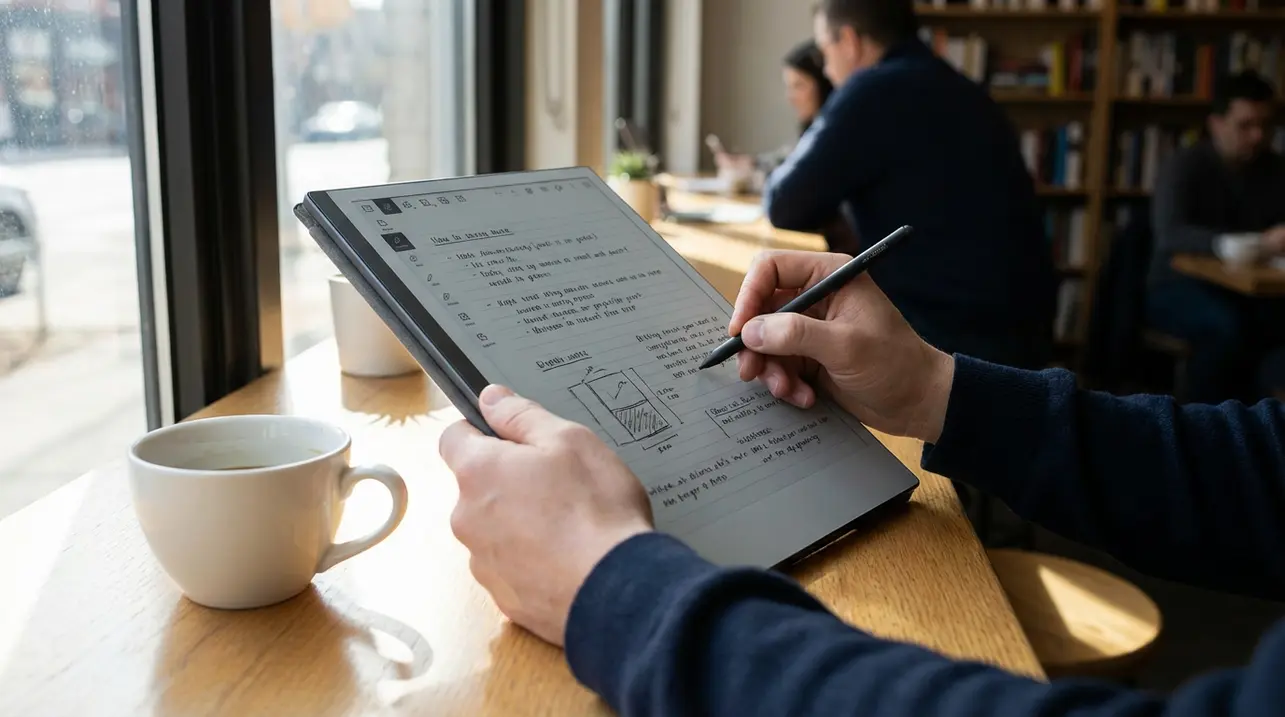
TCL Launches Digital Notebook Like a Smoother Kindle Scribe
AN
6 hours ago7 min read
The tech world’s quiet obsession with digital paper just got a fascinating new chapter. TCL, a name you probably associate more with aggressively priced televisions than with the serene world of E Ink, has thrown its hat into the ring with a new digital notebook that’s being pitched as a smoother, more responsive alternative to the established heavyweight, the Kindle Scribe.It’s a move that feels both surprising and utterly logical when you think about it. On one hand, the e-note market has long been dominated by a few key players like Amazon, Remarkable, and Kobo, each carving out a niche with varying degrees of success in marrying the distraction-free comfort of E Ink with the utility of a digital notepad.On the other, TCL has been quietly building a portfolio of display technologies across every screen in our lives, from phones to tablets to those giant QLEDs in your living room. Their entry feels less like a random pivot and more like a company looking at the convergence of screens and asking, 'Where’s the friction?' Their answer, apparently, lies in the lag.The promise here isn't just another slate; it's the 'comfort of E Ink with the speed of an iPad,' a tagline that cuts right to the heart of what has held back wider adoption of these devices for more dynamic tasks like sketching or rapid note-taking. For years, the trade-off was clear: you chose E Ink for its paper-like, eye-friendly readability and epic battery life, but you accepted a certain ghosting and sluggishness in pen response.It was a medium for contemplation, not creation. TCL seems to be betting that they can bridge that gap, leveraging their panel expertise to refine the refresh rates and latency to a point where the digital pen feels nearly as immediate as a graphite one on actual paper.This isn't just a minor spec bump; it's an attempt to redefine the category's potential user base. Imagine students who no longer have to choose between a tablet for interactive textbooks and a separate e-note for scribbling lectures.Or professionals who can mark up a PDF, sketch a wireframe, and then seamlessly review it all without the jarring switch between a glossy, eye-straining LCD and a serene, but slow, E Ink display. The implications ripple out into discussions about digital minimalism and productivity.The 'second screen' phenomenon—using a tablet or phone alongside a laptop—is well-documented, but often that second screen is just another source of notifications and dopamine hits. A truly fast, responsive E Ink device could become the *productive* second screen, the dedicated space for deep work that the Light Phone promised for communication, but for writing and thinking.
#TCL
#digital notebook
#E Ink
#Kindle Scribe
#iPad
#tablet
#tech launch
#featured
Stay Informed. Act Smarter.
Get weekly highlights, major headlines, and expert insights — then put your knowledge to work in our live prediction markets.
Of course, the devil is in the details, and TCL faces a steep climb. Amazon’s Kindle ecosystem is a behemoth, with seamless integration into the world’s largest book and document store.
Remarkable has cultivated a fiercely loyal following with its hyper-focused, subscription-tinged software experience that mimics a physical notebook down to the leather folio. TCL’s success won't hinge on hardware specs alone; it will live or die by its software.
Will it run a forked version of Android, opening itself up to a universe of apps but potentially compromising the simplicity that draws people to these devices? Or will it build a walled garden, hoping its superior pen performance is enough to lure users away from established ecosystems? Then there's the question of content. Without a robust native bookstore or a compelling partnership for document syncing and conversion, it risks becoming a beautiful, fast brick.
The history of tech is littered with superior hardware that failed because the software experience was an afterthought. Furthermore, we must consider the broader context of the display technology arms race.
While TCL works to make E Ink faster, companies like Apple and Samsung continue to push the boundaries of LCD and OLED with ever-higher refresh rates and advanced stylus technologies. The goalposts are moving in both fields.
The real innovation might eventually come from a hybrid approach, or from a new display technology altogether that finally delivers the best of both worlds without compromise. For now, TCL’s move is a welcome injection of competition.
It signals that the digital notebook space is maturing beyond a niche for early adopters and bibliophiles into a legitimate segment of the computing landscape. It pushes incumbents to innovate on latency and software.
And for consumers, it offers more choice—the fundamental engine of progress. Whether TCL’s notebook will be the device that finally makes the digital paper dream feel complete, or just another interesting footnote in the evolution of how we write and read, is a story whose next pages are yet to be written. But the very fact that a major consumer electronics player is investing here suggests the chapter on E Ink is far from over; it might just be getting to the good part.