SciencebiologyEvolution and Ecology
The Symphony of the Land: Aldo Leopold's Call for Ecological Listening
RA15 hours ago7 min read1 comments
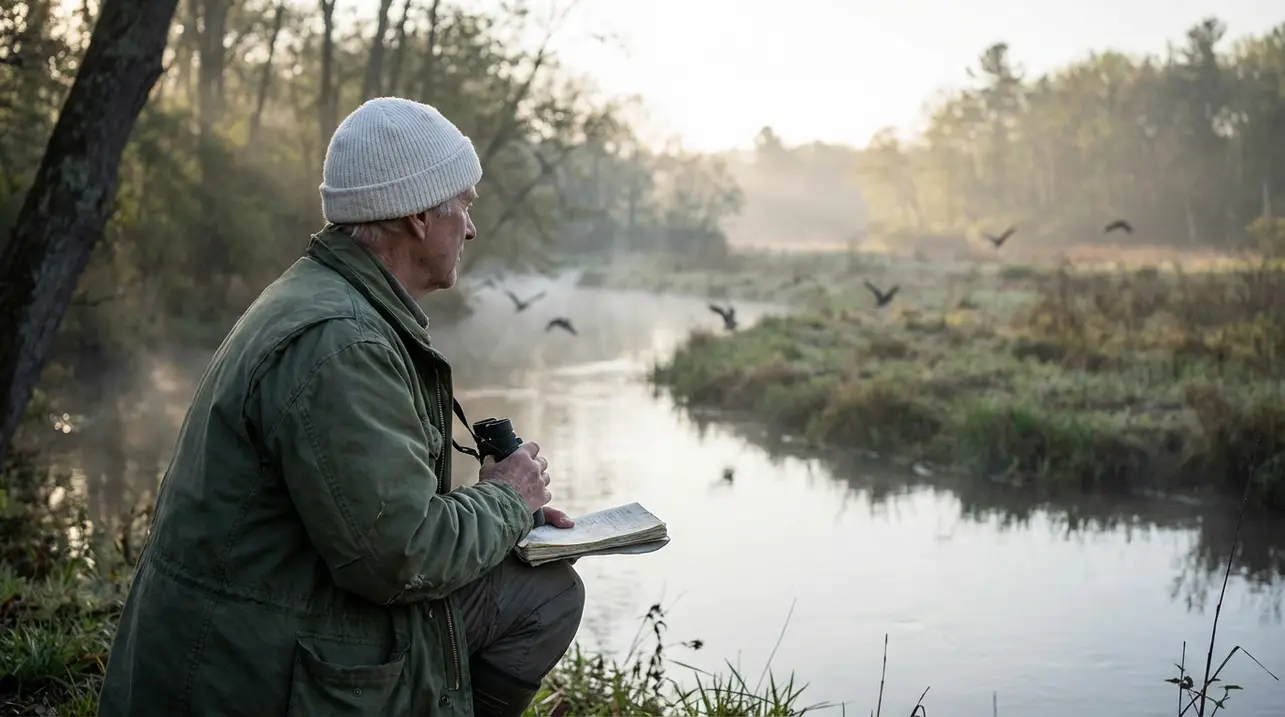
The goal is to perceive the totality—what Virginia Woolf termed 'the thing itself. ' It is not enough to catalog fragments and decipher their mechanics; we must grasp their harmonic unity.This sum, as the overlooked genius Willard Gibbs understood, is 'simpler than its parts'—more elegant and profound. It is the transformation of countless complex chords from a vast orchestra into a single, transcendent symphony.This is the essential wisdom of philosopher, naturalist, and conservation pioneer Aldo Leopold, whose work along the Rio Grande provides a masterclass in deep, holistic perception. More than articulating a land ethic, Leopold taught a methodology for sensing—a way to attune ourselves to the intricate web of life that fragmented modern science often obscures.His Rio Grande essay is a meditation on this very practice of attention, urging us to move beyond tallying species or gauging river flows to hearing the land's true composition: a song woven from interdependent relationships, climate rhythms, and evolutionary history. In our age of catastrophic biodiversity loss and climate upheaval, Leopold's plea has never been more urgent.We possess unprecedented data on ecosystem components—satellite surveillance of forests, genetic blueprints of species, instant pollution metrics—yet we remain deaf to the symphonic whole. The result is policy that safeguards a single charismatic animal while its habitat disintegrates, or reforestation that ignores the vital soil microbiome.To hear life's song, as Leopold implored, demands a radical pivot from reductionism to holism, rooted in patient, place-based observation. It means recognizing that a river's vitality involves more than water chemistry; it depends on the cottonwood roots fortifying its banks, the beaver-engineered wetlands, the migratory birds tracing its corridor, and the cultural practices of human communities within its floodplain.This integrative vision, which resonates with Indigenous knowledge systems globally, is our strongest hope for forging resilient solutions to environmental crises. It forces us to ask not merely 'what is here?' but 'how does this all function together?' The beauty Leopold discerned in that unified complexity is not just aesthetic; it is the core indicator of a healthy, functioning planet.As we confront a future of growing ecological instability, relearning how to listen—to truly hear the living world's symphony in all its interdependent glory—may be the most crucial skill we can cultivate. It is the path from merely exploiting nature to finally understanding our place within it.
#Aldo Leopold
#conservation
#ecology
#philosophy
#nature writing
#environmentalism
#featured