SciencebiologyEvolution and Ecology
Cultivating an Ecological Conscience: Aldo Leopold's Guide to Hearing the Song of Life
RA9 hours ago7 min read2 comments
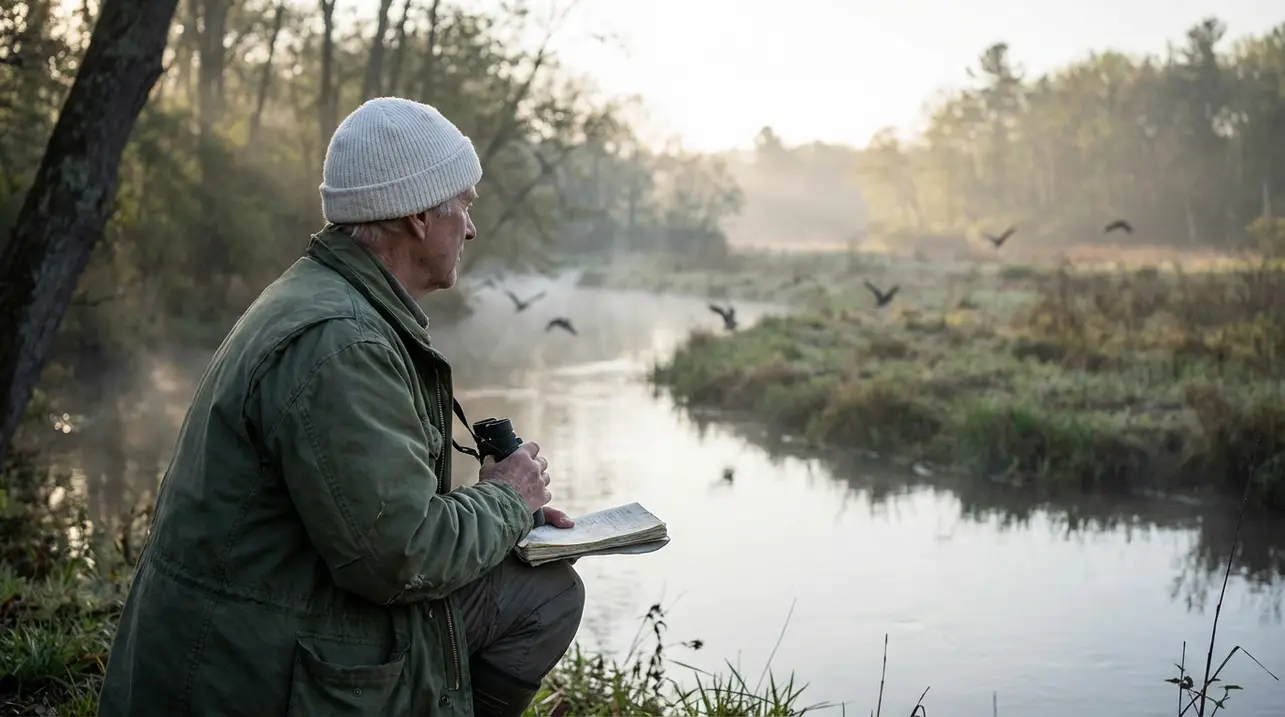
The goal is to perceive the whole—what Virginia Woolf termed 'the thing itself. ' It is not merely to analyze the fragments but to comprehend their harmonic unity—the sum that, as physicist Willard Gibbs observed, is 'simpler than its parts.' This unity is more beautiful, akin to the way countless complex chords from a vast orchestra resolve into a single, transcendent symphony. The philosopher, naturalist, and conservation pioneer Aldo Leopold explored this imperative in a prescient essay on the Rio Grande, a work that grows more urgent with each season of climate disruption and biodiversity loss.Leopold (1887–1948) was not simply describing a river; he was instructing us in how to listen to the land's symphony—a skill we are in danger of losing entirely. His legacy, crystallized in the seminal 'A Sand County Almanac,' established the foundation for a modern land ethic, positing that humans are not conquerors of the land-community but 'plain members and citizens of it.' This fundamental shift—from viewing nature as a commodity to recognizing it as a community—is the essential leap required to hear the song of life. For Leopold, a river was never just H2O flowing downhill.It was a narrative of geological time, a habitat for cottonwood roots and cutthroat trout, a sculptor of canyons, and a sustainer of human cultures along its banks. He practiced a deep, patient observation—a science infused with reverence—understanding that the flash of a kingfisher or the pattern of silt after a flood were each verses in a vast, living epic.Today, as satellite imagery maps deforestation and IPCC reports chart a perilous course, Leopold's call for an ecological conscience is not a nostalgic reverie; it is a survival manual. The 'harmonic unity' he championed is under siege from fragmented policies, industrial agriculture that treats soil as inert substrate, and an economic system that externalizes the cost of collapse.When we dam a river for hydropower, we silence the movement of fish and disrupt the nutrient cycles that sustain floodplains; we replace a complex, self-sustaining melody with a single, monotonous note of energy output. The tragedy, as Leopold foresaw, is that we often do not miss the song until the silence becomes deafening.He wrote of 'thinking like a mountain'—understanding the slow, interconnected feedback loops where the wolf's howl influences the deer herd, which shapes the forest, which in turn holds the mountain's soil. To hear the song is to perceive these relationships, to see that the health of the Rio Grande is tied to the Rocky Mountain snowpack, the water rights of Pueblo communities, and the migratory paths of sandhill cranes.
#Aldo Leopold
#conservation
#ecology
#philosophy
#nature writing
#environmentalism
#featured