SciencebiologyEvolution and Ecology
Cultivating an Ecological Conscience: Aldo Leopold's Call to Hear the Music of the Land
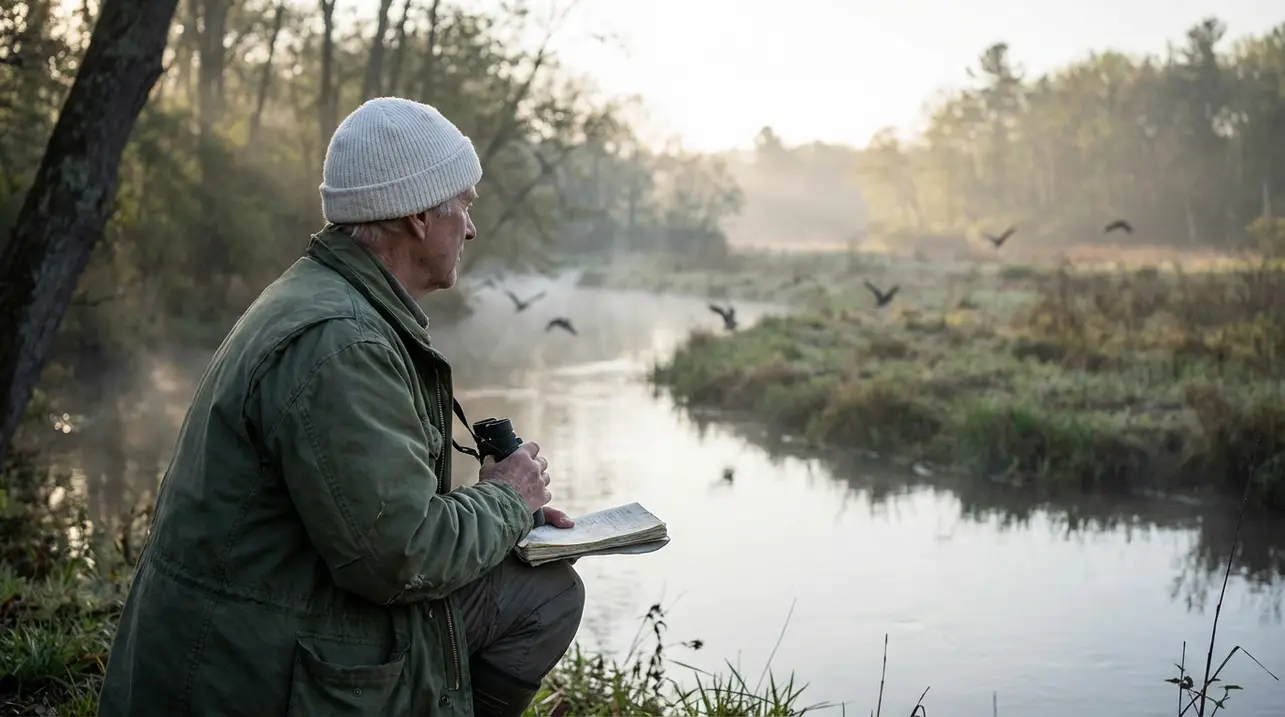
To perceive the natural world in its full majesty requires seeing the whole—what Virginia Woolf termed ‘the thing itself. ’ It is an understanding that the harmonic unity of a system, as scientific visionary Willard Gibbs observed, is often ‘simpler than its parts,’ transforming a cacophony of individual elements into a transcendent symphony.This holistic vision lies at the heart of the work by philosopher, naturalist, and conservation pioneer Aldo Leopold, whose writing on the Rio Gavilan resonates with profound urgency in our current ecological moment. Born in 1887, Leopold chronicled humanity's necessary evolution from viewing land as a commodity to be conquered to recognizing it as a community to which we belong.His posthumously published masterpiece, *A Sand County Almanac* (1949), established the modern environmental ethic, introducing a revolutionary 'land ethic' that expands our moral consideration to include soils, waters, plants, and animals. Hearing the song of life, as Leopold implores, demands moving beyond cold scientific dissection into a realm of emotional and ecological literacy.It is to perceive a river not merely as a hydrological system, but as a living entity with a history etched in its banks, a character forged by drought and flood, and a future bound to the health of its entire watershed. This integrated perspective stands in stark opposition to the reductionist thinking that fueled the Dust Bowl of Leopold's era and continues to drive today's biodiversity crisis.Modern voices, like botanist and Citizen Potawatomi Nation member Robin Wall Kimmerer, amplify this call, braiding Indigenous traditional knowledge with Western science to remind us that the more-than-human world holds our oldest lessons. The data underscores the silence we risk: the World Wildlife Fund's 2022 Living Planet Report documents an average 69% plummet in global wildlife populations since 1970.Yet, Leopold suggests the remedy is not simply more data, but a fundamental recalibration of our perception. It is the practice of sitting quietly by a stream until you no longer see just 'water,' but witness the water strider's delicate dance, the heron's patient hunt, and the alder leaves returning their nutrients to the cycle of life.This is not romantic escapism; it is the foundational work of conservation. As the climate crisis accelerates, comprehending these complex, harmonic relationships is essential for crafting resilient solutions.Policies built on fragmentation—preserving a single species while destroying its habitat—are destined to fail. Leopold’s enduring legacy is thus a challenge: to cultivate an 'ecological conscience.
#Aldo Leopold
#conservation
#ecology
#philosophy of science
#environmentalism
#nature writing
#featured