SciencebiologyEvolution and Ecology
Hearing the Earth's Symphony: Aldo Leopold's Timeless Call for Ecological Listening
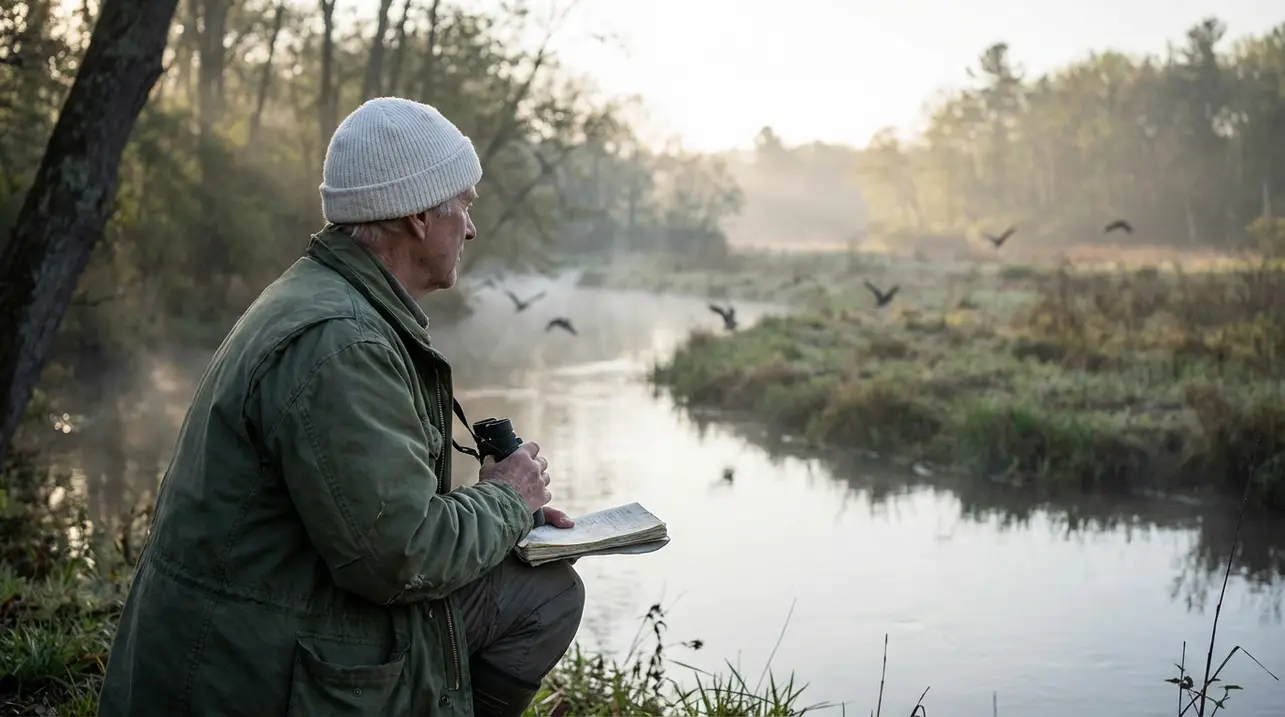
The ultimate aim is to perceive the totality—what Virginia Woolf termed 'the thing itself. ' It is a move beyond cataloging fragments to grasping their harmonic unity, a sum that, as physicist Willard Gibbs observed, can be 'simpler than its parts.' This unity is akin to the transcendent beauty of a symphony emerging from countless complex chords played by a vast orchestra. At the heart of this profound quest for wholeness lies the enduring legacy of Aldo Leopold, a legacy growing more urgent with each new climate report and extinction notice.The philosopher-naturalist and architect of the 'Land Ethic' addresses this directly in a seminal essay on the Rio Grande, urging a shift from mere inventory to deep, resonant listening. For Leopold (1887-1948), the river was not a mere hydrological feature but a living narrative—a song composed of silt, cottonwoods, fish, and the human communities within its floodplain.His perspective emerged from a transformative personal journey, from a forest service agent who viewed predators as vermin to a sage who understood that killing a wolf meant unraveling the very tapestry of the mountain. This evolution mirrored a scientific awakening: the shift from reductionism to systems thinking, where ecology revealed the biotic community as a web of relationships, not a collection of parts.To hear life's song, Leopold argued, requires cultivating an 'ecological conscience'—a moral responsibility extending our community to include soils, waters, plants, and animals. It is a practice demanding patience and a quieted ego, a willingness to sit on a riverbank not as a conqueror but as 'a plain member and citizen of the land.' Today, in an age of satellite surveillance and big data, we possess more fragments than ever—genome sequences, migration tracks, carbon readings—yet we often lack the wisdom to hear the symphony they form. The cost of this deafness is evident in bleaching coral reefs, silent springs, and homogenized landscapes where monocultures supplant complex ecosystems.Contemporary voices, like botanist Robin Wall Kimmerer, echo Leopold's call, blending Indigenous wisdom with science to assert that true understanding springs from reciprocal relationship, not just data extraction. The consequence of failing to develop this auditory sense is a continued management of symptoms—a declining species here, a polluted watershed there—while the systemic illness worsens.Conversely, Leopold's insight offers a path of hope: by learning to hear the song, we can begin to compose a new harmony. This means designing conservation as connected corridors, not isolated parks; valuing wetlands for their flood mitigation and carbon sequestration as much as their beauty; and recognizing human economies as dependent subunits of the broader ecological economy.
#Aldo Leopold
#conservation
#ecology
#philosophy
#nature
#environmentalism
#featured