SciencearchaeologyExcavations and Discoveries
New fossil reveals ancient migration corridor across Pangaea's equator.
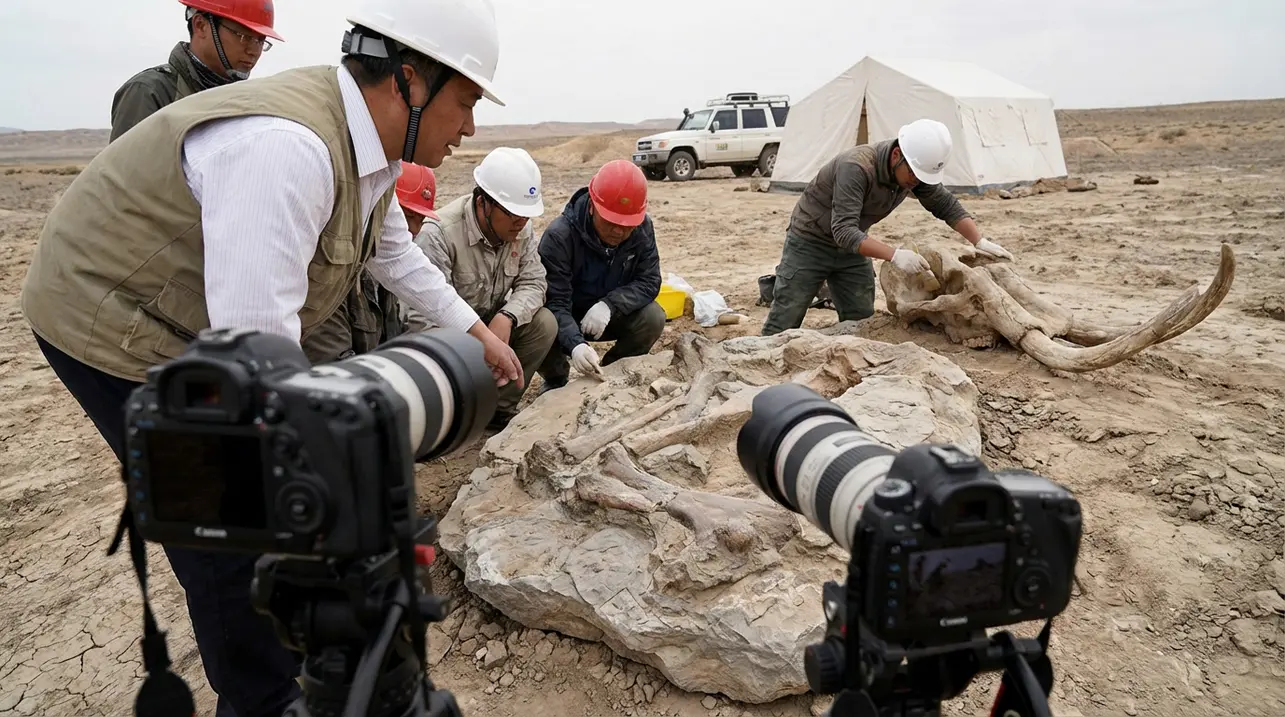
In a discovery that dramatically redraws the ancient map of life, scientists in China have unearthed fossils of a new mammal-like reptile species in Gansu province, a find that carries a profound geographical punch: it’s the first of its genus to be identified in both South Africa and China. This isn't just about adding another name to the prehistoric roster; it’s a revelation about movement on a planetary scale.The finding, centered on a new species of dicynodont—an extinct clade of non-mammalian therapsids often considered a distant cousin to mammals—suggests that during the Late Permian period, roughly 299 to 252 million years ago, large tetrapods were crossing the equatorial heart of the supercontinent Pangaea far more frequently than our previous models allowed. Think of it not as a rare, desperate trek, but as a viable, sustained migration.This points to the existence of a stable ecological corridor, a kind of prehistoric superhighway, capable of supporting the movement of sizable animals across what was long presumed to be a formidable climatic barrier. For decades, paleontologists have wrestled with the distribution patterns of Permian fauna, often finding identical or closely related species separated by vast distances.The prevailing theory suggested that the harsh, arid conditions believed to dominate Pangaea's equatorial region acted as a near-impassable filter, limiting faunal exchange between the northern and southern supercontinents of Laurasia and Gondwana. This new fossil evidence, however, forces a major recalibration.It implies that the equatorial zone wasn't a monolithic desert wasteland but likely hosted a mosaic of habitats—perhaps river systems, floodplains, or more temperate pockets—that could sustain herbivores like dicynodonts and, by extension, the predators that followed them. The implications are cosmic in their own right, reshaping our understanding of biogeography on a unified landmass.It challenges climate models of the Permian and suggests that animal dispersal was a more dynamic and continuous process. This corridor would have been a conduit not just for bodies, but for genes, behaviors, and evolutionary pressures, subtly steering the course of life's development during a critical era just before the planet's most devastating mass extinction.Experts like Dr. Liu, a lead researcher on the Chinese team, compare it to finding evidence of a forgotten intercontinental bridge; it changes how we narrate the story of pre-dinosaur ecosystems.The migration of these robust, often tusked creatures across thousands of miles indicates a surprising level of resilience and adaptability. Furthermore, this discovery adds a crucial piece to the puzzle of how certain therapisd lineages survived and eventually gave rise to mammals, by showing they had a much larger and more connected playground than we thought.
#fossil discovery
#dicynodont
#Pangaea
#migration corridor
#paleontology
#China
#Gansu
#featured