SciencephysicsOptics and Photonics
Less than a trillionth of a second: Ultrafast UV light could transform communications and imaging
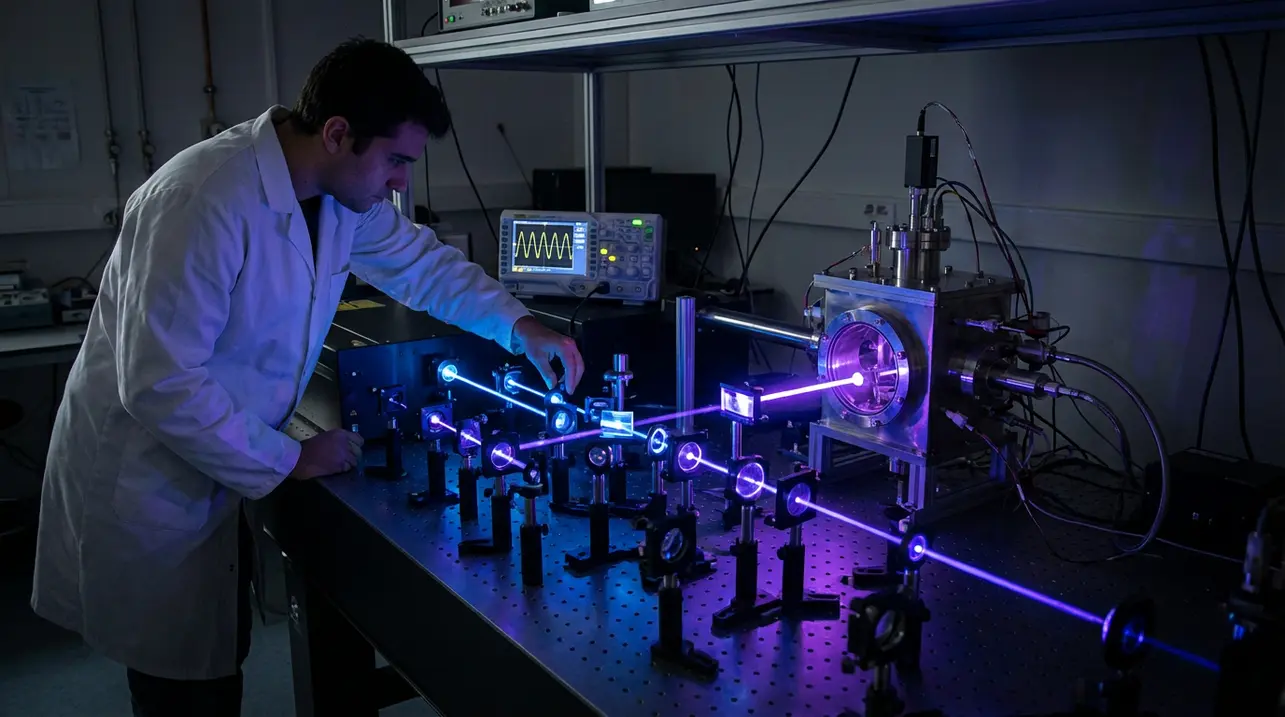
In a development that feels ripped from the pages of a near-future sci-fi novel, a team of researchers has just cracked open a new frontier in photonics. They’ve engineered a platform capable of both generating and detecting ultrashort pulses of ultraviolet-C light at room temperature, a feat that could fundamentally reshape everything from secure communications to medical imaging.The core of the breakthrough lies in the marriage of two cutting-edge components: a system that produces laser flashes lasting mere femtoseconds—that’s less than a trillionth of a second, a timescale so brief it makes a nanosecond feel like an eternity—and a sensor built from atomically thin, two-dimensional materials that can actually capture these fleeting bursts. This isn't just an incremental lab curiosity; it's a holistic engineering leap.The generation side achieves efficient, controlled production of these UV-C pulses, while the detection side leverages materials like graphene or transition metal dichalcogenides, which offer extraordinary sensitivity and speed without the cryogenic cooling typically required for such precise photon counting. The implications are staggering.In communications, this technology could enable the transmission of massively encoded data streams through open space using light that’s inherently difficult to intercept or jam, offering a potential backbone for a quantum-secure internet. In biomedical imaging, femtosecond UV pulses could allow scientists to capture hyper-fast biological processes, like protein folding or cellular responses to drugs, in real-time, with unprecedented clarity.Furthermore, the scalability of the sensor materials points toward a future where these systems aren't confined to research labs but can be manufactured for widespread use, accelerating the entire field of ultrafast photonics. To understand the magnitude, consider the historical context: the journey from the first ruby laser to today's femtosecond Ti:sapphire systems took decades, each leap shrinking pulse durations and expanding applications into new spectral ranges.Breaking into the deep UV with such short pulses at room temperature has been a persistent 'holy grail' challenge, hampered by material limitations and detection inefficiencies. This new platform directly tackles those bottlenecks.Experts in ultrafast spectroscopy suggest this could democratize access to UV-C pulse experiments, much like the commercialization of fiber lasers did for infrared photonics, sparking innovation across chemistry, physics, and materials science. There are, of course, hurdles ahead—optimizing power output, integrating the components into compact, robust devices, and navigating the path from prototype to product.
#ultrafast lasers
#UV-C light
#femtosecond pulses
#photonic technologies
#room-temperature detection
#atom-thin materials
#lead focus news