Sciencespace & astronomyBlack Holes and Galaxies
Art and science converge in book on black hole art.
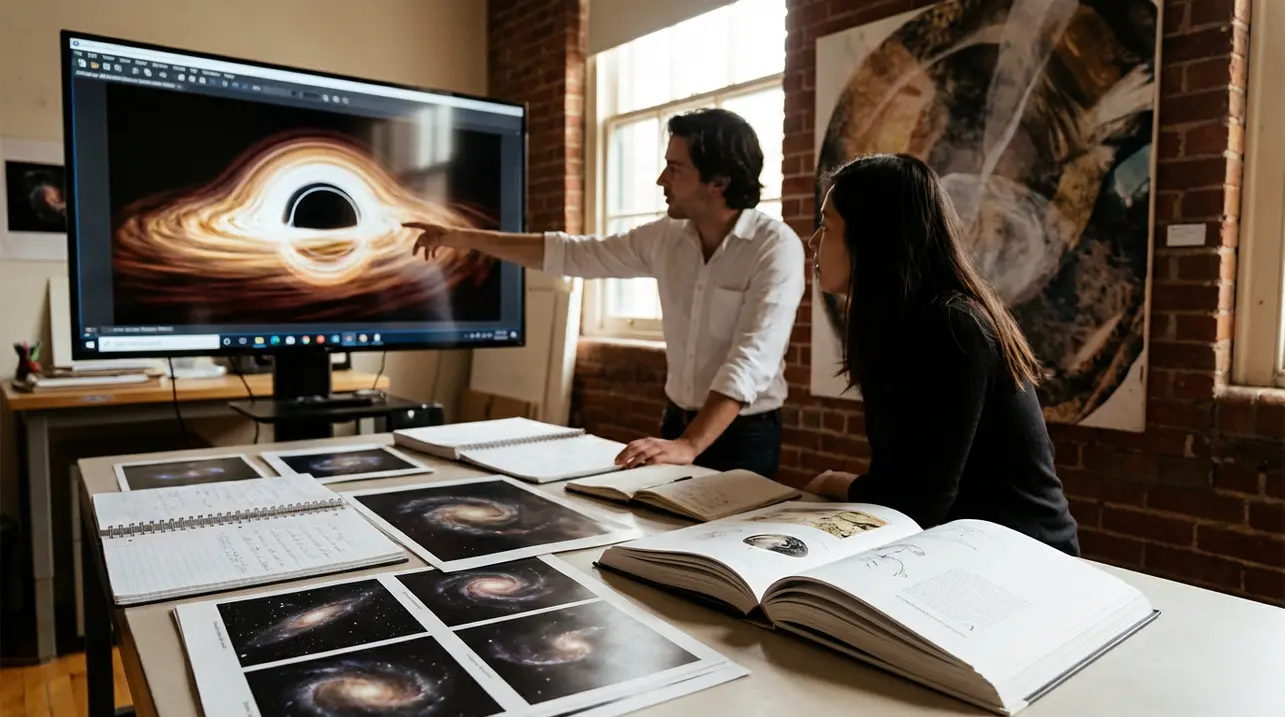
In the vast, silent theater of the cosmos, where the laws of physics perform their most extreme acts, a new production has taken the stage, and it’s not from a research lab but from the realm of human creativity. Lynn Gamwell’s compelling new volume, *Conjuring the Void: The Art of Black Holes*, represents a fascinating and necessary convergence of disciplines, pulling the most enigmatic objects in the universe from the pages of astrophysics journals and into the vivid, interpretive world of visual art.For too long, black holes have been the domain of mathematicians and theoretical physicists, described by crushing equations and rendered as sterile, computer-generated simulations of accretion disks and photon spheres. Gamwell’s work shatters that monologue, initiating a rich dialogue where artists, armed with intuition and pigment, grapple with concepts like spacetime curvature, gravitational lensing, and the sheer, unimaginable nothingness of the event horizon.This isn't merely illustration; it's a profound act of translation, taking the cosmic data beamed back from instruments like the Event Horizon Telescope—which captured the now-iconic image of M87*’s shadow—and filtering it through the human psyche’s capacity for wonder and terror. The historical precedent for this fusion is rich, from Leonardo da Vinci’s anatomical sketches driven by insatiable curiosity to the surrealists who painted dreamscapes that echoed the non-Euclidean geometries later described by Einstein.Today’s artists, featured in Gamwell’s survey, employ digital tools, immersive installations, and traditional media to visualize what equations imply: the warping of light into perfect rings, the spaghettification of matter, and the eerie silence at the point of infinite density. Experts like Dr.Priyamvada Natarajan, a theoretical astrophysicist at Yale, have long argued that such artistic engagements are critical, not as decorative afterthoughts, but as exploratory tools that can ask questions pure science hasn't yet formulated. The consequence of this convergence is a democratization of cosmic awe, making the frontiers of theoretical physics accessible and emotionally resonant.It challenges the public to see black holes not as distant monsters but as fundamental features of our universe’s architecture, key to understanding galaxy formation and the very fate of spacetime itself. Furthermore, in an age where private ventures like SpaceX champion a multiplanetary future, this artistic movement re-anchors that ambition in a deeper, more philosophical contemplation of the cosmos we seek to traverse. The narrative woven by *Conjuring the Void* suggests that our journey to the stars will be navigated not just by rocket equations, but by the human imagination’s ability to stare into the abyss and bring back something beautiful, making the incomprehensible void a source of profound inspiration.
#art
#science
#black holes
#book
#Lynn Gamwell
#Conjuring the Void
#visual voyage
#featured