SciencearchaeologyAncient Civilizations
Ancient Egyptian Diplomacy Revealed Through 3,000-Year-Old Clay Tablets
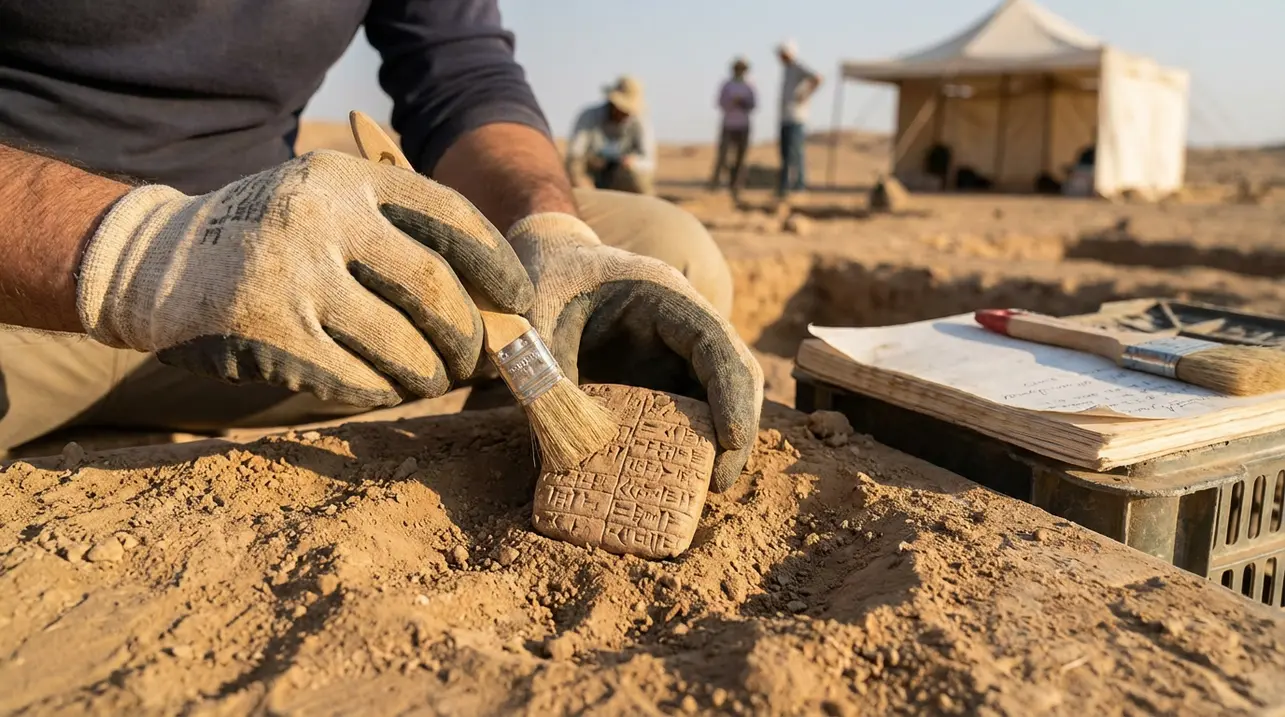
The discovery of the Amarna Letters, a cache of over 300 clay tablets inscribed with cuneiform script, didn't just add another artifact to Egypt's dusty shelves; it fundamentally rewired our understanding of the ancient world's geopolitical landscape. Unearthed in 1887 at the site of Akhetaten, the short-lived capital of the 'heretic' pharaoh Akhenaten, these diplomatic archives span roughly thirty years of the 14th century BCE, revealing a complex web of international relations that connected the Egyptian empire to the great powers of the Near East—Babylonia, Assyria, Mitanni, and the Hittite Empire—as well as a host of smaller vassal states in Canaan.For centuries, the popular imagination painted ancient Egypt as an isolated, monolithic civilization obsessed with its own gods and pyramids, but these tablets, written not in hieroglyphs but in the Akkadian lingua franca of the day, shatter that illusion. They show a superpower deeply enmeshed in a delicate, often fraught, system of gift-exchange, royal marriages, and military alliances, where pharaohs like Amenhotep III and Akhenaten were addressed as 'brother' by foreign kings in correspondence dripping with both flattery and thinly-veiled demands for gold.The letters from vassal rulers are even more revealing, pleading for military support against invaders with a palpable sense of desperation, their appeals sometimes going unanswered as Akhenaten's religious revolution perhaps turned his focus inward. This archive is the LinkedIn of the Late Bronze Age, a testament to a surprisingly globalized world where chariots, precious metals, and skilled artisans were traded as strategic assets, and where diplomatic protocol was as intricate as any modern summit.Scholars like William L. Moran, who spearheaded their translation, have parsed these texts to understand not just statecraft but also the economic pressures, the linguistic nuances, and even the personal rivalries between scribes.The letters expose the fragility of this international system, a 'club of great powers' that maintained a balance through constant communication—a system that would spectacularly collapse in the coming centuries during the broader Bronze Age collapse. Today, as we digitize and re-analyze these fragile tablets with spectral imaging, they continue to yield secrets, reminding us that the drive for connection, alliance, and strategic advantage is a constant across human history, whether the medium is sun-baked clay or a fiber-optic cable. They redefine Egypt not as a solitary sun-king, but as a pivotal node in an ancient network, a player in a game of thrones whose rules we are only now beginning to fully comprehend.
#featured
#Amarna Letters
#clay tablets
#ancient Egypt
#diplomacy
#archaeology
#historical discovery