Catholic Church Beatifies Nearly 200 Martyrs in Spain and France
RO8 hours ago7 min read3 comments
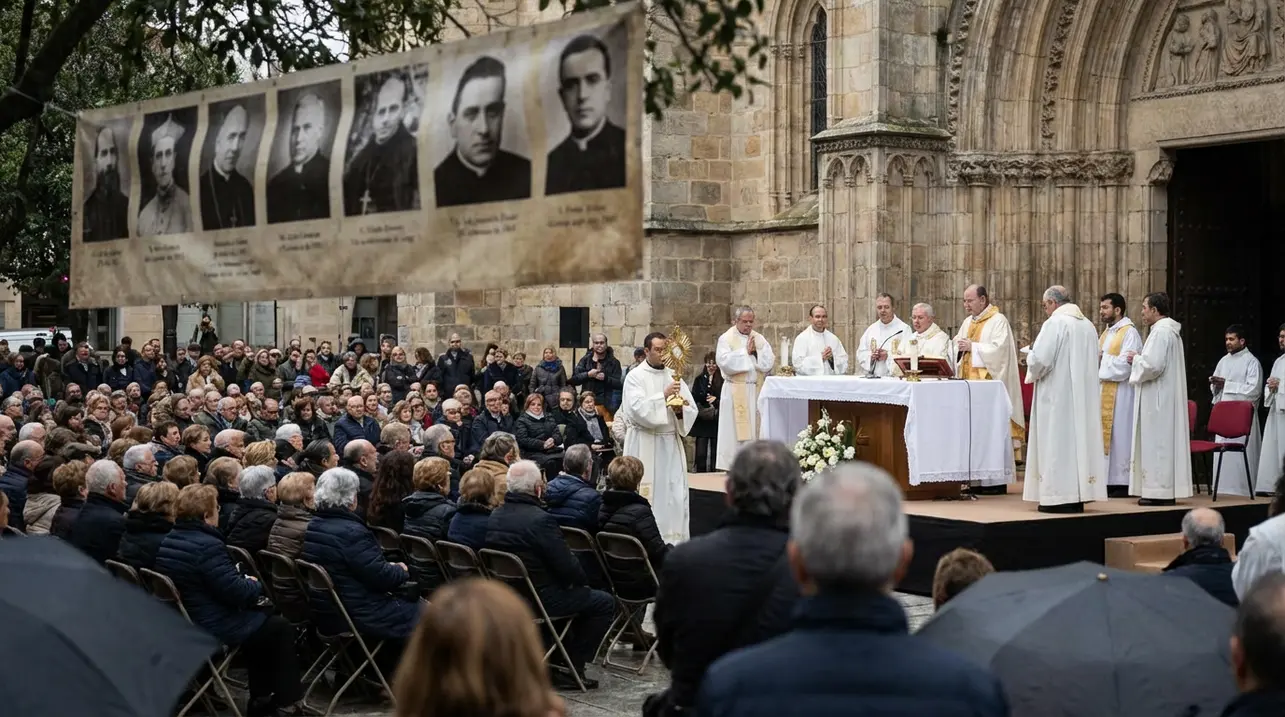
In a solemn ceremony resonant with historical weight, the Catholic Church has beatified nearly two hundred martyrs across Spain and France, a move that underscores the enduring legacy of religious persecution and the complex interplay of faith, memory, and national identity in modern Europe. This single act of beatification, the final step before sainthood, consolidates three distinct groups of individuals who were executed for their faith during the tumultuous and violent Spanish Civil War of the 1930s, a conflict that tore the nation apart along ideological lines and left deep scars that are, in many ways, still being tended to today.The martyrs, comprising priests, nuns, and lay faithful, were predominantly targeted by anti-clerical factions of the Republican side, their deaths emblematic of a broader campaign against the Church, which was seen by many revolutionaries as an arm of the oppressive, monarchist establishment. To understand the full gravity of this beatification, one must look beyond the ritual and into the heart of 20th-century European strife; the Spanish Civil War was not merely a domestic affair but a brutal preview of the coming world war, a battleground where fascism and communism clashed by proxy, with the Church caught in the crossfire.The Vatican’s decision to elevate these figures now is a calculated theological and diplomatic statement, reinforcing the narrative of the Church as a bastion of perseverance against secular tyranny, a narrative that resonates powerfully with conservative Catholic communities worldwide but also risks reopening old wounds in a Spain that has, since Franco’s death, largely operated under a tacit ‘pact of forgetting’ to foster national reconciliation. Historians like Paul Preston have documented the scale of the violence, noting that over 6,800 clergy were killed in the conflict, making this beatification a significant, though selective, acknowledgment of that suffering.The inclusion of French martyrs further complicates the picture, tying the narrative to the broader European experience of anti-religious sentiment in the era of totalitarian ideologies. From an analytical perspective, this event is less about the past and more about the present and future of Catholicism in a secularizing continent.Pope Francis, while championing a more inclusive Church, also presides over a Vatican bureaucracy deeply committed to reinforcing traditional pillars of faith, and beatifications of this scale serve to strengthen the institutional identity and provide modern believers with potent symbols of sacrifice. However, critics, including some theologians and secular historians, argue that such ceremonies can inadvertently sanctify a particular political memory, potentially hindering a more nuanced historical reckoning.The consequences are multifaceted: for the faithful, it is a source of profound inspiration and spiritual renewal; for Spanish society, it may test the durability of its hard-won democratic cohesion; and for the Church’s global posture, it reaffirms its role as a witness to martyrdom, a theme central to its self-conception since the Roman catacombs. In the grand tapestry of Church history, marked by the blood of martyrs from Nero’s Rome to the Islamic State’s caliphate, this beatification is another stitch, binding the 20th century’s ideological horrors to an ancient tradition of suffering witness, ensuring that, as Winston Churchill once remarked about history, ‘the longer you can look back, the farther you can look forward. ’.
#featured
#Catholic Church
#beatification
#martyrs
#Spain
#France
#ceremony
#saints