SciencearchaeologyAncient Civilizations
Roman Mosaic May Depict Lost Trojan War Story by Aeschylus.
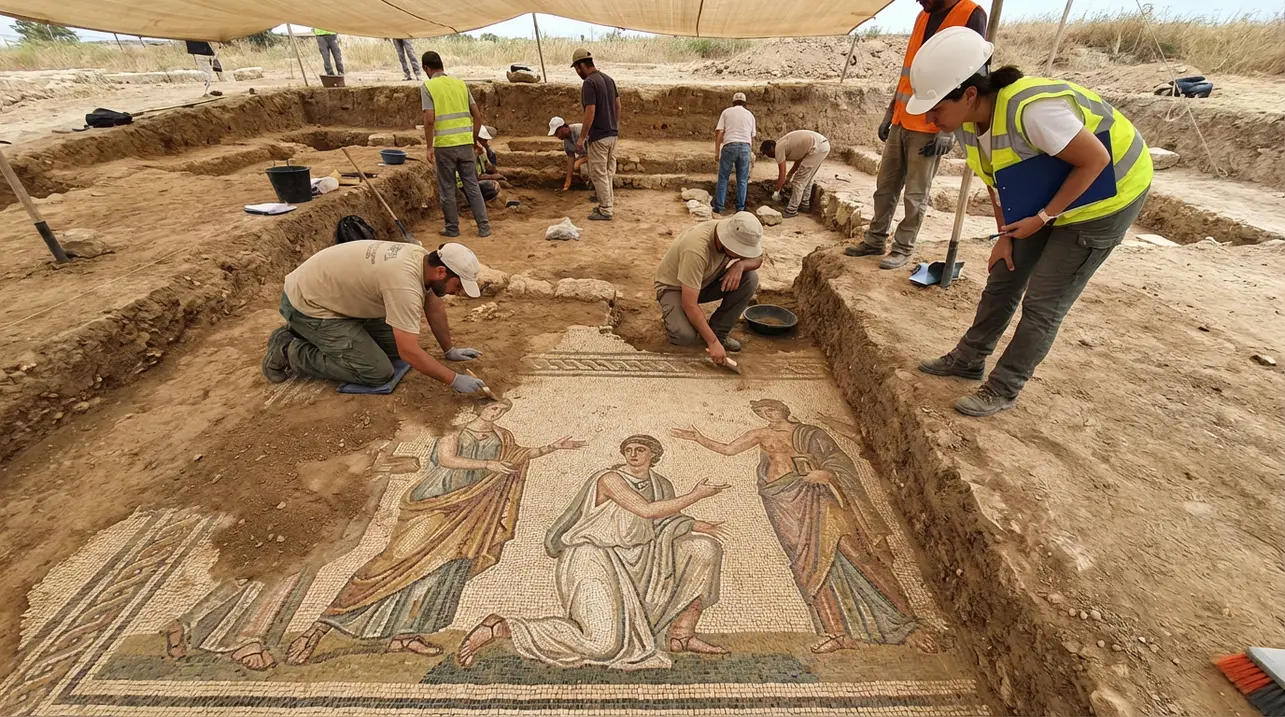
A stunning Roman mosaic, recently unearthed and now captivating the archaeological world, appears to offer a tantalizing glimpse into a lost narrative from the Trojan War, one potentially drawn from the imagination of the great Greek tragedian Aeschylus. This isn't merely a decorative floor; it's a sprawling, cinematic storyboard in stone, challenging our long-held interpretations of one of antiquity's foundational myths.The scenes depicted diverge sharply from the canonical accounts handed down by Homer in the *Iliad*, suggesting the artisans were working from a different, perhaps more theatrical, source material. Aeschylus, the father of tragedy, wrote a trilogy about the Trojan War, of which only *Agamemnon* survives intact; his other plays, like *The Phrygians* or *The Weighing of Souls*, are known only through fragments and references by later writers.This mosaic, therefore, could be a rare visual echo of those lost texts, a silent film version of a play whose script has been ash for millennia. Imagine the process: a wealthy Roman patron, deeply immersed in Greek culture and high art, commissions a workshop to create a centerpiece for their villa.They don't want the common, hackneyed scenes of Achilles dragging Hector's body; they want something erudite, something that speaks to a connoisseur's knowledge of obscure literary tradition. The master mosaicist, or *pictor imaginarius*, would have worked from a detailed cartoon, possibly based on an illustrated manuscript of the play, translating dramatic tension into countless tiny *tesserae* of colored stone and glass.Experts now scrutinize each figure: Is that a rare depiction of the Trojan prince Helenus in a moment of prophetic agony, a theme Aeschylus favored? Does that grouping hint at the controversial 'weighing of fates' scene, where the destinies of Achilles and Memnon were balanced on Zeus's scales? The implications are profound for classical studies. It reinforces the idea that Roman art was not merely derivative but a dynamic interpreter of Greek heritage, curating and recontextualizing stories for a new empire.Furthermore, it highlights the role of theater as a mass medium in the ancient world, where plays could influence visual arts centuries later and continents away. The discovery also raises poignant questions about the fragility of cultural memory.We rely on the vagaries of what manuscripts survived fires, pillaging, and the simple decay of time. A single archaeological find like this mosaic can suddenly illuminate a dark corner of our past, suggesting whole libraries of lost genius.As conservators painstakingly clean each square inch, and philologists compare the iconography to the scant surviving lines of Aeschylus, we await the scholarly debates that will inevitably follow. This mosaic is more than an artifact; it's an invitation to reconsider the Trojan War not as a fixed Homeric epic, but as a living, evolving story that was debated, adapted, and visualized across the ancient Mediterranean, its forgotten chapters waiting to be rediscovered in the earth beneath our feet.
#archaeology
#Roman mosaic
#Trojan War
#Aeschylus
#ancient art
#cultural heritage
#editorial picks news