SciencebiologyAnimal Behavior
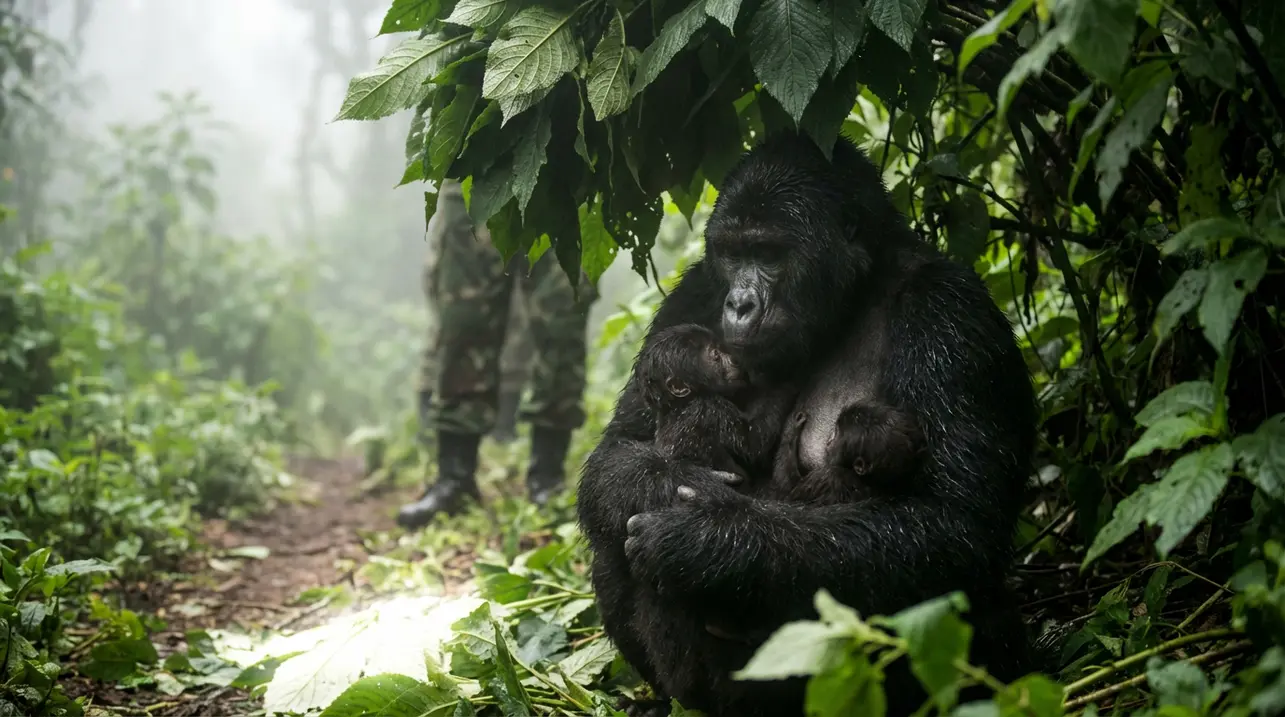
Rare mountain gorilla twins born in DR Congo's Virunga park.
RA
1 day ago7 min read
In the dense, mist-shrouded forests of Virunga National Park, a beacon of hope emerged this past Saturday as trackers confirmed the birth of extremely rare mountain gorilla twins, a sight so precious it feels like a whispered promise from the wilderness itself. The mother, whose identity is being protected by park authorities to minimize human disturbance, was observed cradling the two infants, a moment of profound tenderness amidst the park's ongoing struggle for survival.This event isn't just a heartwarming anecdote; it's a critical data point in the fragile calculus of conservation for a species that has teetered on the brink of extinction. Mountain gorillas (*Gorilla beringei beringei*) are classified as endangered by the IUCN, with the entire global population estimated at just over 1,000 individuals, all residing in the protected forests of the Virunga Massif, which spans the borders of the Democratic Republic of the Congo, Rwanda, and Uganda, and in Uganda's Bwindi Impenetrable National Park.The birth of twins is exceptionally rare in the wild, with a probability of less than one percent, and their survival poses a significant challenge, as the mother must divide her attention and resources between two dependent infants in an environment rife with natural and human-induced threats. Virunga, Africa's oldest national park, is a UNESCO World Heritage site that has become a battleground, not just for biodiversity, but for the very concept of sanctuary.Rangers there operate in what is often described as a war zone, defending the park's inhabitants from armed militias, illegal charcoal production, and poaching, all while navigating the complex socio-political turmoil of eastern DRC. The park's director, Emmanuel de Merode, a figure who has survived assassination attempts for his work, has often framed Virunga's mission as one of ecological defense intertwined with community survival, arguing that protecting the gorillas is inseparable from providing sustainable livelihoods for the surrounding human population.The twins' arrival, therefore, is a monumental morale boost for these frontline conservationists, a tangible reward for their immense sacrifice. Scientifically, the event offers a unique opportunity for primatologists to study twin rearing behavior, which is poorly documented in wild gorillas.Dr. Tara Stoinski, President and Chief Scientific Officer of the Dian Fossey Gorilla Fund, has noted that while twin births occur occasionally in captive populations, where nutritional and medical support is available, wild mothers face immense pressure.Historical data suggests infant mortality for twins in the wild can be high, making the vigilant yet non-intrusive monitoring by Virunga's trackers all the more crucial. They will watch for signs that the mother is able to nurse both effectively and that neither infant is being neglected, intervening only in the most dire circumstances to avoid disrupting natural behaviors.
#featured
#mountain gorillas
#twins
#Virunga National Park
#DR Congo
#wildlife conservation
#rare birth
Related News
3 days ago
This simple math trick could transform earthquake science

3 days ago
Understanding the Science Behind 'Your Body Keeps Score'

3 days ago
Outpoll Weekly Recap: Science (December 29, 2025 – January 4, 2026)

3 days ago
Outpoll Weekly Recap: Science (December 22 – 28, 2025)

3 days ago
Outpoll Weekly Recap: Science (December 15 – 21, 2025)
3 days ago
Outpoll Weekly Recap: Science (December 8 – 14, 2025)
3 days ago
Outpoll Weekly Recap: Science (December 1 – 7, 2025)

3 days ago
Outpoll Weekly Recap: Science (November 24 – 30, 2025)

3 days ago
Outpoll Weekly Recap: Science (November 17 – 23, 2025)

3 days ago
Outpoll Weekly Recap: Science (November 10 – 16, 2025)

Comments
Loading comments...
© 2025 Outpoll Service LTD. All rights reserved.