SciencearchaeologyExcavations and Discoveries
New fossil reveals ancient animal migration route across Pangaea.
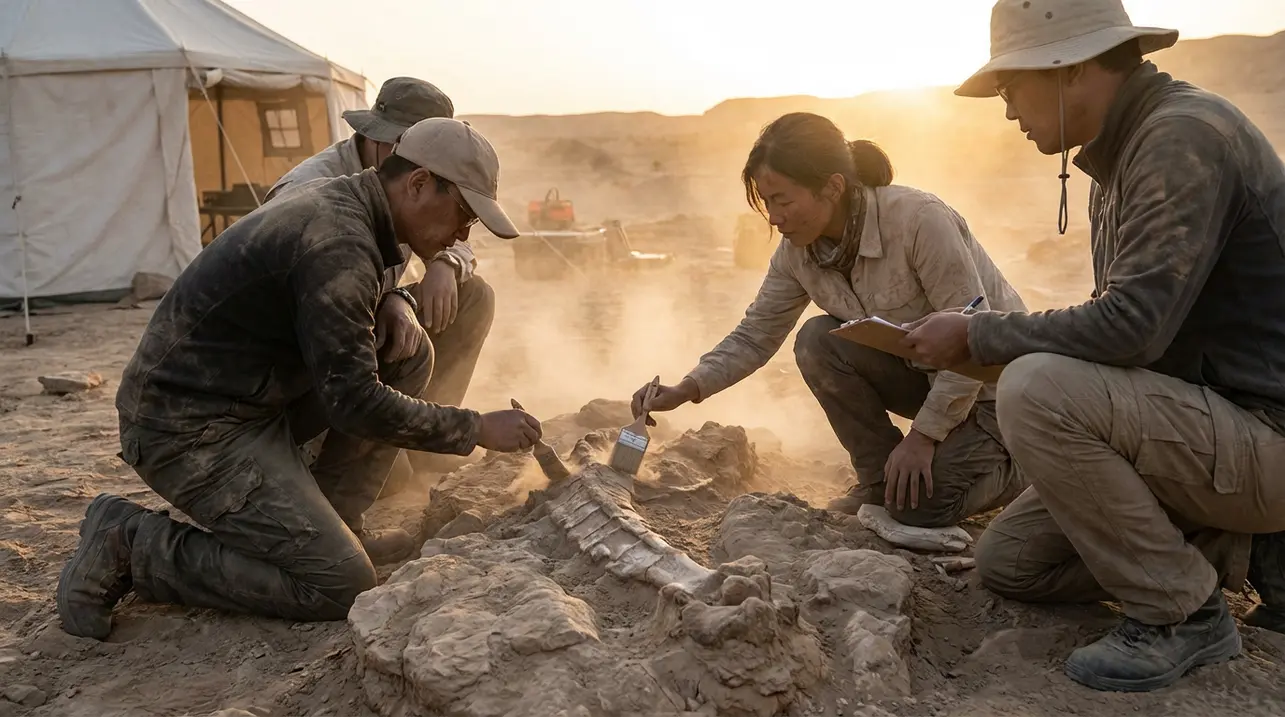
Picture the supercontinent Pangaea, a vast, unbroken landmass where deserts sprawled and mountains rose under a single, immense sky. For decades, paleontologists have theorized about the movement of life across this ancient world, often imagining it as a story of isolated provinces separated by formidable climatic barriers, especially the harsh, arid belt around the equator.But a stunning discovery in the rocky outcrops of China’s Gansu province has just rewritten that script, revealing an ancient animal migration route that functioned like a prehistoric superhighway. Scientists there have unearthed fossils of a new species of dicynodont, a mammal-like reptile that was a member of the therapsid group—the very lineage that would eventually give rise to us mammals.The real kicker? This isn't just a new species; it's the first of its genus to be found in both South Africa and China, a paleontological slam dunk proving these creatures made an epic journey across Pangaea during the Late Permian period, some 299 to 252 million years ago. This finding, detailed in a recent paper, suggests that tetrapods—four-limbed vertebrates—crossed the equatorial region of the supercontinent far more often than our models predicted, hinting at the existence of a viable ecological corridor capable of supporting large-scale animal migration.Think of it not as a barren wasteland but as a series of interconnected oases and river valleys, a green artery pumping life across the planet's waistline. This discovery shatters the old paradigm of isolated Permian ecosystems.Dicynodonts were hardy, beaked herbivores, some as small as a rat and others as large as a modern ox, and their ability to traverse such distances tells us that the environmental conditions, while challenging, were not the impassable death zone we imagined. It forces a complete re-evaluation of Pangaean climate models; perhaps the equatorial region experienced wetter pulses, or these animals possessed remarkable physiological adaptations for drought.The implications ripple outward. If dicynodonts could make this trek, so could the predators that hunted them and the smaller creatures sharing their niche, meaning faunal exchange between the southern and northern hemispheres was a dynamic, ongoing process.This migration route becomes a vector for the spread of evolutionary innovations, a mixing pot where genetic and ecological ideas were shared across thousands of miles. Experts like Dr.Jun Liu, a leading figure in therapsid research, compare it to finding the same species of lion in both Kenya and India today—it immediately tells you a profound story about connectivity. This corridor likely facilitated the spread of dominant Permian species, setting the stage for the ecosystems that would face the planet's greatest catastrophe: the end-Permian mass extinction.
#fossil discovery
#dicynodont
#Pangaea
#migration corridor
#Late Permian
#paleontology
#China
#Gansu province
#featured