Sciencespace & astronomyNASA Missions
January 2026 Wolf Moon: First Supermoon of the Year
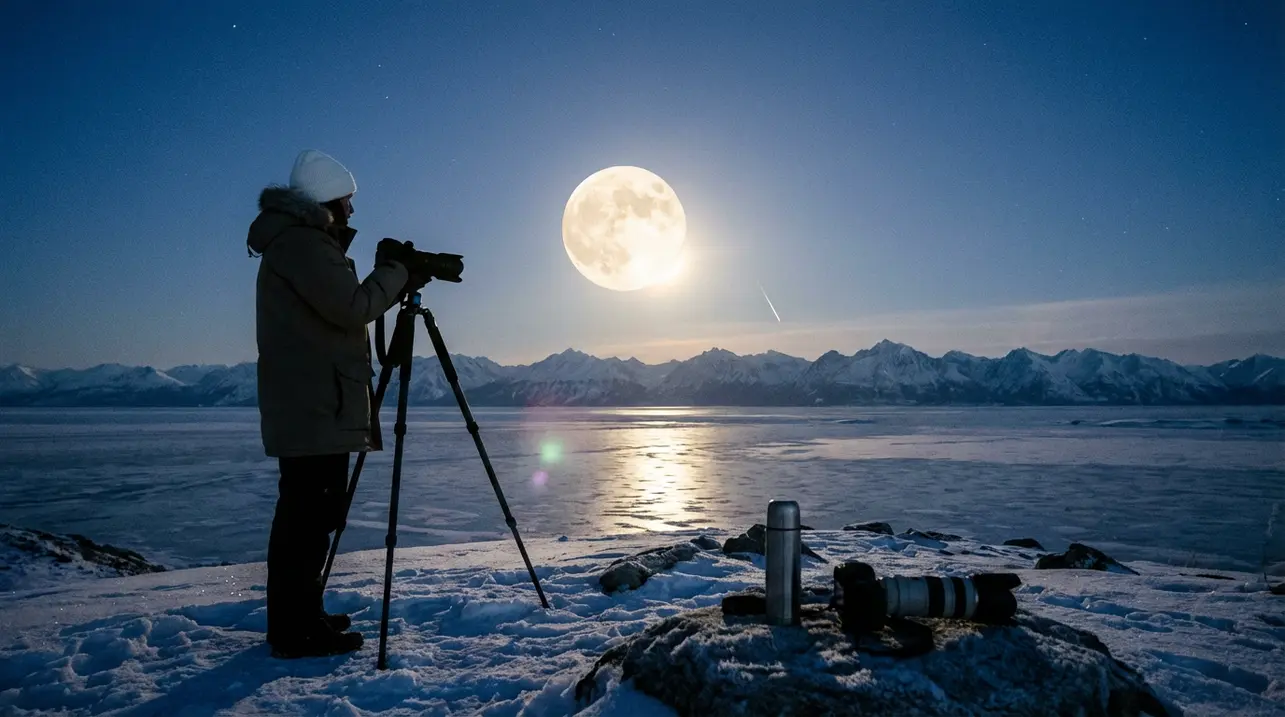
The celestial calendar for 2026 kicks off with a spectacular double feature, as the first full moon of the year—the so-called Wolf Moon—swings into view not just as a full phase, but as a supermoon, sharing the stage with the swift and fiery Quadrantid meteor shower. This lunar event, peaking in the predawn hours of Saturday, January 3rd, at 5:03 a.m. ET, is more than a pretty sight; it’s a gravitational handshake between the Earth and its satellite.A supermoon occurs when the moon’s full phase coincides with perigee, its closest approach to our planet in its elliptical orbit. This proximity, about 225,000 miles away at this pass, will make our celestial neighbor appear roughly 14% larger and significantly brighter in the night sky, a difference perceptible to the keen-eyed observer.The visual drama is heightened by its position near the gas giant Jupiter and within the constellation Gemini, creating a brilliant triangular formation that will dominate the eastern horizon. For optimal viewing, skywatchers should look east at dusk on Friday, January 2nd.The moon will ride low, benefitting from the famous ‘moon illusion,’ a trick of human perception that makes celestial bodies near the horizon seem impossibly vast, as if the cosmos itself is putting on a grand, immersive show. This particular Wolf Moon holds a unique place in a sequential dance: it is technically the fourth and final in a consecutive series of supermoons that began in the waning months of 2025, yet simultaneously serves as the inaugural of three slated for 2026, with others to follow in November and December.The accompanying Quadrantid shower, however, presents a bittersweet counterpoint. Renowned among astronomers for producing intense bursts of bright ‘fireball’ meteors—remnants of the asteroid 2003 EH1—it can peak at an astonishing rate of 120 streaks per hour.Yet, the very brilliance of the supermoon acts as a celestial spotlight, washing out the fainter meteors and challenging enthusiasts to seek out darker patches of sky to catch the shower’s most dramatic, fleeting moments. The nomenclature ‘Wolf Moon’ itself is a piece of cultural astronomy, a term popularized by the *Old Farmer’s Almanac* and believed to have origins with Native American tribes and early European settlers, who associated the deep, resonant howls of wolves with the long, silent nights of midwinter.It’s a reminder that our ancestors used these luminous markers not just for wonder, but for survival, tracking the seasons through a lunar almanac. From a scientific perspective, this event underscores the predictable yet awe-inspiring mechanics of our solar system.While not as historically significant as a total lunar eclipse or a planetary conjunction, the consistent cycle of supermoons offers a perfect gateway for public engagement with astronomy, a chance to contemplate our place in a clockwork universe. As we look up this weekend, we’re witnessing a confluence of orbital geometry, historical tradition, and pure cosmic spectacle—a powerful reminder that even in the depths of winter, the sky is alive with dynamic, radiant energy.
#featured
#wolf moon
#supermoon
#Quadrantid meteor shower
#January 2026
#astronomy
#skywatching