PoliticselectionsElectoral Reforms
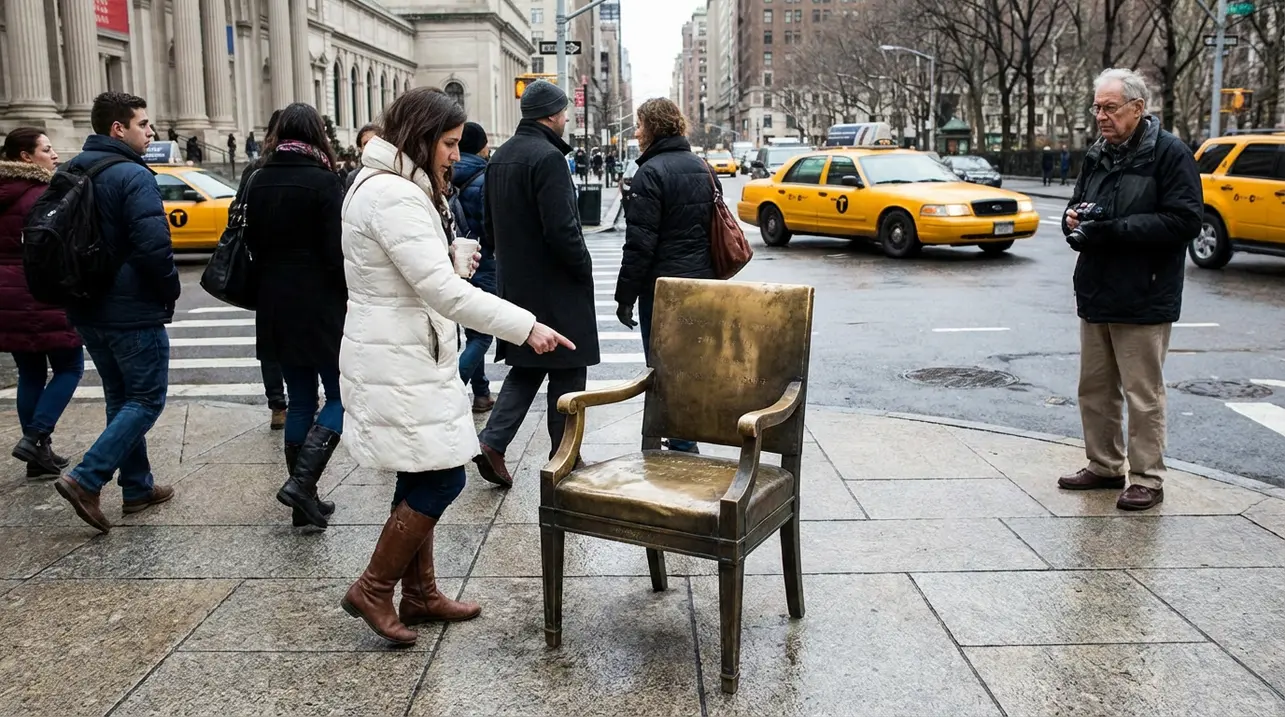
Letters on brass chair turn math paradox into NYC political commentary
In the high-stakes arena of New York City politics, where every public installation is a potential campaign ad and every policy detail a battleground, a new piece of conceptual art has turned a mathematical paradox into a sharp piece of electoral commentary, using the city's own ranked-choice voting system as its canvas. The project, a brass chair etched with letters, isn't just a design object; it's a tactical maneuver, a piece of political jiu-jitsu that uses the very mechanics of a recent electoral reform to highlight its inherent complexities and philosophical quandaries.For those of us who live for the strategy wars—the polling, the messaging, the ground game—this is more than art; it's a brilliant piece of opposition research made tangible. Ranked-choice voting, adopted by NYC in a 2019 ballot measure and first deployed in a major citywide election in 2021, was sold as a reform to reduce negative campaigning and better reflect the will of the majority.Yet, as any seasoned campaign volunteer knows, it introduced a new layer of calculus for both voters and operatives. The 'paradox' referenced here likely points to non-monotonicity—a counterintuitive scenario where ranking a candidate higher can actually cause them to lose, or ranking them lower can help them win.It’s the kind of edge-case that keeps strategists up at night, and to see it physically manifested on a chair in the public square is a masterstroke of political theater. Imagine the focus groups: voters confused by the new ballots, campaigns crafting 'how-to' guides that subtly morph into voting instructions, and the nail-biting elimination rounds on election night that feel more like a reality TV show than a democratic process.This artwork cuts to the heart of that experience. It makes abstract electoral math visceral, forcing a confrontation with the system's imperfections.From a tactical perspective, the piece serves as a permanent, silent critique of the reform from within its own framework—a kind of institutional trolling. It asks whether we've traded one set of problems for another, more opaque set.Does ranked-choice voting truly elevate consensus candidates, or does it merely advantage campaigns with the resources to run sophisticated 'second-choice' outreach operations? The chair becomes a monument not to a solution, but to an ongoing experiment, a reminder that in politics, as in math, there is no perfect system, only trade-offs. The location is everything; this isn't in a gallery but in the city itself, turning every passerby into a constituent confronted with the architecture of their own civic participation.It’s a provocation worthy of a seasoned campaign manager, using symbolism as a weapon. In the relentless media war that defines modern politics, this project wins the news cycle by reframing a dry procedural topic into a tangible, debatable object. It doesn't just comment on NYC politics; it actively participates in it, demonstrating that the most potent commentary often comes not from a op-ed, but from a clever, strategic intervention that lets the system's own logic speak its uncomfortable truths.
#featured
#ranked-choice voting
#New York City
#political commentary
#design
#mathematical paradox
#voting system
#brass chair