AIroboticsHumanoid Robots
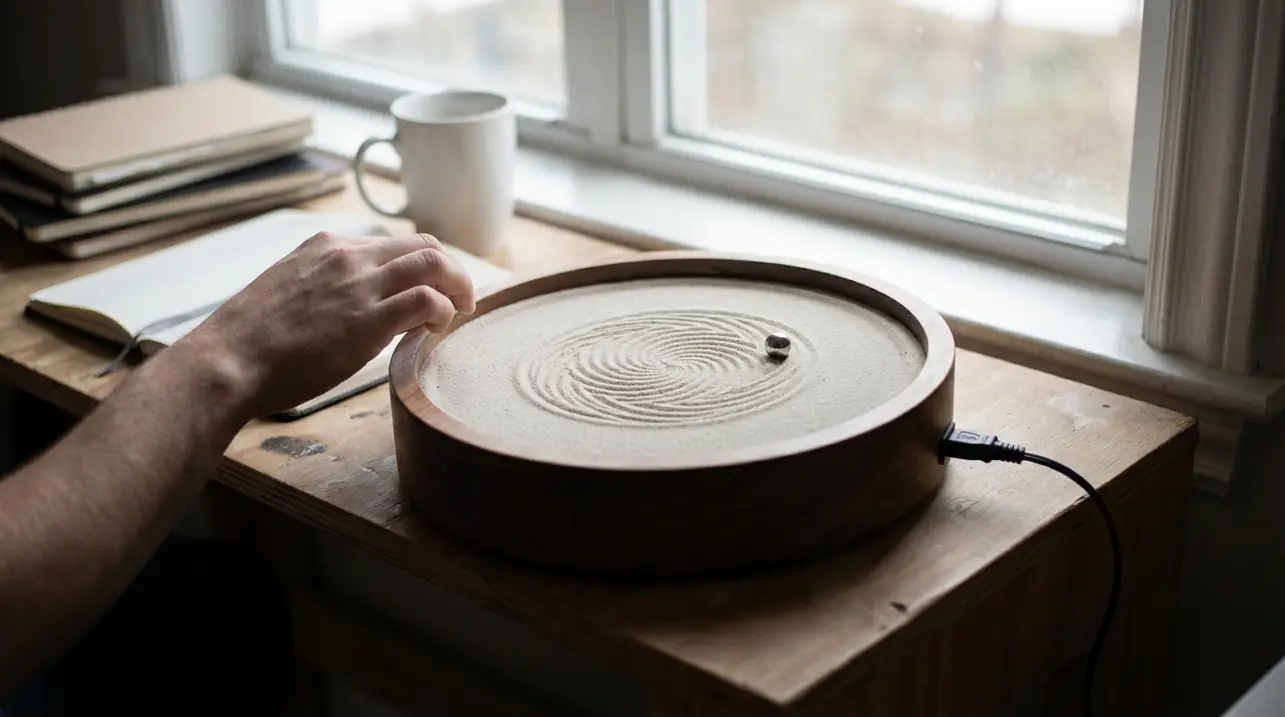
SANDSARA mini: Robotic Timepiece Draws Infinite Patterns in Sand
In a world where digital interfaces dominate, the emergence of the SANDSARA mini feels like a quiet, profound rebellion—a piece of technology that doesn’t scream for your attention but instead invites you to pause and watch time itself take physical form. This isn't just another gadget; it's an ephemeral timepiece, a hybrid object where robotic precision meets the deeply tactile, unpredictable medium of sand.Imagine a small, elegant device, its mechanical arm guided by silent algorithms, tracing intricate, never-repeating patterns across a pristine surface. Each sweep is a meditation in slow, repetitive motion, a deliberate counterpoint to the frenetic pace of our screen-saturated lives.For creatives and designers, this represents a fascinating frontier where AI tools, often associated with generative art on screens, are applied to physical, kinetic sculpture. It’s akin to a Midjourney prompt made manifest, not in pixels but in granules, where the ‘brushstroke’ is a carefully calibrated robotic movement and the ‘canvas’ holds the memory of a pattern only until the next cycle begins.The concept draws a direct line from ancient Zen gardens—where raked gravel symbolized impermanence and contemplation—to contemporary explorations in generative design and calm technology. Think of it as a Figma plugin for the physical realm, where the parameters of shape, rhythm, and flow are programmed, but the final aesthetic outcome retains an organic, slightly imperfect beauty that only a natural material can provide.This fusion speaks to a broader movement in design and art, where creators are leveraging algorithmic precision not to create sterile perfection, but to facilitate unique, human-centric experiences that celebrate materiality and slowness. The SANDSARA mini operates on principles familiar to anyone who has dabbled in creative coding or parametric design, yet its output is profoundly analog.It raises compelling questions about the role of AI and robotics in our domestic spaces: can they be tools for mindfulness rather than just efficiency? As a UX designer fascinated by how technology shapes human emotion, I see this object as a masterclass in emotional design. It provides no notifications, harvests no data, and offers no productivity boost.Its value is purely experiential, serving as a kinetic art piece that visualizes the passage of time in a way a digital clock never could. The infinite patterns are a beautiful metaphor for the non-linear, looping nature of creative thought itself.While the original article frames it as a design object, its implications ripple into discussions about the future of interactive art, the aesthetics of automation, and our yearning for tangible connection in an increasingly virtual world. It’s a reminder that the most impactful applications of technology might not be those that solve problems faster, but those that reconnect us to fundamental, sensory experiences—watching a wave recede, leaves fall, or, in this case, sand being shaped into a fleeting masterpiece.
#robotics
#design
#timepiece
#sand art
#automation
#featured