AIchips & hardwareAI Accelerators
Plaud's AI wearable adds button to flag key moments
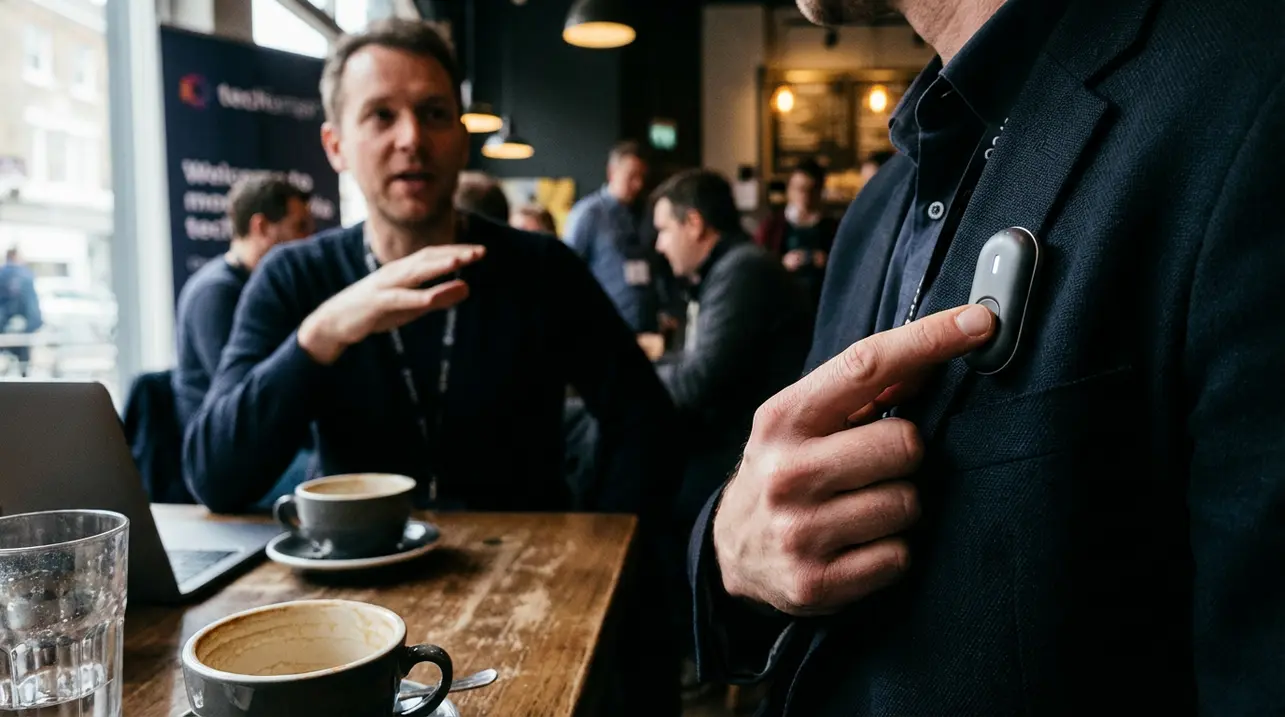
The wearable AI landscape, a space increasingly defined by the tension between ambient convenience and ethical boundaries, sees another incremental yet telling entry with Plaud's NotePin S. This isn't a revolution; it's a refinement, a hardware tweak that speaks volumes about the current trajectory of personal AI assistants.The core proposition remains unchanged from the 2024 original: a capsule-sized device, weighing a mere 0. 6 ounces with dual microphones, designed to passively or actively capture conversations for later AI-powered transcription and summarization.The headline change is almost comically simple: a physical, recessed button replaces the previous squeeze-to-record mechanism. A long press initiates recording, but the more intriguing addition is a 'press to highlight' feature.This user-initiated flagging during a conversation is a clever, low-tech method of supervised learning, providing the backend AI model with a crucial signal. It’s a form of human-in-the-loop training, telling the algorithm, 'This moment is important; weight it accordingly in your summary.' This move from purely passive capture to interactive cueing is a subtle but significant step toward more context-aware and user-directed AI, moving beyond raw data collection to prioritized information extraction. While the reliable range is still advertised at 9.8 feet—a spec students eyeing lecture halls should note—the fundamental package of wearable formats (pin, lanyard, wristband, clip) persists. Priced at $179 and available via Plaud's site and Amazon, the NotePin S arrives not in a vacuum but amidst a burgeoning field of AI wearables from Humane's Ai Pin to Rabbit's r1, all grappling with the same core challenge: making AI contextually useful without being socially intrusive or ethically fraught.The device's very existence forces a re-examination of the consent model in an always-listening world; the article's concluding, almost pleading reminder to 'get their consent before recording them' underscores the unresolved societal and legal questions that outpace the technology itself. From a technical perspective, the button represents a regression in seamless interaction but a potential leap in data quality and model training efficiency.It acknowledges a current limitation of pure ambient AI: without explicit guidance, even the most advanced LLM can struggle to distinguish a passing joke from a crucial action item in a noisy, real-world audio stream. This hardware iteration suggests that for now, the optimal path for these devices may be hybrid—leveraging AI's processing power but anchored by deliberate human input.The broader context here is the evolution of the interface itself, from touchscreens to voice, and now to wearable, context-sensitive agents. Plaud's choice to add a button, a tactile anachronism in a world chasing invisibility, is a pragmatic bet that for AI to be truly useful as a memory and productivity aid, it needs more than just ears; it needs a nudge.
#Plaud NotePin S
#AI wearable
#conversation recording
#button feature
#AI summary
#featured