

AIchips & hardwareNVIDIA GPUs
Nvidia Unveils Alpamayo AI for Human-Like Reasoning in Self-Driving Cars
DA
Daniel Reed
5 months ago7 min read
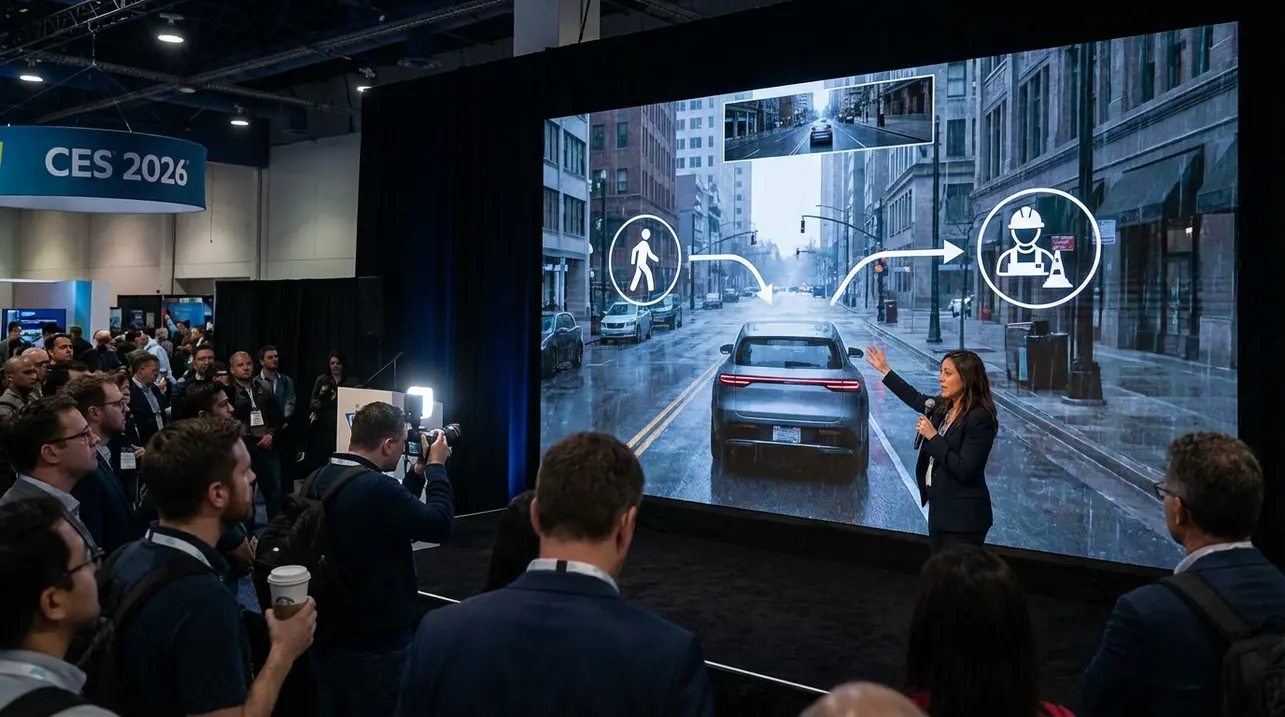
At CES 2026, Nvidia didn't just unveil another incremental chip upgrade; they introduced Alpamayo, a foundational shift toward imbuing autonomous vehicles with a semblance of human-like reasoning. This isn't merely about improved object detection or faster path planning.The core of Alpamayo is its reasoning vision language action model, a system designed to perform chain-of-thought reasoning. In practice, this means the AI doesn't just identify a plastic bag blowing across the road as a 'potential obstacle' and slam the brakes.Instead, it might internally reason: 'That is a lightweight, non-rigid object. Its trajectory is erratic but influenced by wind.Its density suggests minimal risk of damage. A human driver would likely maintain speed or slightly adjust, not perform an emergency stop.Therefore, I will execute a smooth lane adjustment while monitoring. ' This leap from perceptual intelligence to cognitive reasoning represents the next great frontier in AI for mobility, moving us closer to systems that can handle the infinite edge cases—the jaywalking pedestrian hesitating, the construction worker's ambiguous hand signal, the ball rolling into the street followed by a child—that have long been the Achilles' heel of even the most advanced self-driving programs.The implications are profound. For years, the industry has been stuck in a scaling problem: collecting petabytes of data to teach cars every possible scenario.Alpamayo's architecture suggests a pivot toward generalization, where the vehicle can understand intent, context, and physical laws, much like a human driver leverages a lifetime of lived experience. Experts in the field have been cautiously optimistic.Dr. Anika Sharma, a leading roboticist at Stanford, noted in a recent paper that 'the transition from statistical pattern matching to causal, abductive reasoning is the single most significant hurdle for Level 5 autonomy.A model that can articulate its 'why' is a model we can finally audit and trust. ' This transparency is crucial for regulatory approval and public acceptance.However, significant challenges remain. The computational overhead for real-time, multi-step reasoning is immense, likely requiring a hybrid of on-vehicle processing and low-latency edge computing—a area where Nvidia's hardware ecosystem, from their latest Thor SoCs to their data center GPUs, is positioned to dominate.Furthermore, defining the ethical parameters of this reasoning engine introduces philosophical quandaries. How does the model weigh risks? What cultural nuances of driving behavior does it adopt? If a chain-of-thought concludes that a minor collision is unavoidable, how does it choose between two bad outcomes? These are not just engineering problems but deeply human ones, echoing the classic trolley problem debates but now with urgent, practical deadlines.Looking historically, this mirrors the evolution in natural language processing, where models transitioned from simple word prediction to complex reasoning and planning. Alpamayo appears to be the automotive embodiment of that trend, applying the lessons of large language models to the physical world.The competitive landscape will heat up rapidly. Tesla's Full Self-Driving (FSD) system, with its end-to-end neural network approach, and Waymo's meticulously geofenced mastery represent different paths to the same goal.Nvidia, as the supplier of AI brains to nearly every other automaker, is betting that a reasoning-first, explainable AI platform will become the industry's standard operating system. If successful, Alpamayo won't just power cars; its architecture could revolutionize robotics, industrial automation, and any domain where machines must interact with an unpredictable world. The unveiling at CES 2026 is therefore more than a product launch; it is a statement of direction for the entire field of embodied AI, suggesting that the road to true autonomy is paved not with more data, but with better, more human-like thought.
#Nvidia
#Alpamayo
#autonomous vehicles
#reasoning AI
#CES 2026
#computer vision
#featured
Stay Informed. Act Smarter.
Get weekly highlights, major headlines, and expert insights — then put your knowledge to work in our live prediction markets.
Related News









1 month ago
Billy Corgan and Diplo debate AI use in music industry.

2 months ago
Black Forest Labs' Self-Flow makes AI training 2.8x more efficient

2 months ago
Meta and Broadcom Extend AI Chip Partnership to 2029

2 months ago
Outpoll Weekly Recap: Entertainment (April 20 – 26, 2026)

2 months ago
Outpoll Weekly Recap: AI (April 20 – 26, 2026)
Comments
It's quiet here...Start the conversation by leaving the first comment.