

AIroboticsHumanoid Robots
Chinese robotics startup AgiBot targets $142 million revenue for 2025
DA
Daniel Reed
6 months ago7 min read
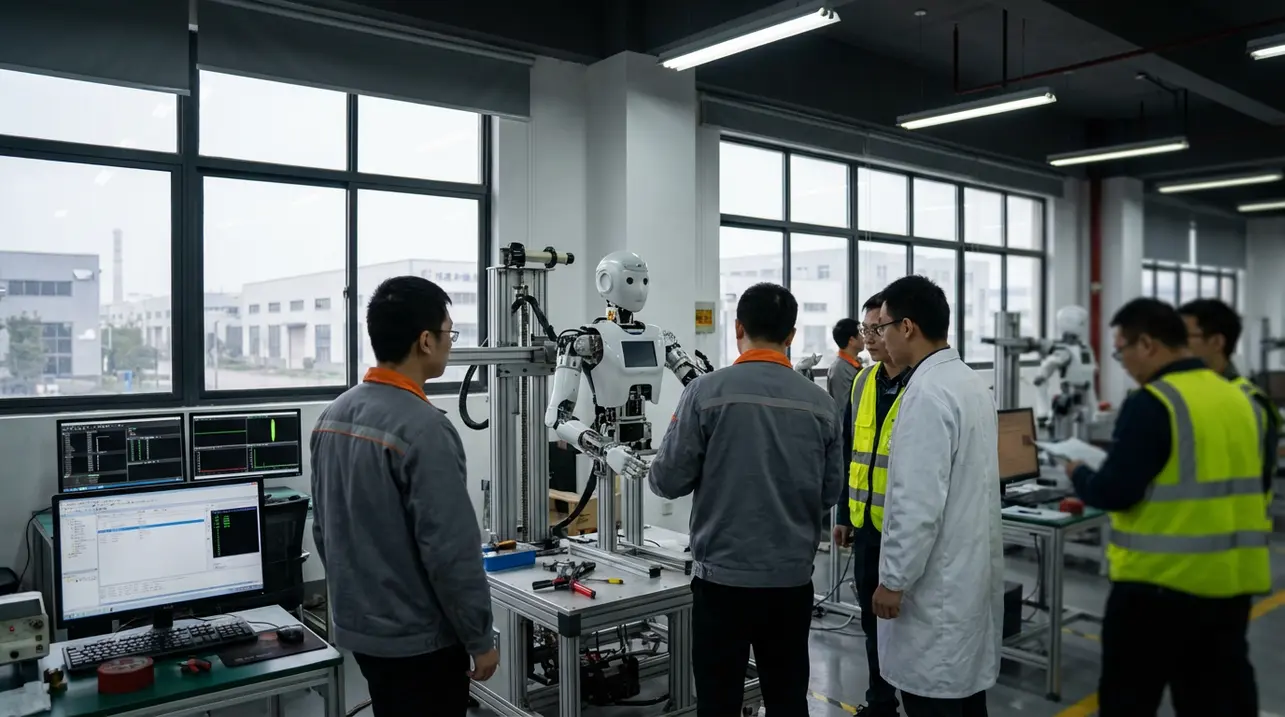
The ambition radiating from China's robotics sector just received a significant new benchmark. AgiBot, a startup that has rapidly ascended to become one of the country's most watched players in humanoid robotics, has publicly declared its target to surpass 1 billion yuan—approximately $142 million—in revenue for 2025.This isn't merely a financial forecast; it's a bold statement of intent in an industry racing from laboratory prototypes to commercial viability. The announcement, made by chairman and CEO Deng Taihua at a company event and subsequently confirmed, is underpinned by a staggering production goal: shipping 5,000 humanoid robots within that same timeframe.To understand the magnitude of this target, one must contextualize it within the broader, feverish landscape of global robotics. We are witnessing a convergence not unlike the early days of personal computing or smartphones, where hardware capabilities, AI software, and market necessity are beginning to align.For years, humanoid robots existed primarily in research papers and controlled demo videos, captivating imaginations but struggling with the chaotic, unstructured nature of real-world environments. The recent leaps in multimodal large language models and embodied AI, however, are providing these machines with the cognitive scaffolding necessary for more adaptive interaction.AgiBot's aggressive roadmap signals a decisive pivot from this R&D phase into what industry insiders term the 'first wave of scaled deployment. ' The company's confidence likely stems from advancements in core technologies like actuator design, dynamic balancing algorithms, and, crucially, AI-driven task planning that allows a single platform to be reconfigured for multiple applications.While specifics on AgiBot's flagship models remain closely guarded, the projected volume of 5,000 units suggests a focus on initial niche industrial and service sectors—think logistics warehouses for pallet handling or high-end customer service in controlled settings—rather than a consumer play. This pragmatic, commercial-first approach mirrors the early strategy of pioneers like Boston Dynamics with its Spot robot, which found its initial footing in industrial inspection and public safety.The financial and logistical hurdles to producing humanoids at this scale are immense. Each unit represents a complex integration of precision mechanics, sensors, and compute power, making supply chain resilience and cost-per-unit economics the true battlegrounds.AgiBot's success will hinge not just on brilliant engineering, but on its ability to forge partnerships with manufacturing giants and secure anchor clients in sectors like electronics assembly or automotive, where labor shortages and repetitive strain injuries are persistent challenges. Furthermore, this announcement intensifies the already fierce competition within China's ecosystem, where companies like Fourier Intelligence and UBTech are also vying for pole position, backed by significant state and private investment aligned with national strategic goals in advanced manufacturing.From a global perspective, AgiBot's move pressures Western counterparts, including Tesla with its Optimus bot and startups like Figure AI, to accelerate their own timelines. The coming 18-24 months will thus serve as a critical litmus test: Can the software stack mature fast enough to justify the hardware capex? Will real-world operational data from early deployments create a virtuous cycle of improvement, or reveal unforeseen technical and ethical roadblocks? The $142 million revenue target is more than a number; it's a stake in the ground for the entire industry, challenging every player to prove that humanoid robotics is not just a spectacle of technological prowess, but a tangible, scalable component of our economic future.
#featured
#AgiBot
#humanoid robots
#revenue target
#commercialization
#robotics startup
#China tech
Stay Informed. Act Smarter.
Get weekly highlights, major headlines, and expert insights — then put your knowledge to work in our live prediction markets.
Related News











2 months ago
Trump wants to stop states from regulating AI

2 months ago
Canva Repositions as an AI Platform with Design Tools

2 months ago
Billy Corgan and Diplo debate AI use in music industry.

2 months ago
Black Forest Labs' Self-Flow makes AI training 2.8x more efficient

2 months ago
Meta and Broadcom Extend AI Chip Partnership to 2029
Comments
It's quiet here...Start the conversation by leaving the first comment.