

AIroboticsHumanoid Robots
China's robotics sector needs five years for its 'EV moment'
OL
Oliver Scott
5 months ago7 min read
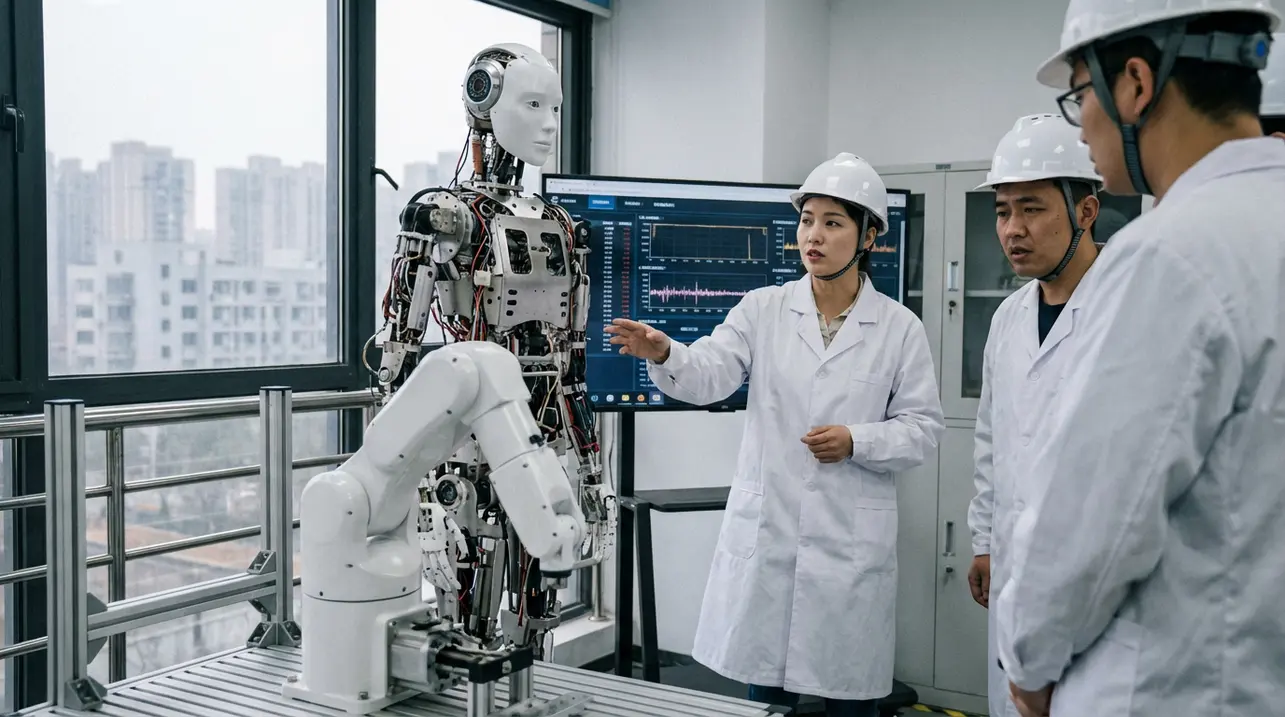
The warning from Hermitage Capital that China’s humanoid robotics sector is a half-decade away from its 'EV moment' isn't just a cautious forecast; it's a stark risk assessment that cuts through the current market euphoria. This isn't about doubting the long-term potential—China has repeatedly demonstrated its capacity to dominate strategic industries, from solar panels to electric vehicles, through state-backed industrial policy and sheer market scale.The robotics push, championed by Beijing as a next-generation pillar of economic power, mirrors that playbook. However, the critical distinction lies in the technological and commercial chasm between a standardized EV powertrain and a genuinely useful, cost-effective humanoid robot.The EV revolution was built on a clear value proposition: lower operating costs, environmental benefits, and, crucially, a product that performed a familiar function (transportation) in a superior way. Humanoid robots, by contrast, must prove their utility in unstructured environments, a challenge of perception, dexterity, and AI that remains largely unsolved.Hermitage, which astutely backed GPU designer MetaX Integrated Circuits—a company whose 700% IPO pop last month itself signals a market frothing for any AI-adjacent hardware—is effectively sounding the alarm on speculative overreach. The firm’s analysis suggests we are in the 'hype cycle' peak, where prototype demonstrations and bold government targets inflate valuations far ahead of tangible revenue or widespread commercial adoption.The five-year timeline is a sobering reminder of the iterative, grueling work required in mechatronics, sensor fusion, and embodied AI. For context, consider the decades it took for industrial robotic arms to become commonplace in factories; humanoids must navigate the infinitely more complex world of human spaces.The immediate consequence is a likely market consolidation. A flood of Chinese startups, buoyed by local government subsidies and venture capital chasing national strategic themes, will face a 'valley of disillusionment' as the technical hurdles become apparent and funding tightens.This will separate companies with genuine IP in actuators, control systems, or specialized AI from those merely assembling off-the-shelf components. Furthermore, the geopolitical dimension cannot be ignored.Just as the US has moved to restrict China's access to advanced semiconductors, progress in robotics—a dual-use technology with clear military applications—could attract similar scrutiny, potentially slowing R&D by limiting access to certain high-performance chips or components. The bubble, if it pops, could temporarily dampen investment but may ultimately benefit the sector by focusing capital on the most viable engineering approaches.The parallel to EVs is instructive but incomplete: while China leveraged its manufacturing ecosystem to become the world's EV battery and assembly hub, robotics requires a deeper mastery of core technologies it does not yet fully control. The next five years will be less about headline-grabbing humanoid reveals and more about the unglamorous, incremental advances in power efficiency, failure-proof software, and finding that first indispensable, mass-market application—be it in logistics, elderly care, or hazardous environments—that proves the model. The risk for investors now is mistaking a coordinated national strategy for an imminent commercial breakthrough.
#China robotics
#humanoid robots
#investment bubble
#MetaX
#Hermitage Capital
#featured
#EV comparison
#industry forecast
Stay Informed. Act Smarter.
Get weekly highlights, major headlines, and expert insights — then put your knowledge to work in our live prediction markets.
Related News











2 months ago
Trump wants to stop states from regulating AI

2 months ago
Canva Repositions as an AI Platform with Design Tools

2 months ago
Billy Corgan and Diplo debate AI use in music industry.

2 months ago
Black Forest Labs' Self-Flow makes AI training 2.8x more efficient

2 months ago
Meta and Broadcom Extend AI Chip Partnership to 2029
Comments
It's quiet here...Start the conversation by leaving the first comment.