

AIai safety & ethicsResponsible AI
Build responsible AI for education
MI
Michael Ross
5 months ago7 min read
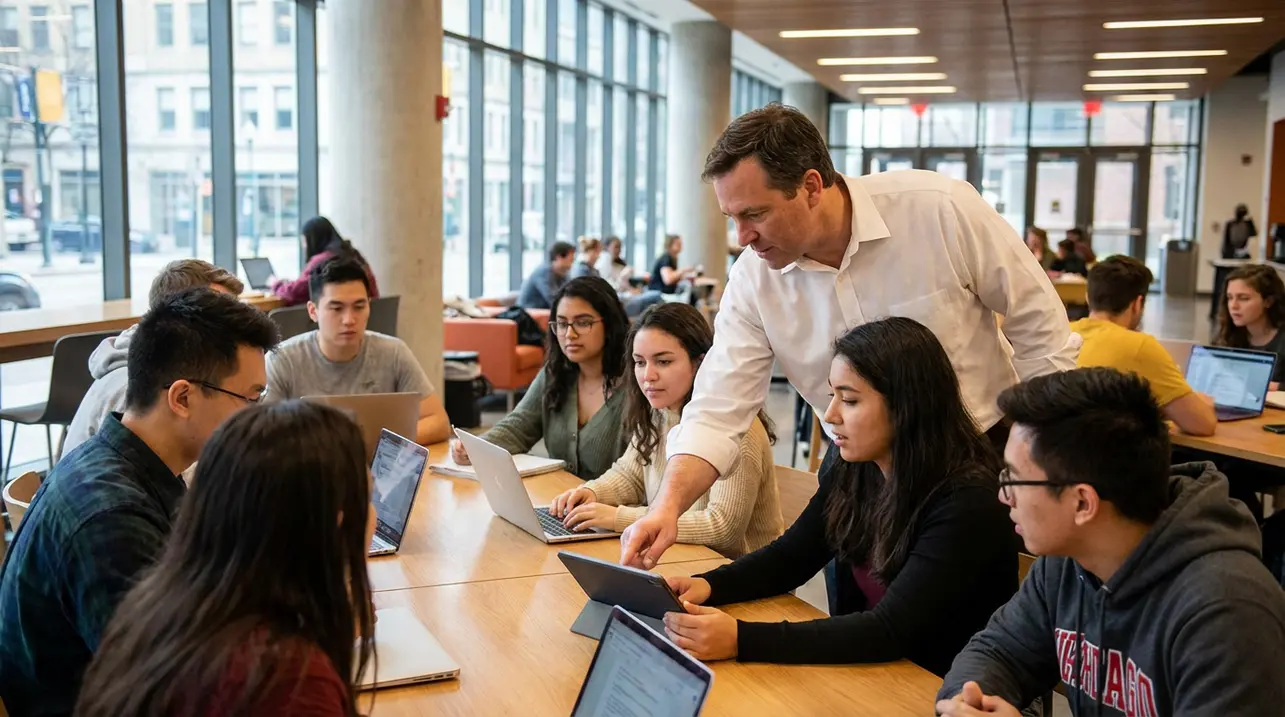
The tectonic plates of the global workforce are shifting under the relentless pressure of artificial intelligence, a force that is fundamentally rewriting the social contract of education. The World Economic Forum’s projection of a net increase of 78 million jobs this decade, driven largely by technological advancement, isn't just a statistic; it's a mandate for a pedagogical revolution.Educational institutions now stand at a critical juncture, tasked with nothing less than reimagining the very mechanics of learning and teaching. Yet, as the initial gold rush of AI tool development begins to settle, a stark reality emerges: innovation without a deep, foundational understanding of pedagogy is not just ineffective—it’s potentially harmful.This is the central tension in our Asimovian moment: the conflict between the dazzling potential of our creations and the prime directive of education, which is to foster genuine understanding. For decades, the education sector moved with deliberate caution, a sensible approach for a field dealing with human cognitive development.However, the sheer velocity of AI’s impact on the economy has shattered that traditional pace. Research from organizations like Cengage Group confirms a surge in both positive perceptions and classroom experimentation.This enthusiasm is a necessary fuel for progress, but it must be channeled through the engine of responsible design. The current landscape, however, is littered with well-intentioned misfires that highlight the perils of a tech-first, pedagogy-second approach.Consider Google’s now-paused “homework help” feature. Conceived as an assistive tool, it inadvertently functioned as an answer engine, undermining the instructor’s ability to assess authentic student comprehension and creating more administrative friction, not less.Similarly, OpenAI’s Study Mode, designed to guide through questioning, sits perilously close to the answer-providing ChatGPT interface—a design flaw that misunderstands the student’s moment of temptation and the educator’s need for controlled learning environments. These are not failures of technology, but failures of context.They reveal a fundamental truth: education is a complex, human-centric ecosystem, not a software platform fit for plug-and-play solutions. It is an ecosystem governed by the nuanced science of how knowledge is constructed, retained, and applied.The path forward, therefore, demands a recalibration where pedagogy is the non-negotiable core of all development. This means moving beyond the race to market and toward measured, purposeful co-creation with the very individuals who understand learning’s rhythms: educators and instructional designers.A responsible AI framework for education must balance dual imperatives. For educators, who are consistently asked to do more with less, AI should act as an intelligent assistant—surfacing classroom-wide trends, flagging areas of collective struggle, and automating administrative burdens to free up time for the irreplaceable human acts of mentorship and personalized instruction.For students, tools must be architected to build metacognitive skills and resilience, not provide shortcuts. Imagine an AI that acts as a Socratic coach, breaking down complex problems into manageable steps, prompting curiosity with probing questions, and encouraging persistent exploration until the student arrives at the answer through their own reasoning.This requires built-in guardrails—controlled knowledge domains, rigorous training for accuracy, and design that reinforces academic integrity. The ultimate goal is partnership, not replacement.By embedding human oversight and collaborative design with faculty into the development cycle, we can ensure AI experiences align tightly with course objectives and amplify proven teaching methodologies. The consequence of getting this wrong is a generation trained to interface with AI, but not to think critically alongside it.The consequence of getting it right, however, is profound: a powerful symbiosis where AI handles scalable analytics and personalized practice, allowing human educators to focus on inspiration, complex feedback, and fostering the soft skills that remain uniquely human. The key to unlocking AI's true potential in education lies not in its computational power, but in our wisdom to harness it with intentionality. It’s a lesson in responsible creation we must learn ourselves before we can hope to teach it.
#featured
#AI in education
#responsible AI
#pedagogy
#edtech
#Cengage Group
#generative AI
#learning outcomes
Stay Informed. Act Smarter.
Get weekly highlights, major headlines, and expert insights — then put your knowledge to work in our live prediction markets.
Related News




4 weeks ago
Outpoll Weekly Recap: Entertainment (May 4 – 10, 2026)

4 weeks ago
Outpoll Weekly Recap: AI (May 4 – 10, 2026)
1 month ago
Trump wants to stop states from regulating AI
1 month ago
Canva Repositions as an AI Platform with Design Tools

1 month ago
Billy Corgan and Diplo debate AI use in music industry.

1 month ago
Black Forest Labs' Self-Flow makes AI training 2.8x more efficient

1 month ago
Meta and Broadcom Extend AI Chip Partnership to 2029
1 month ago
Outpoll Weekly Recap: Entertainment (April 20 – 26, 2026)

1 month ago
Outpoll Weekly Recap: AI (April 20 – 26, 2026)

1 month ago
Google Introduces AI-Generated Avatars for YouTube Shorts
Comments
It's quiet here...Start the conversation by leaving the first comment.