AIenterprise aiAI in Healthcare
Biotech firm Chai Discovery raises $130M in Series B funding.
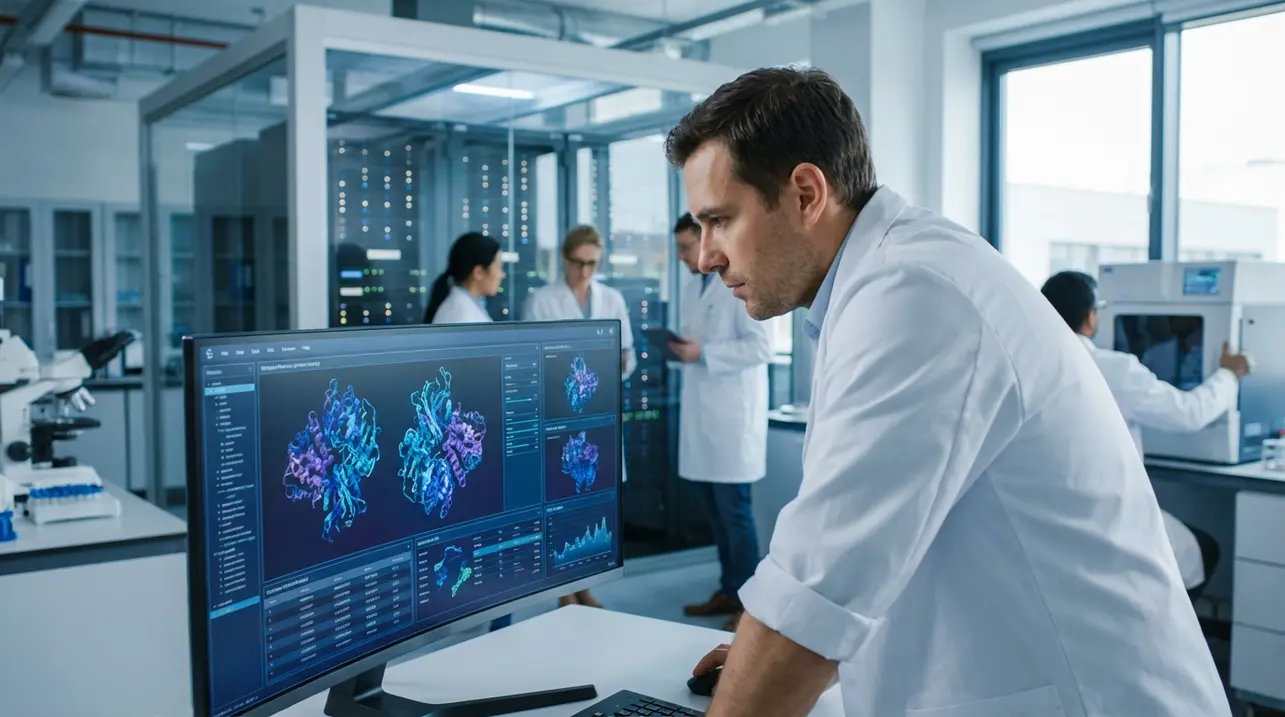
In a move that signals the biotech sector's accelerating pivot toward computational biology, Chai Discovery has just secured a monumental $130 million in Series B funding. This isn't just another venture capital round; it's a substantial bet on a foundational shift in how we discover medicines.Chai is building what they term 'foundation models' for drug discovery, a concept borrowed from the AI world that's now revolutionizing biology. Their core mission is to predict molecular interactions with such high fidelity that existing compounds can be systematically 'reprogrammed' for new cures, essentially treating biology as a vast, decipherable code.For those of us tracking the fusion of AI and life sciences, this is a watershed moment, reminiscent of the early days of CRISPR when the potential for precise genetic editing first became tangible. The traditional drug discovery pipeline is notoriously slow, expensive, and fraught with failure, often likened to finding a needle in a haystack while blindfolded.Companies like Chai are aiming to replace that metaphor with one of a highly tuned search engine, using deep learning models trained on petabytes of biological data—from protein structures and genomic sequences to decades of clinical trial results—to map the intricate dance between molecules in the human body. The implications are staggering.Imagine being able to take a molecule known for one function and, through predictive modeling, identify its hidden potential to inhibit a cancer pathway or modulate a rogue immune response, dramatically shortening the decade-long journey from lab to patient. This approach, often called 'in-silico' discovery, is moving from a promising auxiliary tool to the central engine of R&D.The $130 million war chest will undoubtedly be funneled into scaling their computational infrastructure, attracting top-tier talent from both AI research labs and pharmaceutical giants, and validating their predictions in wet labs. The broader context here is a global race.From DeepMind's AlphaFold revolutionizing protein folding to startups leveraging generative AI to design novel proteins from scratch, the landscape is hyper-competitive. Chai's specific focus on interaction prediction places it squarely at the heart of this race, as understanding how a potential drug binds to its target is the single most critical step.Expert commentary in journals like *Nature Biotechnology* has increasingly argued that the companies that master these foundational biological models will build insurmountable 'data moats,' akin to the advantage Google has in search. However, significant challenges remain.The 'black box' nature of some complex AI models can be a regulatory hurdle; the FDA will require not just predictions, but understandable causal reasoning. Furthermore, the biological data these models feast on must be of unprecedented quality and diversity to avoid biased outcomes.
#OpenAI
#Chai Discovery
#drug discovery
#foundation models
#biotech
#Series B
#funding
#hottest news