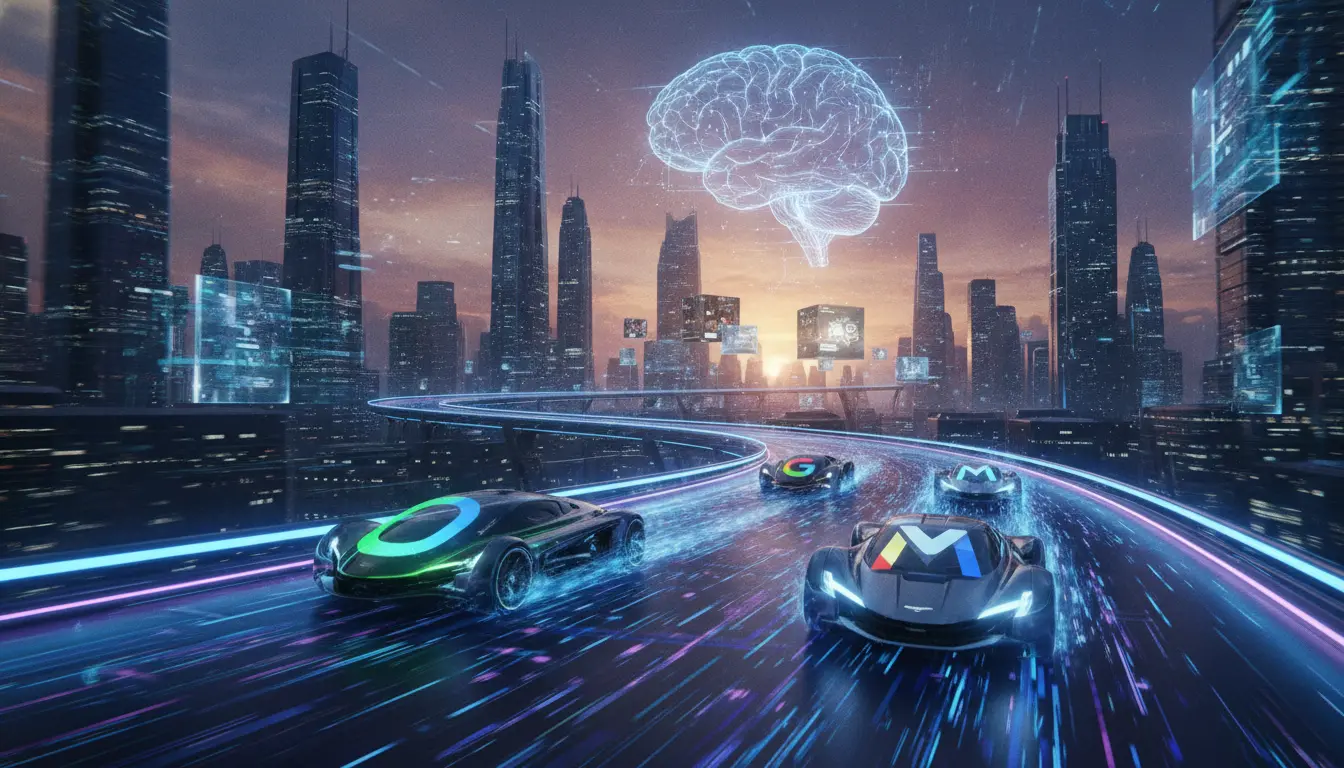
Tech Giants Escalate High-Stakes Race for Next-Generation AI Models
SOSophia King1 day ago7 min read
The artificial intelligence landscape is in the throes of an unprecedented acceleration, with the industry’s leading players locked in a fierce, high-stakes competition to develop and release the next generation of flagship large language models (LLMs). Following a recent cascade of major announcements from Google, OpenAI, and Apple, it has become clear that the current wave of powerful AI, exemplified by models like GPT-4o and Gemini 1.5 Pro, is not a plateau but rather a launchpad for an even more intense development cycle. The race is no longer simply about creating a chatbot that can write an email; it is about building the foundational platforms for the next era of computing, a contest that could redefine market leadership and create trillions of dollars in economic value.The starting gun for this modern AI arms race was arguably fired in late 2022 with the public release of OpenAI’s ChatGPT, a moment that catapulted generative AI into the global consciousness. Since then, the pace has been relentless.The focus has rapidly shifted from pure text-based interaction to a much richer, more intuitive “multimodal” experience. OpenAI’s recent demonstration of GPT-4o, with its ability to engage in fluid, real-time verbal conversations and interpret visual information, set a new benchmark for human-computer interaction.Not to be outdone, Google used its annual I/O conference to showcase sweeping integrations of its Gemini model across its vast ecosystem, from Android to its core search engine, emphasizing a massive “context window” that allows the AI to process and recall vast amounts of information, such as an entire book or hours of video. Each major competitor is carving out a distinct strategic path in this crowded arena.OpenAI, backed by Microsoft, continues to leverage its first-mover advantage, aiming to push the boundaries of capability with what is widely speculated to be GPT-5 on the horizon. Google, with its deep research roots and immense data resources, is fighting to reclaim its perceived leadership by deeply embedding AI into products used by billions.Meanwhile, Anthropic has positioned itself as the leader in AI safety and enterprise reliability with its Claude 3 family of models, attracting businesses wary of the risks associated with less constrained systems. In a different corner, Meta is championing an open-source approach with its powerful Llama 3 model, aiming to commoditize the technology and build a broad ecosystem that challenges the walled gardens of its rivals.And finally, Apple has entered the fray, not with the largest model, but with a characteristically polished and privacy-focused strategy called “Apple Intelligence,” which promises to bring practical AI to hundreds of millions of users through on-device processing and seamless integration with its hardware. Underpinning this frantic race are monumental technical and logistical challenges.The computational power required to train these frontier models is astronomical, consuming entire data centers packed with tens of thousands of specialized GPUs from manufacturers like NVIDIA. The demand for these chips has fueled a global supply chain crunch and created a new geopolitical flashpoint.Beyond hardware, the acquisition of high-quality training data has become a critical bottleneck, leading to complex licensing deals with media companies and raising new questions about copyright and intellectual property. Furthermore, as these models grow more capable, fundamental research problems persist, including the tendency for AIs to “hallucinate” or fabricate information, their struggles with complex multi-step reasoning, and the immense difficulty in ensuring they behave as intended in all situations.The stakes extend far beyond corporate bragging rights. The company that develops the next truly groundbreaking model could establish a dominant technological standard, similar to Microsoft's Windows in the PC era or Google's search in the internet era.This leadership would translate into immense influence over enterprise software, consumer applications, and the very way information is accessed and processed globally. As the industry hurtles forward, the timeline for the next major leap continues to shrink. While the exact date for a model that makes today’s best systems seem quaint is unknown, the consensus within the industry is that the intense investment and competition make another significant breakthrough not a matter of if, but when.
#hottest news
#Artificial Intelligence
#LLM
#OpenAI
#Google
#Meta
#Anthropic