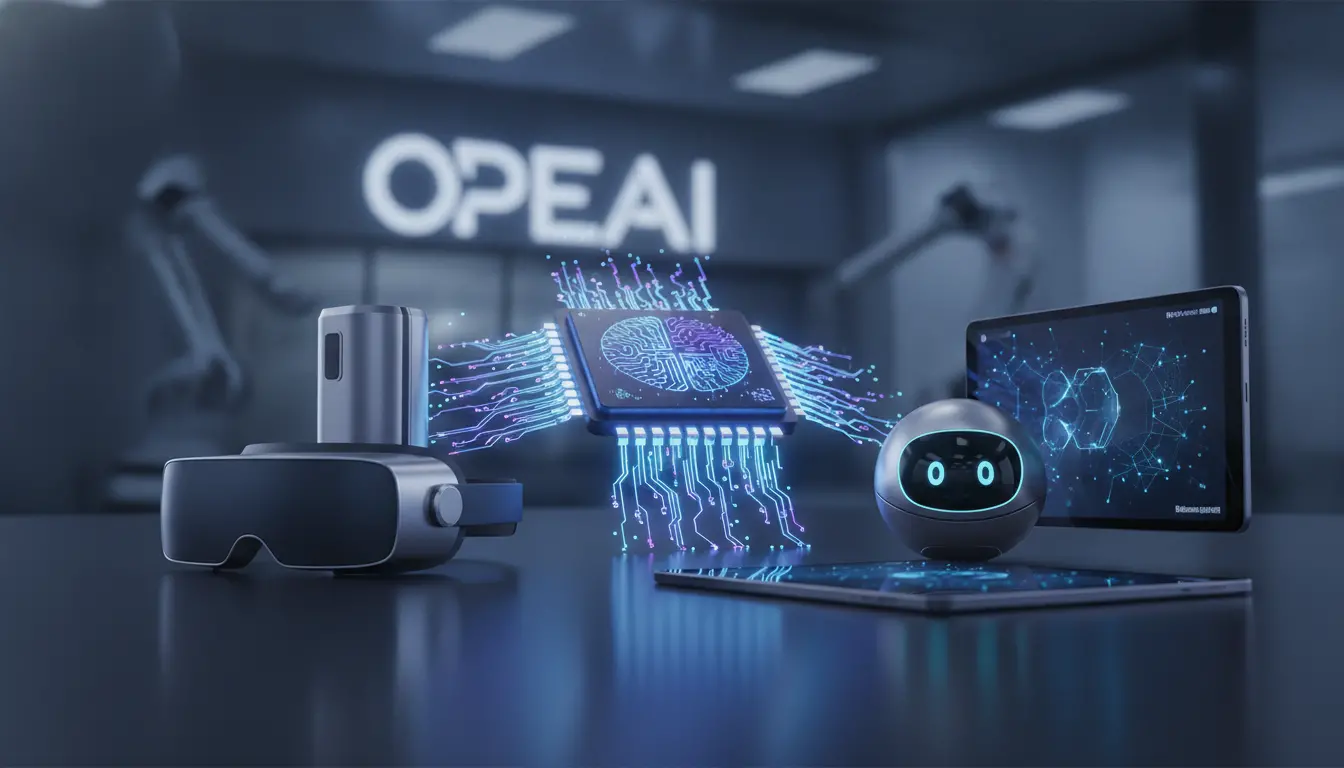
OpenAI Intensifies Focus on Consumer Hardware Market, Driven by Custom Chip Development
SOSophia King6 hours ago7 min read
OpenAI, the trailblazing artificial intelligence research and deployment company, is increasingly signaling its strategic intent to move beyond pure software offerings and delve into the burgeoning consumer hardware market. This potential pivot marks a significant evolution in the company’s trajectory, extending its influence from cloud-based AI models directly into the hands of users through dedicated devices.The clearest indication of this ambition recently emerged from a collaboration with Broadcom, where the two companies announced efforts to develop a custom chip specifically optimized for large language model (LLM) inference, a crucial component for enabling sophisticated AI capabilities on specialized hardware. This move by OpenAI reflects a broader trend among leading technology firms to vertically integrate their operations, bringing hardware and software development under one roof to optimize performance, control costs, and secure supply chains.Currently, much of the advanced AI infrastructure, particularly for training and inference, heavily relies on powerful graphics processing units (GPUs) from companies like Nvidia. However, custom application-specific integrated circuits (ASICs) can offer significant advantages in terms of efficiency and cost-effectiveness for specific AI workloads, especially at scale.By designing its own silicon, OpenAI could potentially achieve breakthroughs in the speed and energy consumption of its AI models, making them more viable for integration into compact, consumer-grade devices. Driving this strategic direction is OpenAI’s co-founder and CEO, Sam Altman, who has openly expressed a vision for AI to be ubiquitous and seamlessly integrated into daily life.Altman has previously emphasized the need for substantial investments in AI chip manufacturing and has highlighted the challenge of securing enough compute power to realize the full potential of artificial general intelligence (AGI). His long-standing interest in addressing the bottlenecks of AI compute infrastructure suggests that building custom hardware is not merely a tactical decision but a foundational step towards achieving the company’s ambitious long-term goals.A consumer-facing device would serve as a tangible embodiment of OpenAI’s advanced models, offering unique interaction paradigms currently unavailable through conventional interfaces. The competitive landscape for AI-powered consumer devices is rapidly heating up, with tech giants like Google, Amazon, and Apple already deeply entrenched in smart home devices, wearables, and personal assistants that increasingly leverage on-device AI.OpenAI’s entry would introduce a formidable new player, potentially redefining user expectations for AI interaction. Such a product could range from sophisticated voice assistants and personalized AI companions to novel form factors designed specifically to harness the power of OpenAI’s advanced LLMs.The success of such an endeavor would hinge not only on the technological prowess of the device but also on the seamless integration with OpenAI’s robust backend services and its ability to offer truly differentiated user experiences. Developing consumer hardware presents a host of complex challenges, including manufacturing, supply chain management, distribution, and establishing a robust ecosystem of developers and users.OpenAI, primarily a software-focused entity, would need to build or acquire significant expertise in these areas, or forge strategic partnerships beyond chip design. However, the potential rewards are immense.A successful consumer hardware product could unlock new revenue streams, diversify OpenAI’s business model beyond API access, and solidify its position as a frontrunner in the global AI race. It would also allow the company to control the entire user experience, ensuring that its AI models are presented in the most intuitive and powerful way possible.The implications of OpenAI venturing into consumer hardware are far-reaching. It could accelerate the mainstream adoption of advanced AI, bring new levels of personalization to everyday technology, and foster an era where AI becomes an even more integral part of our personal and professional lives.The current development phase, marked by the Broadcom partnership, signifies a serious commitment to this hardware-centric future. As the industry watches closely, the coming years are set to reveal the specific form and function of OpenAI’s consumer-oriented ambitions, potentially reshaping the contours of the personal technology market.Ultimately, OpenAI's exploration of consumer hardware, buttressed by its foray into custom silicon, illustrates a clear strategic intent to exert greater control over the entire AI stack, from foundational models to user-facing applications. This integrated approach, mirroring the successful strategies of other tech giants, positions OpenAI not just as a leading AI developer but as a potential innovator in how humans interact with intelligent machines on a daily basis. The stakes are high, but the potential for transformative impact on the consumer technology landscape is equally significant.