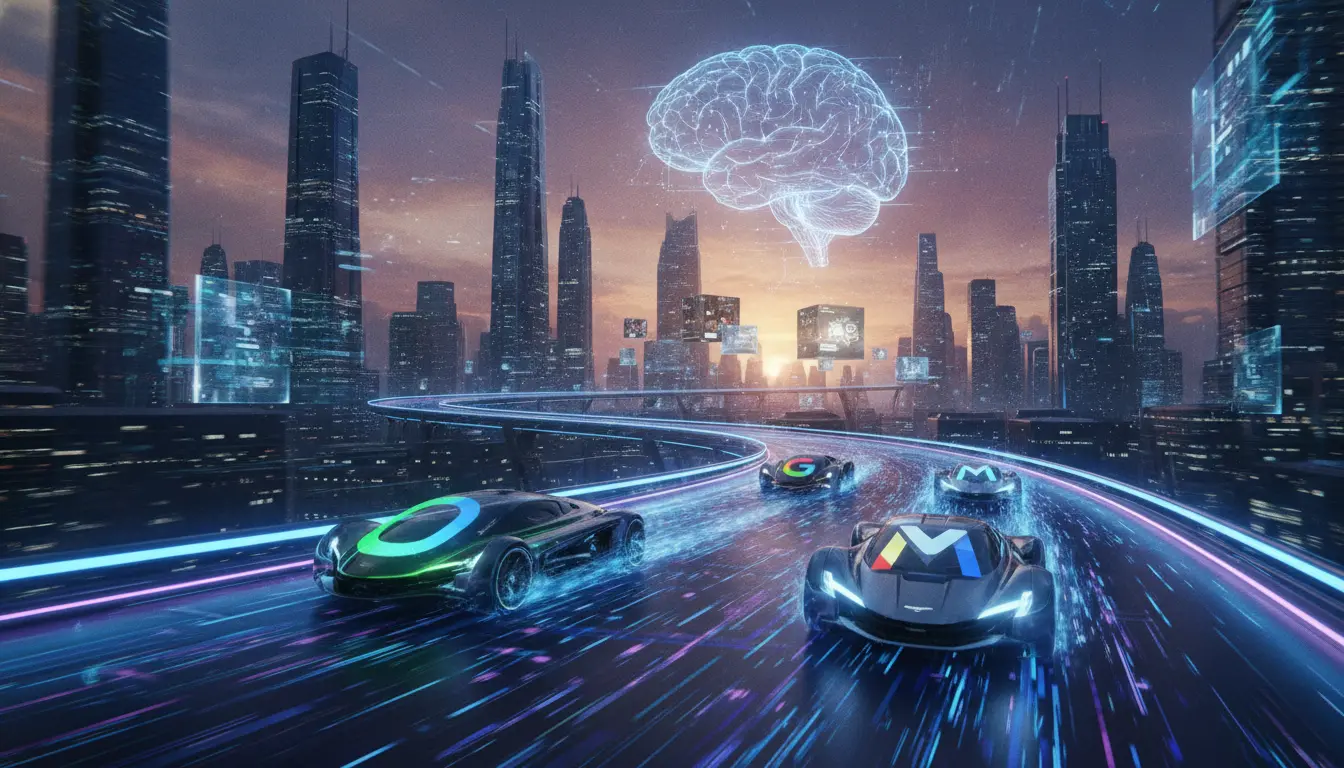
AI Race Accelerates as Tech Giants Push for Next-Generation Flagship Models
CHChloe Evans1 day ago7 min read
The artificial intelligence landscape is in the throes of an unprecedented and costly arms race, with tech behemoths like Google, OpenAI, and Meta locked in a fierce battle for supremacy. Following a recent flurry of announcements, including Google’s integration of its Gemini models across its product suite and Apple's entry into the fray with 'Apple Intelligence,' the focus is now shifting towards the next frontier: the development and release of even more powerful, next-generation flagship AI.The industry is operating on a timeline measured in months, not years, with immense pressure to deliver a breakthrough model that could redefine both consumer technology and the enterprise landscape before the end of 2026. The current wave of accelerated innovation was ignited by the public release of OpenAI’s ChatGPT in late 2022, a moment that fundamentally altered the strategic priorities of every major technology firm.What followed was a cascade of multi-billion-dollar investments, strategic partnerships like Microsoft’s deep integration with OpenAI, and a relentless cycle of model releases. Google responded with its Gemini family, Anthropic with its safety-focused Claude models, and Meta with its influential open-source Llama series.This competition is fueled by the belief that leadership in AI will dictate market dominance for the next decade, turning the development of large language models (LLMs) into the most critical research and development endeavor in the modern corporate world. At the heart of this race is the quest for models that surpass current capabilities in several key areas.The next flagship AIs are expected to feature vastly improved reasoning and planning abilities, moving beyond sophisticated pattern matching to a more genuine form of problem-solving. True multimodality is another key objective, where a single, unified model can seamlessly understand and generate content across text, images, audio, and video, a leap that would power more intuitive and versatile applications.The pursuit of longer 'context windows'—the amount of information a model can consider at once—also continues, enabling AI to tackle more complex, multi-step tasks by recalling vast amounts of user-provided data. However, the path to these next-generation systems is fraught with significant challenges that even the most well-funded companies must navigate.The computational cost of training these models is staggering, running into the hundreds of millions or even billions of dollars per model, creating an insatiable demand for specialized hardware from companies like Nvidia. This 'compute wall' is a major barrier to entry and a significant drain on resources.Furthermore, a looming data bottleneck threatens progress; many researchers believe the well of high-quality, publicly available text and data on the internet is close to being exhausted, forcing companies to explore synthetic data generation and novel data acquisition strategies. Alongside these technical hurdles, the challenge of AI safety and alignment grows with each leap in capability, putting pressure on developers to ensure these powerful systems remain controllable, unbiased, and beneficial to humanity.While the competition is most visible among the major U. S.tech firms, the global landscape is becoming increasingly complex. International players, particularly from China, are investing heavily to close the gap, while innovative companies like France's Mistral AI are proving that a more focused, open-source approach can produce highly competitive models.This dynamic prevents a simple duopoly and fosters a more diverse ecosystem of both closed, proprietary models and open, community-driven alternatives. This global dimension adds a layer of geopolitical significance to the AI race, as nations view technological leadership in AI as a matter of economic and strategic security.Looking ahead to the 2026 timeline, the question is not if a new flagship model will be released, but rather how transformative it will be. The industry's current trajectory suggests multiple major releases are not only possible but probable.The ultimate prize is a model that could be a significant step toward Artificial General Intelligence (AGI), a system with human-like cognitive abilities. The astronomical sums being invested are a clear signal of the perceived value of reaching that milestone first. For consumers and businesses, this relentless competition promises a future of increasingly integrated and powerful AI tools, but it also raises critical questions about market concentration, ethical oversight, and the societal impact of such rapidly advancing technology.
#hottest news
#AI
#Large Language Models
#Google
#OpenAI
#Meta
#Tech Competition