SportathleticsOlympic Games
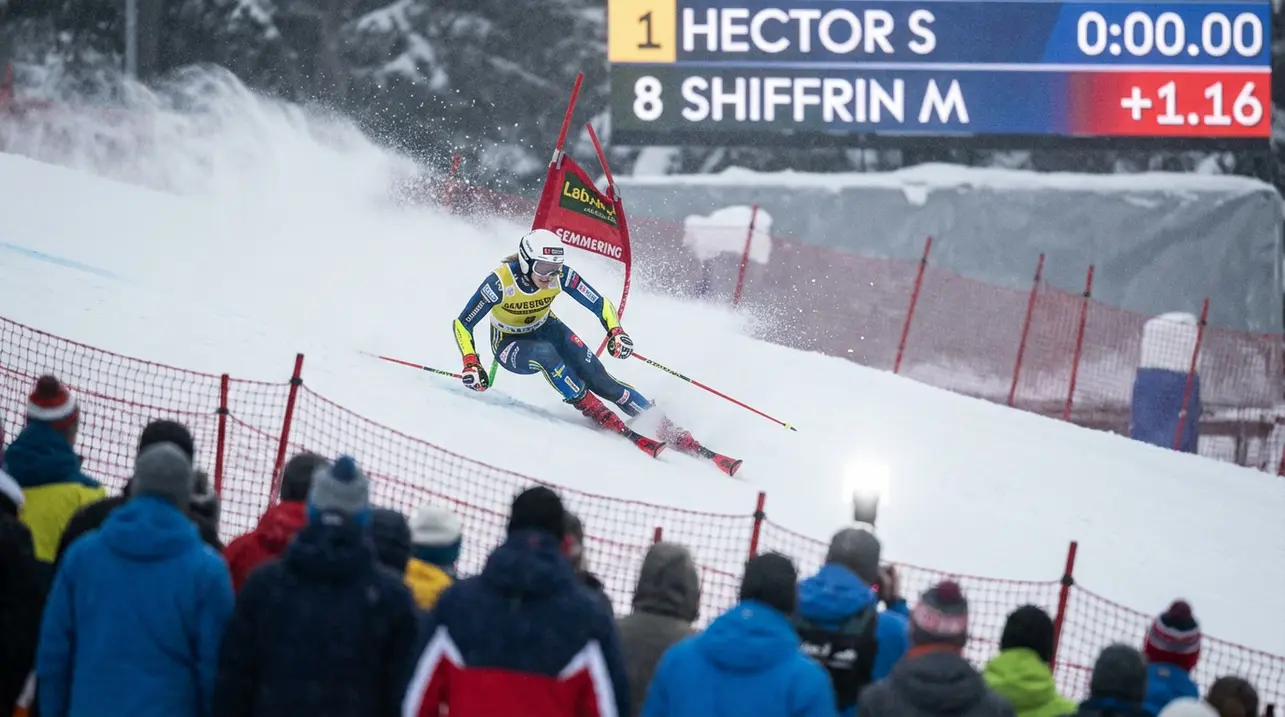
Olympic champion Sara Hector leads World Cup GS after 1st run. Mikaela Shiffrin stands 8th.
In the crisp, demanding air of Semmering, Austria, the narrative of the women’s World Cup giant slalom unfolded not just as a race against the clock, but as a profound study in resilience, pressure, and the relentless pursuit of form. Olympic champion Sara Hector, a skier whose grace on snow has often been shadowed by the weight of expectation since her last victory nearly a year ago, carved a statement of intent down the Planai course.Leading by a razor-thin margin of 0. 02 seconds over Austria’s Julia Scheib, and 0.13 ahead of the intriguing talent Lara Colturi of Albania, Hector’s first run was a masterclass in controlled aggression. Her post-run reflection to Austrian TV—'It’s not easy, the course set is unrhythmic.I just tried to give gas and ski cleanly'—encapsulates the athlete’s mindset: a blend of technical acknowledgment and raw competitive fire. With seven career wins, all in this discipline, the Swedish star is no stranger to the podium, yet the journey back to the top step is a marathon of its own, testing mental fortitude as much as physical prowess.Meanwhile, the story taking shape further down the standings carried its own compelling gravity. Mikaela Shiffrin, the American icon whose 22 GS victories set a benchmark that seems almost mythical, found herself in an unfamiliar eighth place, a daunting 1.16 seconds adrift. For Shiffrin, this season has been a tale of two specialties: absolute dominion in slalom, contrasted with a searching, sometimes frustrating quest to rediscover her peak giant slalom form.The context here is critical and human. It stretches back over a year to a horrific crash in Killington, Vermont, that left her with a deep puncture wound and severe trauma to her core muscles—injuries that don’t merely heal but require a complete reconstruction of the trust and kinetic intuition that define a champion’s skiing.Her current nine-race podium drought in GS, the longest such streak of her storied career since its very beginnings, isn’t a decline; it’s a testament to the arduous climb back from physical and psychological adversity. Watching her navigate the bumps in Semmering, seeming to hold back after a near-miss, was to witness an athlete in a delicate dialogue with her own limits, a chapter in a comeback story still being written.The drama of the day was also one of sudden absence. Alice Robinson of New Zealand, the discipline leader coming into the race, had flashed the fastest intermediate time, only to see her challenge evaporate in a heartbreaking loss of balance, sliding out of contention.Her candid disappointment—'I got unlucky and off balance. I am really disappointed not to be walking away with any points'—highlighted the fine line these athletes walk between triumph and disaster, where hundredths of a second and centimeters of balance dictate glory or heartbreak.This twist threw the standings wide open, intensifying the duel between Scheib, a recent winner in Tremblant, and the chasing pack. Beyond the times, the event underscored the global tapestry of alpine skiing.From Sweden’s icy slopes to the Austrian Alps, from the American program rebuilding its giants to Albania finding a new standard-bearer in Colturi, the competition is a world stage. The scary but thankfully unhurt crash of Shiffrin’s teammate Nina O’Brien served as a stark reminder of the inherent risk these competitors embrace every time they push out of the start gate.As the athletes prepared for the second run, the stage was set for more than just a World Cup result. It was a canvas for Hector to reclaim her winning feeling, for Shiffrin to battle through a public test of patience, and for a new order to potentially emerge in a technical discipline where confidence is as crucial as technique. In Semmering, the snow told stories of past glory, present struggle, and the undying human spirit that defines sport at its very best.
#Sara Hector
#Mikaela Shiffrin
#Alpine Skiing
#Giant Slalom
#World Cup
#lead focus news
#Semmering
#Alice Robinson