ScienceneuroscienceBrain-Computer Interfaces
CES 2026: I Tried a Gaming Headset That Can Read Your Mind
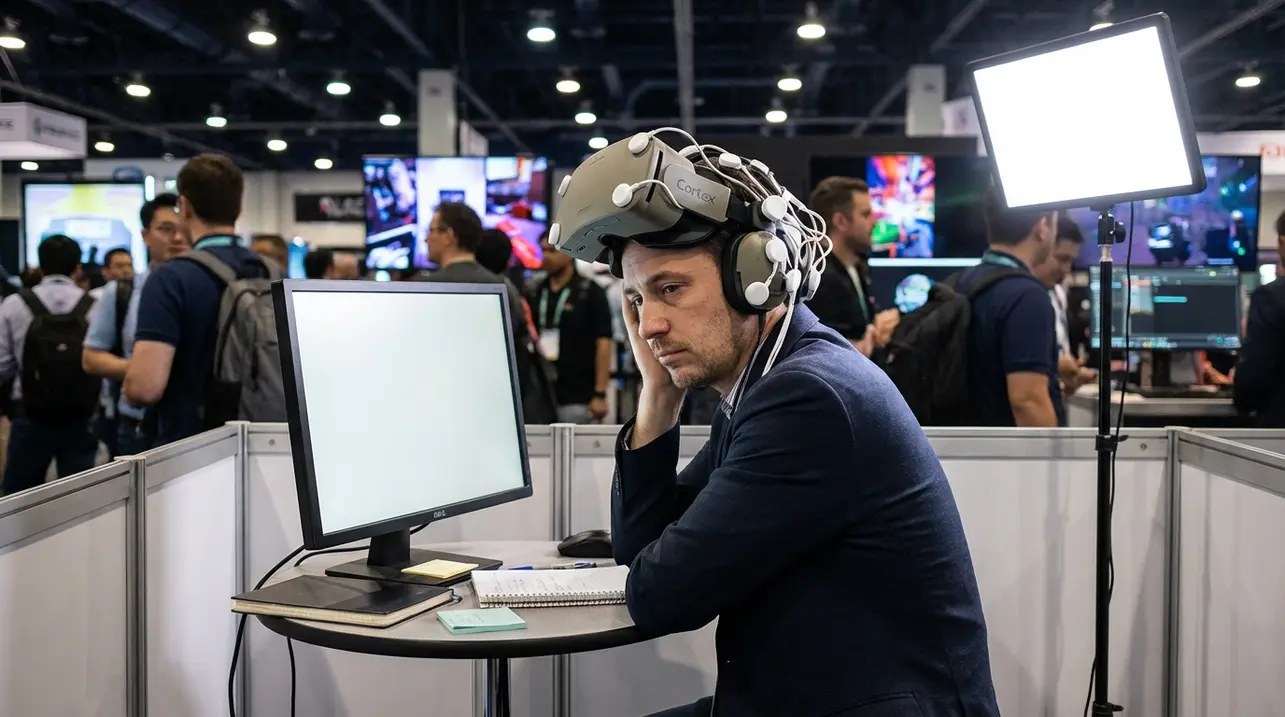
Lock in before you drop in. That’s the new mantra, and at CES 2026, I strapped into a gaming headset that’s about to make that phrase terrifyingly literal.We’re not talking about another incremental upgrade to audio fidelity or microphone clarity. This is the frontier: a headset that reads your mind.I got my hands—or rather, my head—on NeuroSync’s prototype ‘Cortex’ headset, and the experience was less like gearing up for a ranked match and more like stepping into a sci-fi flick where the line between player and game dissolves into pure, unfiltered intent. The demo was deceptively simple.A stripped-down, zen-like puzzle game where you move blocks with your thoughts. No controller, no keyboard, no voice commands.Just focus. The sensation is bizarre.You *think* ‘move left,’ and after a barely perceptible lag, the block slides. It’s clunky at first, like learning to walk again, but within minutes, a terrifying fluency emerges.Your frustration at a failed jump is instantly quantified by the headset’s companion app, showing a spike in your neural ‘entropy. ’ Your moment of clutch focus during a timed section is mirrored by a clean, coherent brainwave pattern.This isn’t gaming; it’s a biometric deep dive. The implications are massive, and the tech, built on a refined form of non-invasive electroencephalography (EEG) paired with machine learning algorithms that decode specific neural signatures, is advancing faster than anyone in the Twitch chat anticipated.For competitive esports, this is the ultimate cheat code—or the ultimate ban. Imagine a pro player whose reaction time is literally the speed of thought, bypassing the physical limitations of fingers on a mouse.Tournaments would need entirely new rulebooks. But it’s not just about speed.The real game-changer is adaptive gameplay. The NeuroSync engineers showed me a horror game demo where the environment itself reacted to my fear levels, measured in real-time.Get too scared, and the monster would back off, lulling you into a false sense of security. Stay too calm, and it would ramp up the intensity.The game was playing *me*, crafting a bespoke nightmare. This moves us from static difficulty sliders to a dynamic, emotionally intelligent experience.Of course, the elephant in the room is the data. This headset isn’t just reading your commands; it’s mapping your cognitive state, your focus, your emotional responses.Who owns that neural data? Where is it stored? NeuroSync’s PR folks gave the standard assurances about encryption and user control, but in an industry with a spotty privacy record, the potential for misuse is staggering. Targeted ads based on your frustration levels? Performance analytics sold to future employers? It’s a dystopian loot box waiting to be opened.Historically, gaming interfaces have evolved from joysticks to motion controls to VR, each step increasing immersion by translating more of our physical world into the digital one. Neuro-gaming represents the final frontier: translating our internal world.It’s the logical endpoint of the ‘player agency’ dream. Yet, for all the hype, the tech is still in its infancy.The headset is bulky, the calibration is a pain, and the command library is limited to simple, binary actions. Complex thought, nuanced strategy? Not yet.Experts I spoke to at the show believe we’re a good five to seven years from a consumer-ready product that can reliably interpret more than basic intent. But the seed is planted.The demo, for all its roughness, was profoundly convincing. It created a feedback loop between thought and action so direct it felt magical.As I took the headset off, the noisy chaos of the CES floor felt jarringly slow, almost primitive. The future of gaming won’t be just about what you see and hear, but what you think and feel.The controller is dying. Long live the mind. Now, if you’ll excuse me, I need to go touch grass—my brain needs a hard reset.
#brain-computer interface
#gaming headset
#CES 2026
#neurotechnology
#mind-reading
#featured