SciencearchaeologyExcavations and Discoveries
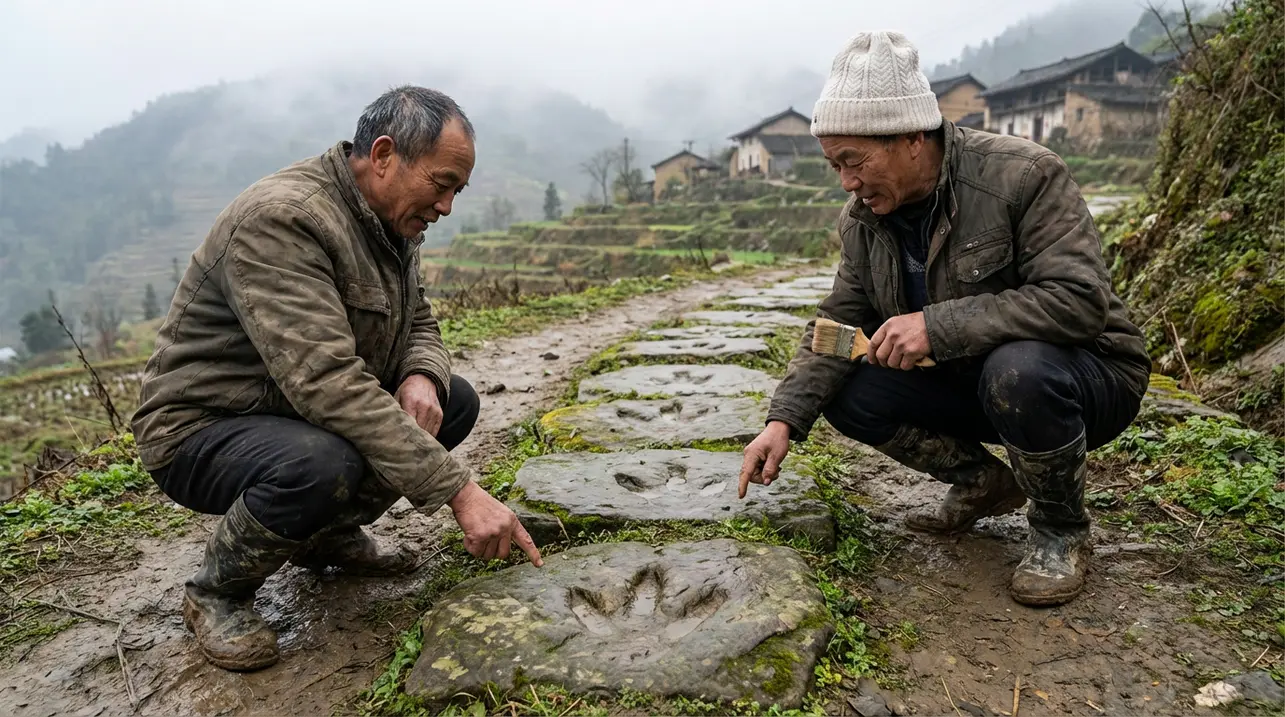
Brothers discover dinosaur footprints used as stepping stones in China.
In a discovery that feels ripped from the pages of a science fiction novel, two brothers in the misty hills of Sichuan province have been living atop a secret from the age of giants. For decades, they casually stepped on a set of rocks to cross a muddy patch near their village, utterly unaware that the peculiar 'chicken claw prints' etched into the stone were, in fact, the preserved footsteps of dinosaurs that roamed the Earth some 190 million years ago.The story, which recently came to light after researchers from the China University of Geosciences and other institutions completed a formal study in late November, is a stunning reminder of how the most profound chapters of our planet's history can be hiding in plain sight, waiting for a curious eye to decipher their code. According to reports in mainland media like Guangming Daily, the Ding brothers first unearthed these peculiar slabs while quarrying stone back in 1998 in Wuli village.To them, the three-toed impressions were a curious oddity, but practical needs prevailed; the rocks were flat and useful, so they were repurposed as humble stepping stones, bearing the weight of daily life while silently holding the weight of epochs. It wasn't until much later, when one of the brothers saw a documentary about dinosaur footprints, that a spark of recognition ignited.This moment of connection between casual observation and specialized knowledge is what drives paleontology forward, echoing discoveries like the famous 'dinosaur dance floor' track sites in Colorado or the vast exposures in the Gobi Desert. The researchers' confirmation revealed the footprints to be from the Early Jurassic period, a time when the supercontinent Pangaea was just beginning to fracture and creatures like the bipedal, carnivorous theropods—likely ancestors to the mighty Allosaurus—stalked the landscapes of what is now China.The preservation is remarkable; the fine details of the claw marks and pad impressions speak to a specific moment when these creatures traversed a muddy shoreline, their steps quickly filled with sediment and fossilized over incomprehensible spans of time. Dr.Lida Xing, a renowned Chinese paleontologist who has worked on numerous trackway discoveries, often emphasizes that trace fossils like these are 'snapshots of behavior,' offering a dynamic glimpse into dinosaur life that bones alone cannot provide. Were these tracks made by a single animal on a hunt, or multiple individuals? The spacing and orientation could tell a story of speed, gait, and even social interaction.This find in Sichuan adds another crucial data point to the region's rich paleontological tapestry, which includes the famous Dashanpu Dinosaur Quarry, helping scientists map the distribution and diversity of species in prehistoric Asia. Beyond the pure science, there's a profound human element here—a narrative of inadvertent stewardship.The brothers, by simply moving and using these stones, inadvertently protected them from more destructive forces, a quirky twist of fate that preserved them for formal study. It makes one wonder how many other such relics are embedded in village walls, garden paths, or farm fields around the world, their stories untold.For the scientific community, the immediate next steps involve detailed photogrammetry and 3D modeling to analyze the tracks without risking damage, and likely a push for local heritage protection. For the rest of us, it's a cosmic-scale reality check: our human timeline is but a blink in the geological eye, and the ground we walk on is an archive of epic adventures, written in stone.
#dinosaur fossils
#footprint discovery
#Sichuan province
#paleontology
#China
#accidental find
#featured