Sciencespace & astronomyAstrophysics Discoveries
Astronomers discover one of the Universe’s largest spinning structures
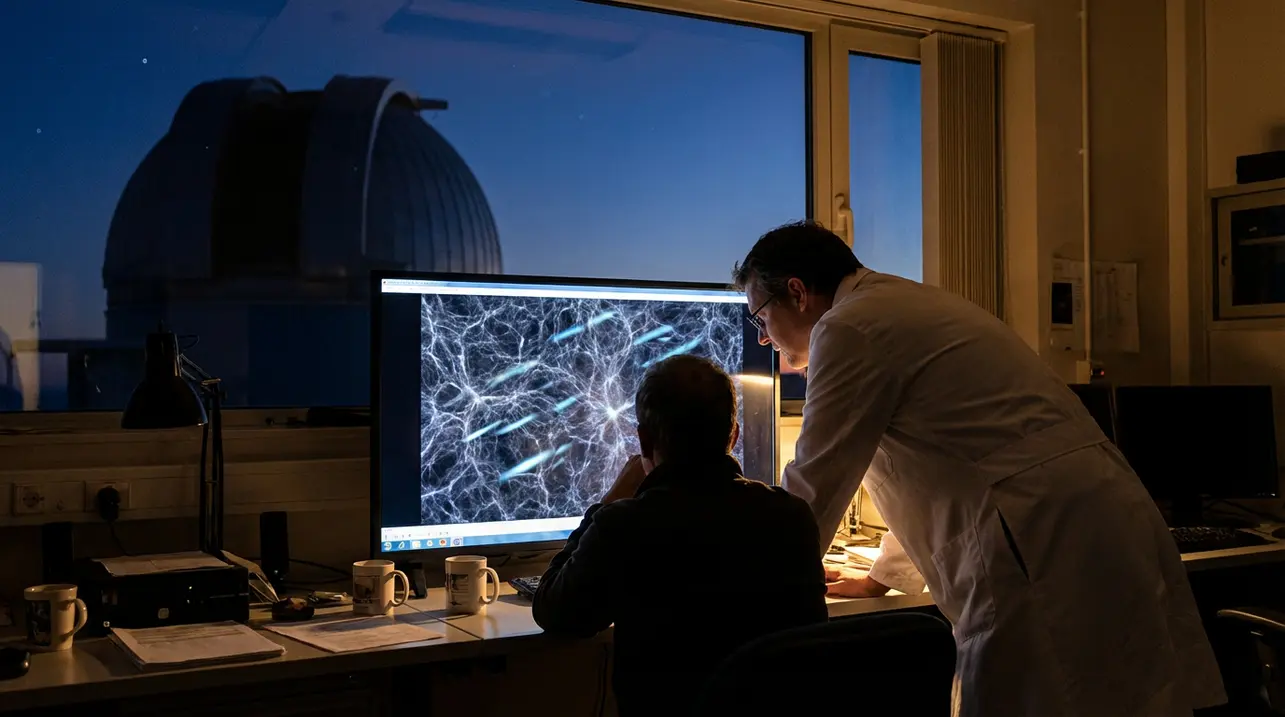
In a discovery that feels ripped from the pages of a cosmic epic, astronomers have peeled back another layer of the universe’s grand design, revealing one of its largest spinning structures: a colossal cosmic filament where galaxies are not just passive inhabitants but active participants in a slow, majestic whirl. This isn't about a single galaxy spinning on its axis; this is about a razor-thin, billion-light-year-long chain of galaxies, embedded within an even larger filament of the cosmic web, rotating in a coordinated dance.The sheer scale of this motion—far stronger than any random chance could produce—suggests something profound: that the spin of galaxies might be an inherited trait, a legacy passed down from the swirling dynamics of the cosmic web itself, the very skeleton upon which the universe is built. Imagine the cosmic web not as a static scaffold of dark matter and gas, but as a dynamic, flowing river system on the grandest imaginable scale.For decades, our understanding posited that these filaments were the highways along which matter streamed into the dense nodes where galaxy clusters form, but the idea of the entire structure possessing coherent angular momentum, a gentle torque on such an unimaginable scale, pushes theoretical cosmology into new territory. This finding, emerging from painstaking analysis of thousands of galaxies within the Sloan Digital Sky Survey, opens a transformative window into the primordial forces that shaped everything we see.It hints that the angular momentum driving galaxy rotation didn't originate solely from local gravitational tumbles as galaxies assembled, but was imprinted much earlier, perhaps from the tidal torque forces generated in the infant universe as these vast filaments first condensed out of the smooth soup of the Big Bang. Experts liken it to discovering that every leaf on a massive, continent-spanning tree not only grew from the same trunk but also sways in rhythm with a deep, planetary wind.The implications cascade through astrophysics. If confirmed, this means we can trace the spin of our own Milky Way—and the eventual orientation of its spiral arms—back to the specific geometry and dynamics of the filament it was born within billions of years ago.It reshapes our narrative of galaxy formation, suggesting that the cosmic web is not just a passive backdrop but an active choreographer, directing the flow of matter and the inheritance of motion. Furthermore, it provides a critical new test for our models of the universe's large-scale structure and the nature of dark matter, which forms the gravitational backbone of these filaments.Could different dark matter candidates produce different large-scale spin signatures? Future observatories, like the Vera C. Rubin Observatory, will be tasked with mapping this faint, coordinated motion across more of the sky, seeking to understand if this is a universal phenomenon or a spectacular local peculiarity. This discovery does more than add a new fact to a textbook; it fundamentally alters our perception of cosmic evolution, revealing a universe where the largest structures and their smallest galactic constituents are linked by an invisible thread of motion—a slow, cosmic spin that has been turning since the dawn of time.
#featured
#cosmic filament
#galaxy spin
#cosmic web
#large-scale structure
#universe rotation
#astronomy discovery