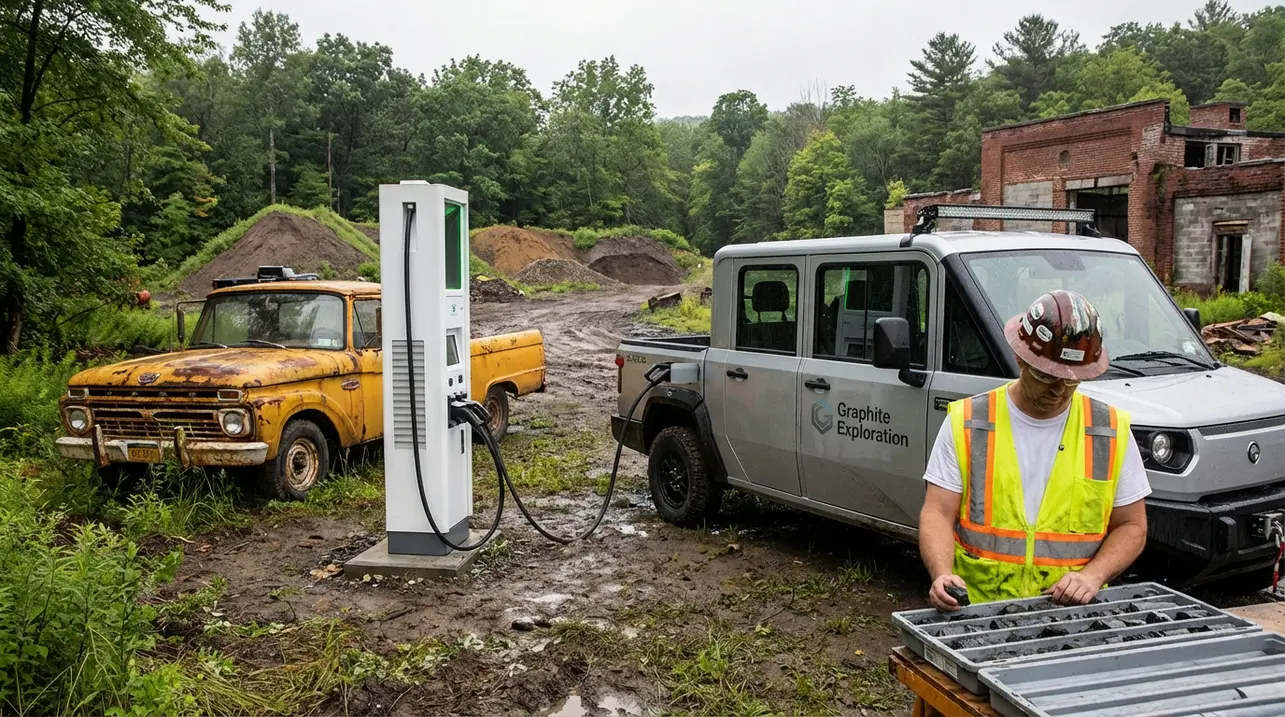
The quiet woods of upstate New York, a region once synonymous with the iconic yellow Ticonderoga pencil, are now ground zero for a strategic pivot in American industrial policy. For seven decades, the United States effectively ceded the graphite market, allowing its domestic mines to shutter as inexpensive imports, predominantly from China, flooded the global market.Graphite, that ubiquitous mineral found in everything from pencils to nuclear reactors, was considered a commodity best sourced elsewhere. That calculus has been irrevocably shattered by the battery boom and escalating geopolitical tensions.Today, demand for graphite—a critical anode material in the lithium-ion batteries powering our phones, electric vehicles, and grid storage—is surging, and federal officials are scrambling to secure a reliable domestic supply chain for what the Department of the Interior classifies as a 'critical mineral. ' This isn't just about economics; it's a calculated move to de-risk a foundational component of the energy transition from the whims of a single, dominant supplier.China currently commands the market for both natural and synthetic graphite, a dominance that has long worried policymakers in Washington. Recent moves by Beijing, including the imposition and subsequent temporary relaxation of export controls on graphite and other minerals, served as a stark reminder of the fragility of these global supply lines.In response, the U. S.has activated a multi-pronged strategy, embedding tax credits for critical mineral production in the 2022 Inflation Reduction Act, striking bilateral mineral deals, and fast-tracking permitting for projects deemed strategically significant. The market is responding.Titan Mining Corp. , operating from a site in New York just miles from the Canadian border, is emblematic of this shift.Leveraging its existing zinc mine infrastructure, the company has begun limited extraction of ore containing roughly 3% graphite, with ambitions for commercial-scale production by 2028. CEO Rita Adiani frames the opportunity in stark, geopolitical terms: 'We have the ability to supply a significant portion of U.S. needs.And that’s largely because you can’t see China now as a reliable supply-chain partner. ' Titan’s project, which recently received a federal designation for expedited permitting and is being considered for up to $120 million in financing from the U.S. Export-Import Bank, aims to produce 40,000 metric tonnes of graphite concentrate annually—approximately half of current U.
#graphite
#battery minerals
#supply chain
#US mining
#China trade
#critical minerals
#lead focus news
#electric vehicles
#Inflation Reduction Act
#Titan Mining
Stay Informed. Act Smarter.
Get weekly highlights, major headlines, and expert insights — then put your knowledge to work in our live prediction markets.
S. Geological Survey notes four other active projects, from the Coosa Deposit in Alabama, where Westwater Resources is advancing permitting, to Graphite One Inc.
's ambitious undertaking in Alaska, touted as the nation's largest known large-flake graphite deposit. Anthony Huston, CEO of Graphite One, encapsulates the prevailing sentiment: 'When we are sitting with one of the largest graphite deposits in the entire world … there’s no reason why we need to rely on China for our graphite.
' From an investment perspective, this represents a fundamental re-rating of domestic mineral assets. Forecasters predict global graphite demand will continue its parabolic rise alongside EV adoption and renewable energy storage deployment.
The play here isn't merely about replacing imports; it's about capturing value in a high-growth segment while insulating a key sector from external shock. As Gregory Keoleian of the University of Michigan’s Center for Sustainable Systems notes, 'What’s happening now needs to happen.
I think you just don’t want to be completely reliant on other countries when you have resources that you could develop. ' The financial mechanisms are now aligned, with federal incentives lowering the capital hurdle and de-risking early-stage development.
However, the path forward is not without its challenges. Scaling from pilot projects to full-scale, economically competitive mining operations will require sustained capital investment, navigating complex environmental reviews, and building out downstream processing capacity—much of which also resides overseas.
The ultimate success of this domestic push will be measured not just in tonnes produced, but in the creation of a vertically integrated, cost-competitive supply chain that can withstand market volatility and geopolitical pressure. For investors watching the interplay of policy, technology, and trade, the revival of the U.
S. graphite industry is a compelling case study in how national security concerns are reshaping global commodity markets and creating new opportunities in once-forgotten industrial corners.