Entertainmenttheatre & artsArt Exhibitions
Paintings on Antique Navigational Tools Nod to Bird Migration
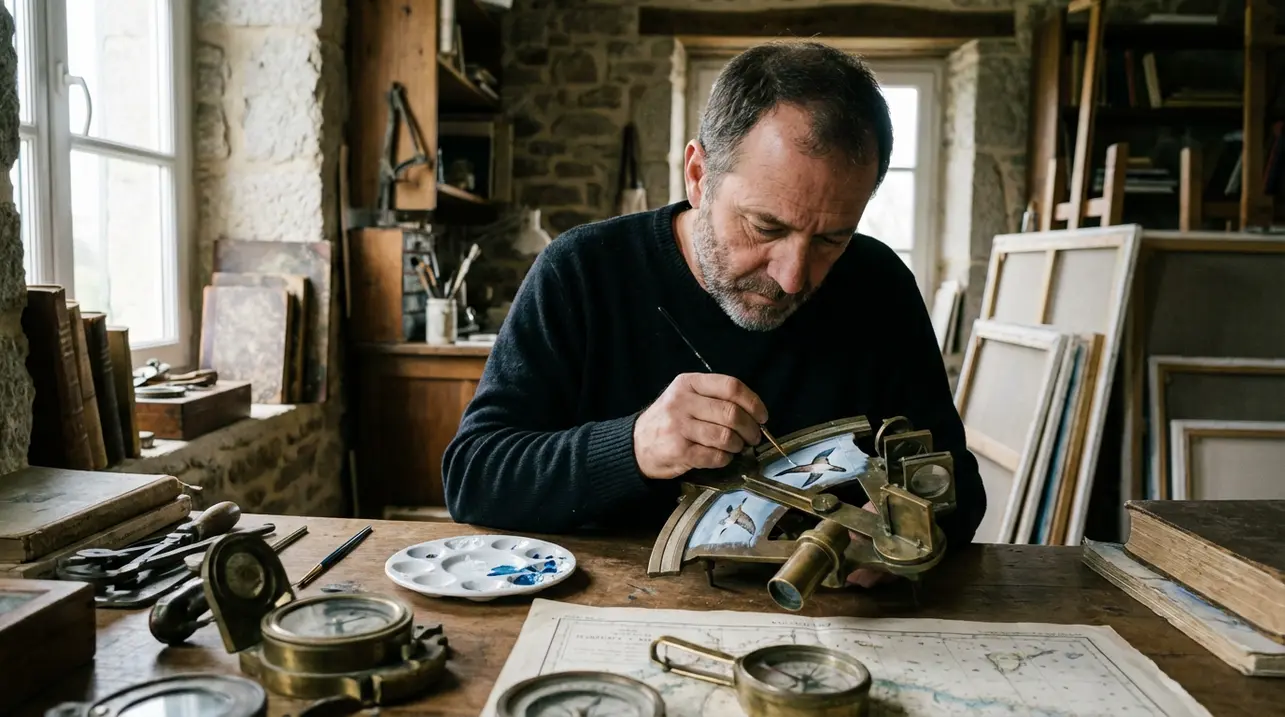
In a quiet studio in France, where the scent of old paper and varnish hangs in the air, artist Steeven Salvat is performing a delicate act of resurrection, merging the paths of avian travelers with the very tools humans once used to chart their own courses across the globe. His upcoming solo exhibition, 'Latitude/Longitude,' set to open next month in the historic port city of Le Havre, features a series of exquisite paintings rendered directly onto antique navigational instruments—sextants, astrolabes, and weathered maritime charts.Each piece is a profound meditation on migration, not of ships, but of birds, transforming cold, precise brass and parchment into canvases that pulse with life and journey. Salvat meticulously depicts species like arctic terns and swallows in mid-flight, their forms rendered in delicate, almost ethereal washes of color that seem to bleed into the engraved lines of longitude and latitude, suggesting a harmony between natural instinct and human calculation that is both poetic and startlingly direct.The choice of Le Havre as the exhibition's home is itself a masterstroke of context; this is a city built on centuries of maritime departure and arrival, a gateway where countless explorers set sail into the unknown, much like the birds that navigate by starlight and magnetic fields over the same vast oceans. Salvat’s work asks us to consider the parallel languages of navigation—the coded mathematics of celestial navigation versus the innate, genetic maps followed by migratory birds—and finds a silent, beautiful dialogue between them.It’s a concept that resonates deeply with the history of art itself, recalling the tradition of *memento mori* or the Dutch Golden Age still-lifes where scientific instruments symbolized the pursuit of knowledge, yet here the symbolism is inverted towards life, continuity, and natural wonder. Critics familiar with his past installations note a maturation in this series; where previous works explored isolation, these pieces speak of connection across impossible distances.The tools, once held in the hands of sailors staring at horizons, now carry images of creatures who cross those horizons seasonally, effortlessly, creating a poignant narrative about time, memory, and the shared vulnerability of all travelers on this planet. In an era dominated by GPS and satellite surveillance, Salvat’s antique mediums reclaim a sense of tangible, hands-on exploration, making the awe of migration feel immediate and intimate again.The exhibition promises to be more than a visual display; it’s an immersive experience that will likely include soundscapes of bird calls and lapping waves, pulling the viewer into the very intersection of art, science, and history. For collectors and art historians, this series signifies a growing movement within contemporary art that seeks to bridge ecological awareness with historical artifact, turning relics of human ambition into testaments of natural resilience. As climate change alters migratory patterns and habitats, Salvat’s paintings on these fading instruments become a gentle, urgent reminder—a cartography of life that predates our own and may well outlast it, charted not in ink, but in wingbeats.
#Steeven Salvat
#bird migration
#antique navigational tools
#art exhibition
#Latitude/Longitude
#painting
#featured